



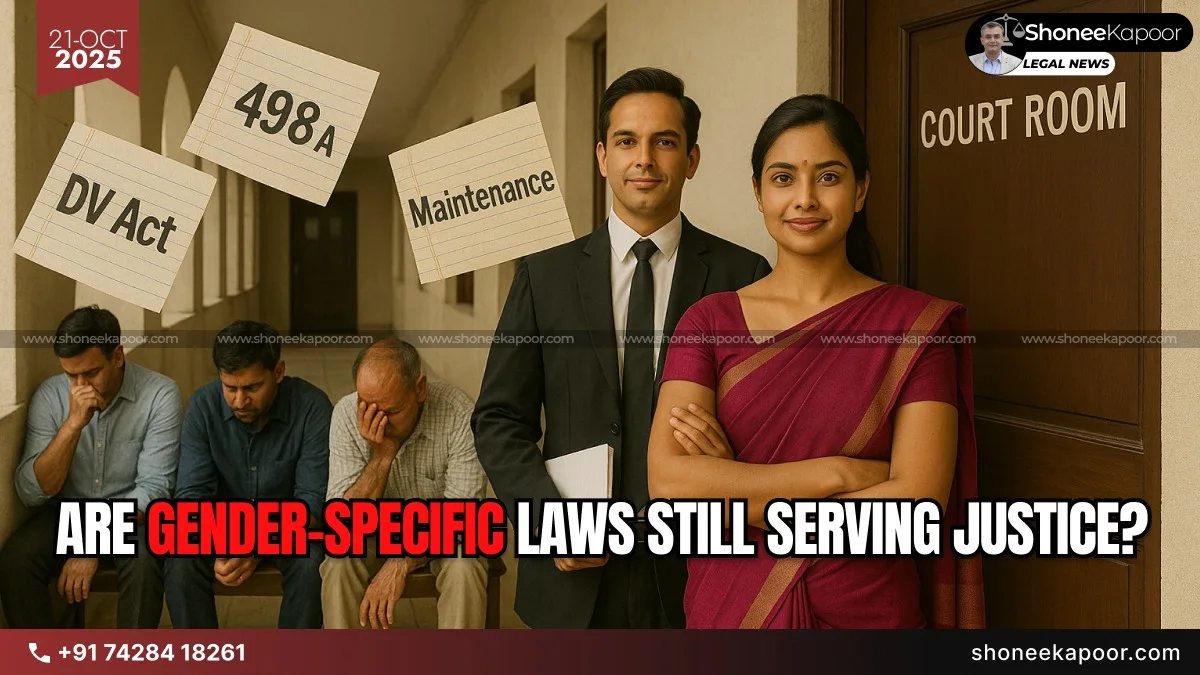
India’s gender laws were designed to protect women — but today, countless innocent men are being destroyed by false cases, biased arrests, and one-sided justice. This is the untold story of how equality lost its meaning when the law stopped being blind to gender.
Introduction: The Forgotten Half of Justice
India is often celebrated as a land of goddesses — a nation where women are revered, protected, and held in high regard.
But what happens when the same society forgets that men are human too?
Across courtrooms in India, countless men are charged not because their guilt has been proven, but because the law presumes it. Before facts are examined or the truth is heard, a man’s reputation is already destroyed — his parents humiliated, his job lost, his name reduced to a headline.
This is the new face of gender inequality, hidden beneath the noble mask of protection.
Laws are meant to protect, not persecute.
But beneath the surface of India’s gender-specific laws lies a silent injustice.
What began as a noble effort to protect women from centuries of oppression has, in many cases, been turned into a weapon — a legal sword used to settle personal scores, gain financial leverage, or inflict emotional harm.
Justice should be decided by truth, not gender.
Yet, when laws are drafted in a way that assumes one gender is always the victim and the other always the oppressor, justice begins to tilt.
By the time courts determine whether a man is guilty or innocent, he has already been socially condemned, financially ruined, and emotionally shattered.
When Legal Protection Becomes Legal Persecution
Laws like Section 498A IPC, Section 125 CrPC, and the Protection of Women from Domestic Violence Act, 2005 (PWDVA) were enacted with good intentions — to protect women from cruelty, neglect, and abuse.
But over time, those shields have also turned into swords, capable of destroying innocent lives with a single false accusation.
The Supreme Court itself cautioned that Section 498A was “intended to be used as a shield and not an assassin’s weapon” in Sushil Kumar Sharma v. Union of India (2005).
Yet misuse has only risen.
NCRB data shows that over 80% of men charged under 498A are acquitted, but only after years of humiliation, legal costs, and emotional trauma.
Behind every false case lies a silent victim — a husband branded as a criminal, aged parents dragged to court, and children left fatherless.
Their stories don’t trend. Even after acquittal, society continues to whisper: “He was accused.”
Understanding Gender-Specific Provisions
Certain Indian laws were designed as buffers to protect women from dowry harassment, desertion, and domestic abuse — all rooted in historical gender imbalance. But society has evolved. Unfortunately, the laws haven’t.
Let’s look at the four key pillars of these provisions:
Section 498A of the Indian Penal Code (IPC)
Introduced in 1983, it aimed to shield women from cruelty by husbands or in-laws.
But its non-bailable and cognizable nature has made it vulnerable to misuse, where a single complaint can destroy entire families without evidence ever being tested.
Section 125 of the Code of Criminal Procedure (CrPC)
Intended to prevent destitution of wives, children, and parents.
Yet, maintenance has become a battlefield, where exaggerated claims often override genuine need. Men end up financially crippled long before justice is served.
Protection of Women from Domestic Violence Act, 2005 (PWDVA)
A progressive law that expanded “violence” to include emotional and economic cruelty.
However, by recognizing only women as “aggrieved persons,” it left men legally voiceless, even in cases of verbal, emotional, or physical abuse.
Dowry Prohibition Act, 1961
A landmark act against dowry — yet decades later, false dowry cases remain rampant, pulling in entire families as accused and turning a preventive law into an instrument of punishment.
The Hazy Line Between Protection and Persecution
As society modernized, relationships evolved — but the law didn’t.
What was once a lifeline for genuine victims has become, in some hands, a tool of revenge or leverage.
The real question isn’t “Should women be protected?” — of course, they must be.
It’s “Can protection remain just when it becomes biased?”
When laws start assuming guilt based on gender, protection becomes persecution.
The Human Cost of False Accusations
The Faces Behind the Statistics
Rohit, a 29-year-old Pune software engineer, was jailed the same night his wife filed a false dowry case. After four years, he was acquitted — but he had already lost his home, job, and peace. “The case ended, but the punishment didn’t.”
Vijay’s parents, both in their seventies, were forced to appear in court monthly under Section 498A despite not living with their daughter-in-law. Their entire savings vanished in legal fees and medicine for stress-related illnesses. “The law didn’t respect us, but we raised our son to respect women,” said his father.
Aman, a teacher, was falsely accused of molestation after refusing to inflate a student’s grades. Cleared after two years — but no school would rehire him. “Even when proven innocent, I’ll always be that teacher.” These men exist — invisible, unheard, forgotten.
The Toll No One Talks About
Acquittal doesn’t heal. The damage is irreversible.
Men report panic attacks, depression, sleeplessness, and social ostracism.
Over 90,000 men die by suicide every year in India — many driven by false accusations, marital stress, and stigma.
The Supreme Court has warned repeatedly:
- “Section 498A is a shield, not an assassin’s weapon.” — Sushil Kumar Sharma (2005)
- “No automatic arrests without investigation.” — Arnesh Kumar v. State of Bihar (2014)
Yet the arrests continue, and justice remains blind — not with fairness, but with indifference.
The Invisible Suffering
There are no helplines or shelters for men falsely accused.
When women cry, society listens. When men cry, society says — “Man up.”
The Rajesh Sharma v. State of U.P. (2017) judgment suggested Family Welfare Committees to verify complaints before arrests — a lifeline later modified in Social Action Forum for Manav Adhikar (2018), which rightly stated: “Protection of women must not come at the cost of men’s fundamental
rights.”
False accusations destroy reputations permanently.
Even after acquittal, the court of public opinion keeps the sentence alive.
The Ripple Effect
Every false case:
- Ruins an innocent life.
- Destroys faith in genuine victims.
- Weakens public trust in the justice system.
“A serious relook at Section 498A is needed.”
“A serious relook at Section 498A is needed.” — Supreme Court in Preeti Gupta v. State of Jharkhand (2010)
The fallout spreads:
- Companies hesitate to hire accused men.
- Police treat every complaint as conviction.
- Families live in fear.
- Real victims suffer from rising skepticism.
When justice becomes gendered, everyone loses.
Moving Past Blame and Toward Balance
This is not about men versus women.
It’s about truth versus abuse.
India urgently needs:
- Gender-neutral laws for domestic violence and harassment.
- Punishment under Section 211 IPC for proven false complaints.
- Fast-track courts to protect the falsely accused.
- Mental health helplines for men in distress.
- Judicial sensitivity training against gender bias.
Justice Chandramauli Prasad once said: “Every misuse of the law is not only a miscarriage of justice but a mockery of equality.”
Timeline of the Supreme Court’s Caution
| Year | Case | Judicial Observation |
|---|---|---|
| 2005 | Sushil Kumar Sharma v. Union of India | Section 498A was “meant to be a shield, not an assassin’s weapon.” |
| 2010 | Preeti Gupta v. State of Jharkhand | Warned that false complaints were being filed with “oblique motives.” |
| 2014 | Arnesh Kumar v. State of Bihar | Directed “no automatic arrests” under 498A IPC. |
| 2017 | Rajesh Sharma v. State of U.P. | Recommended Family Welfare Committees to verify complaints before arrests. |
| 2018 | Social Action Forum for Manav Adhikar v. Union of India | Reiterated that women’s protection must not come at the cost of men’s rights. |
Did You Know? The Hidden Numbers Behind a Silent Crisis
Over 80% of men accused under 498A are eventually acquitted.
No compensation, no apology, no rehabilitation.
One man commits suicide every six minutes — many due to marital or legal harassment.
Each false case doesn’t just destroy one man — it scars entire families.
Justice is no longer blind; it has chosen to look away.
The Forgotten Reforms We Need
- Gender-Neutral Laws: Domestic violence and sexual offences must protect everyone. Abuse has no gender.
- Accountability for False Complaints: Section 211 IPC must be enforced with real consequences — fines, jail, and public record of falsehood.
- Fast-Track Relief for the Falsely Accused: Prolonged trials are silent torture. Fast-track verification and dismissal of false cases are essential.
- Mental Health Support for Men: Depression and suicide are real. Create men’s distress helplines, legal aid cells, and counselling centres nationwide.
- Public Awareness: “Men Deserve Justice Too”: Justice must be gender-neutral. The law should protect all citizens, not selectively shield one side.
“The strength of a democracy is not how loudly it defends one group, but how fairly it protects everyone.”
Conclusion: When Justice Forgets Its Sons
He enters the courtroom already condemned — not by law, but by public opinion.
His crime? Being born a man.
His tears are invisible, his pain mocked, his silence mistaken for strength.
His parents stand trembling before a judge, his marriage becomes a battlefield, his name a case number.
Even when declared innocent, he remains “the accused.”
Society celebrates a woman’s lie as empowerment, but mocks a man’s truth as weakness.
No candle marches are held when he dies.
Justice must not see gender — only truth.
Because any law that punishes one for being a man is not justice; it is legalized cruelty.
Reform is not revenge — it is redemption.
India must protect both her daughters and her sons.
Only then can equality be more than a slogan.
Justice isn’t justice at all if it forgets its sons.

2 Comments
Seriously this problem has become such a menace to society. You have articulated fact fully the situation of most men in india who is facing this cruelty. I am also facing abusive behaviour of my wife every now and then and my home is a battle field. I live in Pune and 5 months back brought my father and mother here because my father is a CKD stage 5 patient and his health deteriorated severely at my home town where he was living. Right now he is on regular maintenance dialysis thrice a week. My wife is very abusive towards us and directly or indirectly she is abusing me in front of them and sometimes saying bad words to them as well, both are senior citiZens. My daughter who is just 1 year 4 months old also faces the wrath of my wife, she abruptly denies her feeding making her uncomfortable and crying for hours causing us immense pain. She keeps scolding her and sometimes even hit her. When i tries to counsel my wife she fights with me. Abuse me badly. I am struggling between managing my father and mother health, my daughter care, my office and job, household chores along with the constant emotional trauma given to us by my wife. She is a working professional and always scolds me that she is not a house wife and cites office work to skip some of the household work like cooking which my mother is doing since she has arrived and most of the remaining chores are outsourced to house maid and we have a permanent babysitter who take cares of the baby and lives with us only. Still my wife has a lot of complaints and make issues over petty things to start arguments. I don’t know how to handle this situation while keeping calm.
You need to quietly document every incident, ensure your parents’ and child’s safety, and consult a local family-law lawyer or counselor immediately so you can plan safe, lawful options without escalating the conflict.