
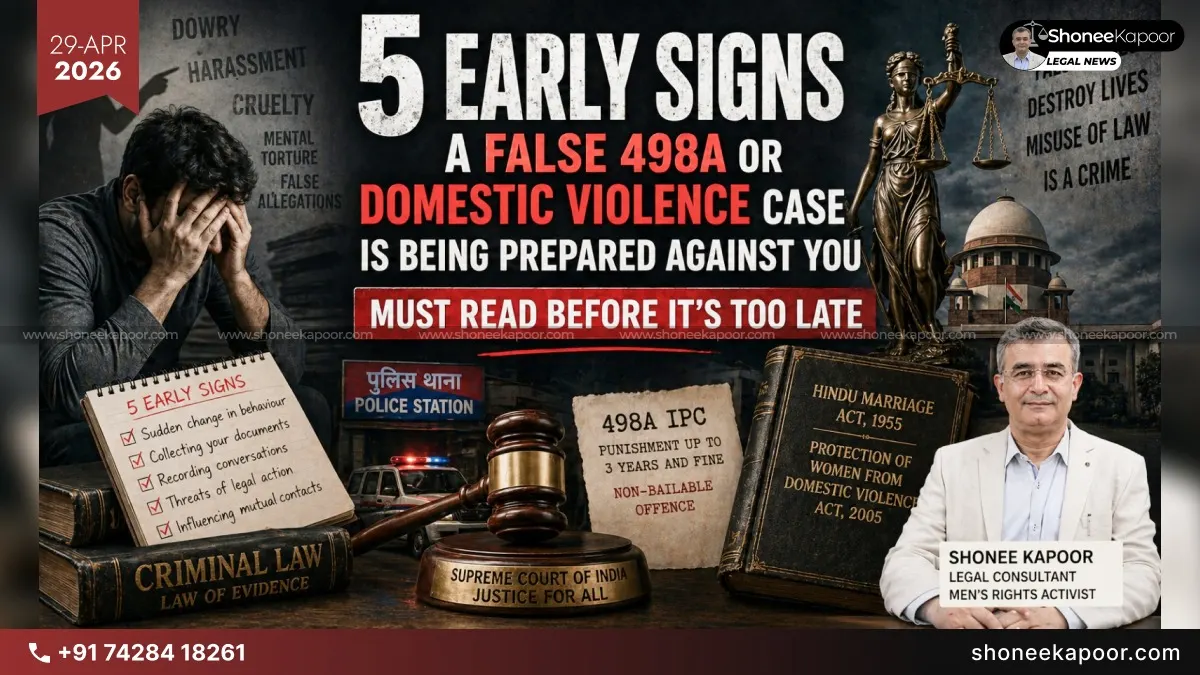
5 Early Signs a False 498A or Domestic Violence Case Is Being Prepared Against You

Written and analysed by Shonee Kapoor
Legal Consultant, Author & Men's Rights ActivistLearn the early warning signs of false 498A, BNS Section 85/86 and Domestic Violence cases in India, with Supreme Court case laws, legal strategy and evidence tips.
NEW DELHI: False cases do not begin in court. They begin much earlier — in threats, recordings, planned allegations, selective messages, financial pressure, and sudden involvement of relatives.
Many men realise the danger only after receiving a police call, summons, or notice from court. By then, valuable time and evidence are already lost.
Indian law does protect genuine victims of cruelty and domestic violence. But the Supreme Court has repeatedly warned that matrimonial laws must not become tools of personal vendetta, harassment, or pressure tactics.
Section 498A IPC has now been replaced in substance by Sections 85 and 86 of the Bharatiya Nyaya Sanhita, 2023, which punish cruelty by husband or relatives and define cruelty in terms similar to the earlier Section 498A IPC.
The Domestic Violence Act, 2005 remains a separate civil protection law where a woman can seek protection orders, residence orders, monetary relief, custody, compensation and other remedies through an application before the Magistrate.
The problem is not the existence of law. The problem begins when law is used as a weapon.
SIGN 1: THREATS LIKE “I WILL RUIN YOU AND YOUR FAMILY”
The first warning sign is verbal threat.
Common statements include:
“I will put you and your family in jail.”
“I will file dowry case.”
“I will file domestic violence.”
“I will destroy your career.”
“I will not leave your parents.”
“You will come begging for settlement.”
Never ignore such threats. In many false 498A and DV cases, the FIR or complaint later contains the same allegations that were earlier used as threats.
The Supreme Court in Arnesh Kumar v. State of Bihar recognised the danger of automatic arrests in matrimonial cases and directed that arrest should not be mechanical in offences punishable up to seven years. Police must follow statutory safeguards before arrest.
This is why the first threat itself must be treated as evidence.
Preserve:
- Call recordings where legally permissible
- WhatsApp chats
- SMS
- Emails
- Social media messages
- Voice notes
- Witnesses who heard the threat
- CCTV or building entry records
Do not reply emotionally. Reply factually.
SIGN 2: SUDDEN CREATION OF A FALSE DOWRY STORY
A second major sign is sudden invention of dowry allegations.
For example:
After years of marriage, there was never any complaint. Suddenly, wife or her family starts saying that gold, cash, car, furniture or property was demanded. They begin preparing lists of articles. They start claiming that jewellery is with the husband’s family. They create a story that the husband and his parents always demanded money.
This is a classic pre-litigation pattern.
Under BNS Section 86, cruelty includes harassment with a view to coercing a woman or her relatives to meet unlawful demand for property or valuable security. Therefore, false dowry demand is often inserted because it directly fits the legal ingredients.
Courts now look carefully at vague and omnibus allegations.
In Kahkashan Kausar v. State of Bihar, the Supreme Court held that general allegations against husband’s relatives, without specific and distinct roles, cannot be allowed to continue as criminal prosecution. The Court warned against using Section 498A as a tool to settle personal scores.
In Dara Lakshmi Narayana v. State of Telangana, the Supreme Court again discouraged dragging family members into matrimonial criminal cases merely by naming them without specific allegations showing active involvement.
If dowry allegations suddenly appear after separation, divorce discussion, maintenance dispute, property dispute or child custody dispute, document the timeline immediately.
SIGN 3: WIFE STARTS COLLECTING MEDICAL PAPERS WITHOUT REAL INJURY
Another warning sign is sudden creation of medical records.
This may include:
- Visiting hospital after ordinary arguments
- Claiming anxiety, depression, stress or physical injury
- Taking photographs of old marks
- Creating MLC after a delay
- Sending messages like “you hit me” even when nothing happened
- Calling neighbours or relatives after a staged argument
In a genuine case, medical evidence has value. But in a false case, medical papers are often created to support a later DV or cruelty complaint.
A husband must not panic. He must build his own evidence.
Preserve:
- Your location records
- Office attendance
- CCTV footage
- Cab or travel records
- Chats showing normal conduct after alleged incident
- Medical history of complainant, where legally available
- Witnesses present at home
- Proof of separate residence
In DV cases, courts may examine whether allegations are supported by documents, medical proof, photographs, witnesses, or credible surrounding circumstances. A recent Delhi court report noted dismissal of a DV appeal where allegations were not supported by medical records, photographs or independent witnesses.
Courtrooms do not run on emotions. They run on evidence.
SIGN 4: SUDDEN INVOLVEMENT OF HER PARENTS, LAWYERS, NGOS OR POLICE CONTACTS
The fourth sign is when the dispute stops being between husband and wife and suddenly becomes a pressure campaign.
You may notice:
- Her parents start threatening settlement
- Her relatives demand money
- Someone says “case kar denge”
- Police calls begin before any written complaint is shared
- A local lawyer starts speaking on her behalf
- She sends legal notices with inflated allegations
- She refuses mediation unless money/property is offered
- She threatens to implicate your parents, sisters and married relatives
This is where many men make the biggest mistake. They try emotional negotiation. They apologise without fault. They send desperate messages. They make cash payments without record.
That becomes evidence against them.
In Preeti Gupta v. State of Jharkhand, the Supreme Court expressed concern that exaggerated versions of incidents are reflected in many matrimonial complaints and that courts must scrutinise such allegations carefully.
In State of Haryana v. Bhajan Lal, the Supreme Court laid down categories where criminal proceedings can be quashed, including cases where allegations are absurd, inherently improbable, or maliciously instituted with an ulterior motive.
When pressure starts, stop informal settlement drama. Start documentation.
SIGN 5: SHE CREATES A RECORD THAT SHE WAS “THROWN OUT”
This is one of the most dangerous early signs.
A common false narrative is:
“She was beaten.”
“She was denied food.”
“She was thrown out.”
“She was not allowed to enter matrimonial home.”
“She was harassed for dowry.”
“She was forced to leave.”
Many husbands later discover that the complaint was prepared around this one line: “I was thrown out of my matrimonial home.”
Why is this important?
Because under the Domestic Violence Act, residence rights and protection orders are major remedies. Under Section 12 of the DV Act, an aggrieved person may approach the Magistrate seeking reliefs, and the Magistrate ordinarily fixes the first hearing within three days and endeavours to dispose of the application within sixty days from first hearing.
Therefore, if she leaves voluntarily, record it properly.
Send a calm written message:
“You left the matrimonial home on your own on [date]. I have not stopped you from returning. You may collect your belongings peacefully through proper process.”
Do not block entry illegally. Do not use force. Do not create a scene. Do not give them the evidence they are looking for.
WHAT COURTS HAVE SAID ABOUT FALSE 498A AND VAGUE ALLEGATIONS
The Supreme Court has consistently drawn a line between genuine cruelty and misuse.
In Arnesh Kumar, the Court protected personal liberty by stopping automatic arrest in 498A-type cases.
In Kahkashan Kausar, the Court held that relatives cannot be forced into trial on general allegations.
In Dara Lakshmi Narayana, the Court again warned against merely naming family members without specific roles.
In Bhajan Lal, the Court gave the legal foundation for quashing malicious or abusive criminal proceedings.
Your defence starts before FIR. Not after arrest.
IMMEDIATE LEGAL STEPS IF YOU SEE THESE SIGNS
- Preserve all chats, calls, emails and recordings.
- Create a date-wise timeline.
- Do not threaten, abuse or retaliate.
- Do not make cash settlements without record.
- Keep proof of your income, expenses, loans and liabilities.
- Keep your parents and relatives away from unnecessary confrontation.
- Consult a competent matrimonial criminal lawyer early.
- If police calls you, ask for written notice and cooperate legally.
- Prepare anticipatory bail strategy where required.
- Prepare quashing strategy if allegations are vague, delayed, omnibus or malicious.
Men lose cases not because they are always guilty. Men lose because they wake up late.
Final Word
A false 498A or domestic violence case is not fought with emotion. It is fought with documents, dates, contradictions and strategy.
The man who keeps crying “why me” loses time.
The man who starts preparing evidence survives.
The law may be gender-specific, but courts still require facts. If the complaint is false, vague, delayed, exaggerated or filed as revenge, the defence must expose it from day one.
FAQs
No. After Arnesh Kumar, arrest is not automatic in offences punishable up to seven years. Police must follow legal safeguards.
Old IPC Section 498A is now substantially covered under BNS Sections 85 and 86 for new offences after BNS came into force.
They can be named, but courts have repeatedly held that vague and omnibus allegations against relatives are not enough.
Yes. If allegations are unsupported by evidence, documents, witnesses or credible facts, the case can fail.
Preserve evidence, prepare a timeline, avoid emotional replies, and take legal advice before the complaint is filed.
Related Articles
Legal Mistakes Men Make During Divorce: Costly Errors That Destroy Cases
Costly legal mistakes Indian men make during divorce, maintenance, custody, 498A/BNS cruelty cases and evidence colle...
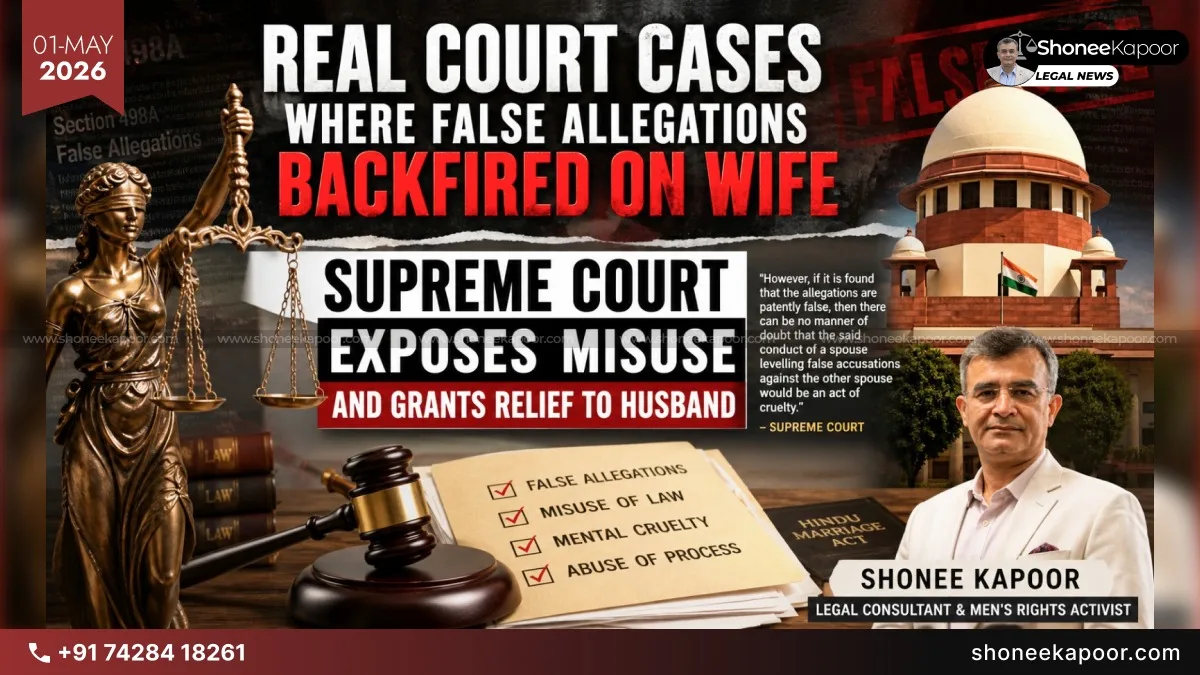
Real Court Cases Where False Allegations Backfired On Wife
Real Indian court cases where false 498A, dowry, cruelty and defamatory allegations against husbands backfired, leadi...

Wife Filed False IPC 498A / BNS 85? What To Do Immediately Before Police Action Starts
False 498A is now BNS 85 for new cases after 1 July 2024. Here is what to do immediately: arrest protection, BNSS not...




Share Your Thoughts
Comments are moderated before publication.