
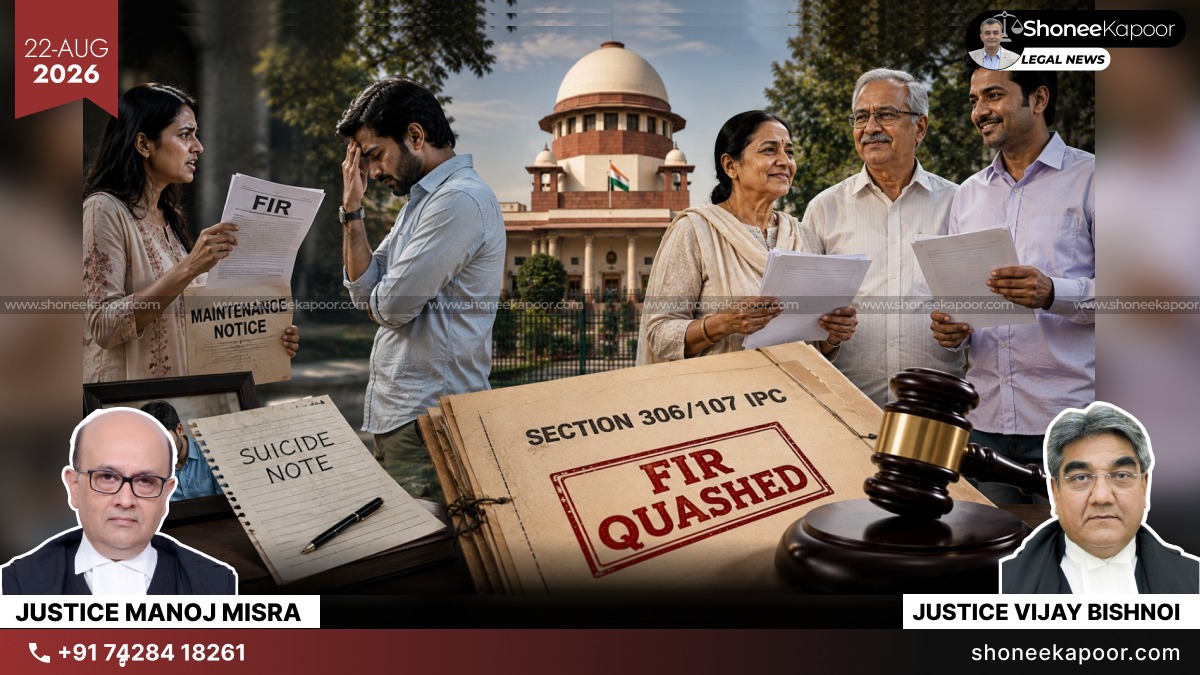
Wife Lodging FIR Against Husband, Even If False, Is Not Abetment Of Suicide: Supreme Court Frees In-Laws Of Man Who Committed Suicide
A husband died by suicide after his wife left
the matrimonial home, filed an FIR and initiated maintenance proceedings, while
his suicide note blamed her family.
But can even an allegedly false matrimonial FIR make the wife’s family guilty
of abetment when there was no instigation or intentional aid?
NEW DELHI: The Supreme Court has quashed an abetment of suicide case under Sections 306 and 114 IPC against the mother-in-law, father-in-law and brother-in-law of a deceased husband, holding that merely starting legal proceedings, even if they are alleged to be false, cannot by itself amount to instigation to commit suicide.
A Bench of Justice Manoj Misra and Justice Vijay Bishnoi set aside the Gujarat High Court order which had refused to quash the FIR. The Supreme Court found that neither the FIR nor the husband’s suicide note disclosed the essential ingredients of abetment under Section 107 IPC, namely instigation, conspiracy or intentional aid.
The dispute arose from a marriage solemnised in 2009. On 6 March 2020, the wife lodged an FIR against her husband at Chandkheda Police Station, Ahmedabad City, under Sections 498A and 323 IPC. She alleged that on 1 March 2020, her husband abused and assaulted her. The Supreme Court also recorded that her subsequent medical examination found multiple contusions on her body.
The wife had left the matrimonial home and gone to her parents. According to the later FIR lodged by the deceased husband’s brother, the husband was allegedly being harassed by his in-laws because they wanted the couple to live in Ahmedabad. It was further alleged that a false FIR had been filed against the husband and that he had also received a maintenance notice, which ultimately drove him to suicide.
The husband’s in-laws approached the Gujarat High Court under Section 482 CrPC to quash the abetment FIR, but the Court dismissed their petition. They then approached the Supreme Court.
After examining the suicide note, the Supreme Court found that the husband believed his married life had been ruined by his in-laws. However, the Court found no allegation of any specific act showing that they had instigated him, intentionally aided the suicide or subjected him to such conduct that he was left with no option except taking his life.
The Court observed:
“In our view, lodging an FIR, even if it is false, against a person, per se, does not amount to instigating that person to commit suicide. Besides, here the FIR was lodged by the deceased’s wife who had suffered injuries. Otherwise also, every individual has a right to take recourse to appropriate proceedings under law to protect his or her rights. Therefore, if a person sets the criminal justice delivery system in motion, he cannot be held liable for abetment to commit suicide, if the person against whom proceedings were initiated commits suicide.”
The Court also noted that the accused in-laws were living separately from the deceased husband. Therefore, they could not be treated as having such an overpowering influence over him that they could have driven or instigated him to commit suicide.
The Bench further observed:
“Merely because a dejected husband, or lover, out of frustration, ends his life and puts the blame on the accused, in his suicide note, is not enough to conclude that a prima facie case is made out against those who are blamed. The court would have to consider whether the conduct of the accused complained of in ordinary circumstances would have driven an ordinary person, not an oversensitive person, to take that drastic step to end his life.”
The ruling makes it clear that a suicide note naming relatives is not, by itself, sufficient to establish abetment. Courts must examine the surrounding circumstances and determine whether the accused actually committed an act satisfying the legal requirements of Section 107 IPC.
On matrimonial litigation, the Supreme Court stated:
“In matrimonial relationship, often differences arise between husband and wife where they tend to blame each other and institute proceedings against each other. Initiation of such proceedings cannot by itself be taken as an act of instigation to commit suicide. Because, ultimately, it is for the courts to decide whether those proceedings are bona fide or mala fide.”
The Court recorded that the husband was dejected because his wife had left him and initiated proceedings against him. At the same time, it noted that her allegations in the earlier FIR had prima facie support from the medical report. The Court refused to speculate about the exact reason for the suicide and confined itself to whether the legal ingredients of abetment existed.
Under Section 107 IPC, abetment requires a person to instigate another, participate in a conspiracy, or intentionally aid the act. The Supreme Court found these essential ingredients completely missing from both the FIR and the suicide note.
The Court ultimately held that the Gujarat High Court should have examined the allegations more closely instead of allowing the prosecution to continue. The appeal was allowed, the High Court order was set aside, and the FIR along with all consequential criminal proceedings was quashed.
EXPLANATORY TABLE OF LAWS AND SECTIONS
| Law / Section | Simple Meaning | Application In This Case |
|---|---|---|
| Section 306 IPC | Punishes abetment of suicide. There must first be legally recognised abetment connected with the suicide. | The in-laws were booked under Section 306. The Supreme Court found that the necessary ingredients of abetment were absent and quashed the proceedings. |
| Section 107 IPC | Defines abetment. It requires instigation, conspiracy or intentional aid. | The Court examined the FIR and suicide note and found none of these essential ingredients against the deceased husband’s in-laws. |
| Section 114 IPC | Applies where an abettor is present when the offence for which he has abetted is committed, subject to its statutory requirements. | Section 114 was invoked along with Section 306 in the impugned FIR. The entire prosecution was ultimately quashed. |
| Section 498A IPC | Punishes specified cruelty by a husband or his relatives against a married woman. | The deceased husband’s wife had earlier lodged an FIR against him under Section 498A IPC. |
| Section 323 IPC | Punishes voluntarily causing hurt. | This section was also invoked in the wife’s FIR against the deceased husband. |
| Section 482 CrPC | Gives the High Court inherent powers to prevent abuse of court process and secure the ends of justice, including in appropriate cases quashing criminal proceedings. | The in-laws approached the Gujarat High Court under Section 482 seeking quashing, but the High Court dismissed their petition. The Supreme Court later set aside that decision. |
| Section 113A, Indian Evidence Act, 1872 | Permits a statutory presumption regarding abetment of suicide by a married woman in specified circumstances. | The Supreme Court referred to Section 113A while explaining that, in cases outside such presumptive provisions, the material must prima facie show an act amounting to abetment. |
CASE DETAILS
| Particular | Details |
|---|---|
| Case Title | Patel Joshnaben Pravinkumar Patel & Ors. v. State of Gujarat & Anr. |
| Court | Supreme Court of India |
| Jurisdiction | Criminal Appellate Jurisdiction |
| Neutral Citation | 2026 INSC 886 |
| SLP Number | SLP (Crl.) No. 18705/2025 |
| Bench | Justice Manoj Misra and Justice Vijay Bishnoi |
| Decision Date | 18 August 2026 |
COUNSELS
| Side | Counsel Details |
|---|---|
| For the Petitioners/Appellants | Ms. Pyoli, Advocate; Mr. Somesh Chandra Jha, AOR; Mr. Brijesh Raj, Advocate; Mr. Animesh Rajoriya, Advocate |
| For the Respondents | Ms. Deepanwita Priyanka, Advocate; Ms. Swati Ghildiyal, AOR; Mr. Nimesh Bhatt, Advocate |
KEY TAKEAWAYS
- Husband died by suicide after matrimonial litigation, but his suicide note alone could not prove abetment.
- Even an allegedly false FIR is not automatically abetment of suicide, the Supreme Court held.
- His wife left the matrimonial home, filed an FIR and initiated proceedings; his distress still did not satisfy Section 306 IPC.
- Matrimonial litigation cannot become an abetment case merely because the husband later dies by suicide.
- The Supreme Court finally quashed the FIR and all proceedings against the in-laws.
Related Reading
 High Court
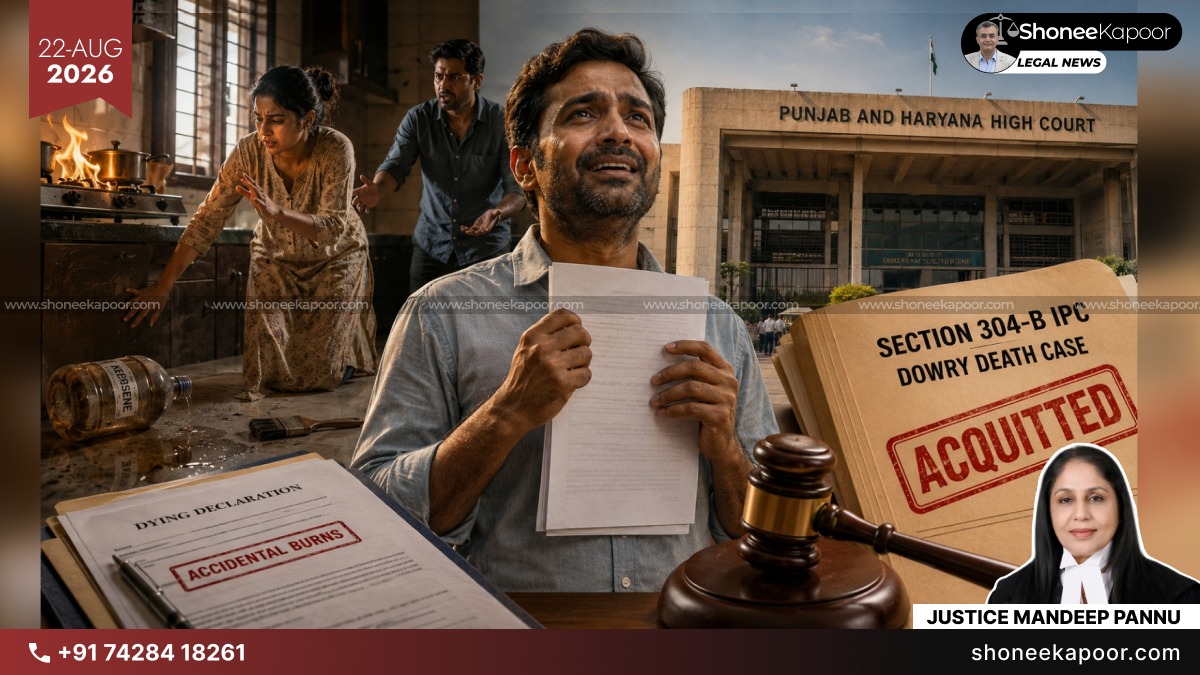
Husband Convicted Of Dowry Death Despite Wife’s Dying Declaration Saying Burns Were Accidental; Punjab & Haryana High Court Acquits After 22 Years
 High Court
Section 24 HMA Is Gender-Neutral, But Able-Bodied Husband Cannot Claim Maintenance From Wife As It Would Prompt Idleness: Karnataka High Court
 High Court
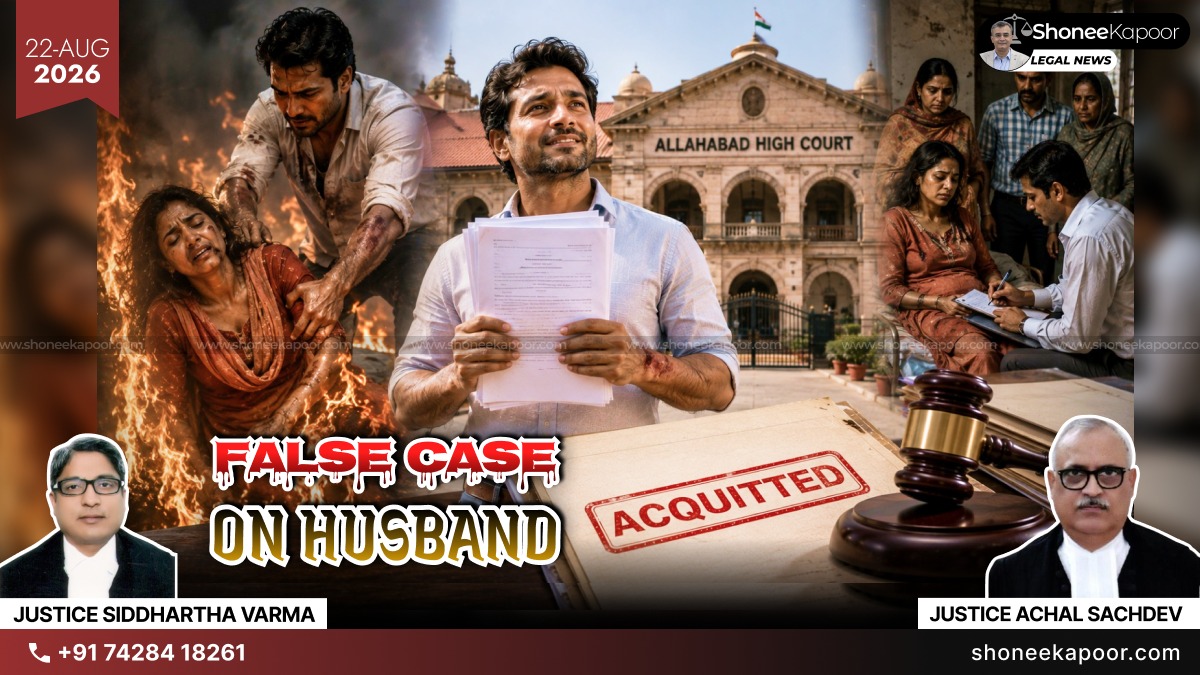
Husband Burnt Himself Trying To Save His Wife—Still Got Life Imprisonment; Allahabad High Court Acquits Him After Finding Dying Declaration Unreliable
 High Court

Share Your Thoughts
Comments are moderated before publication.