
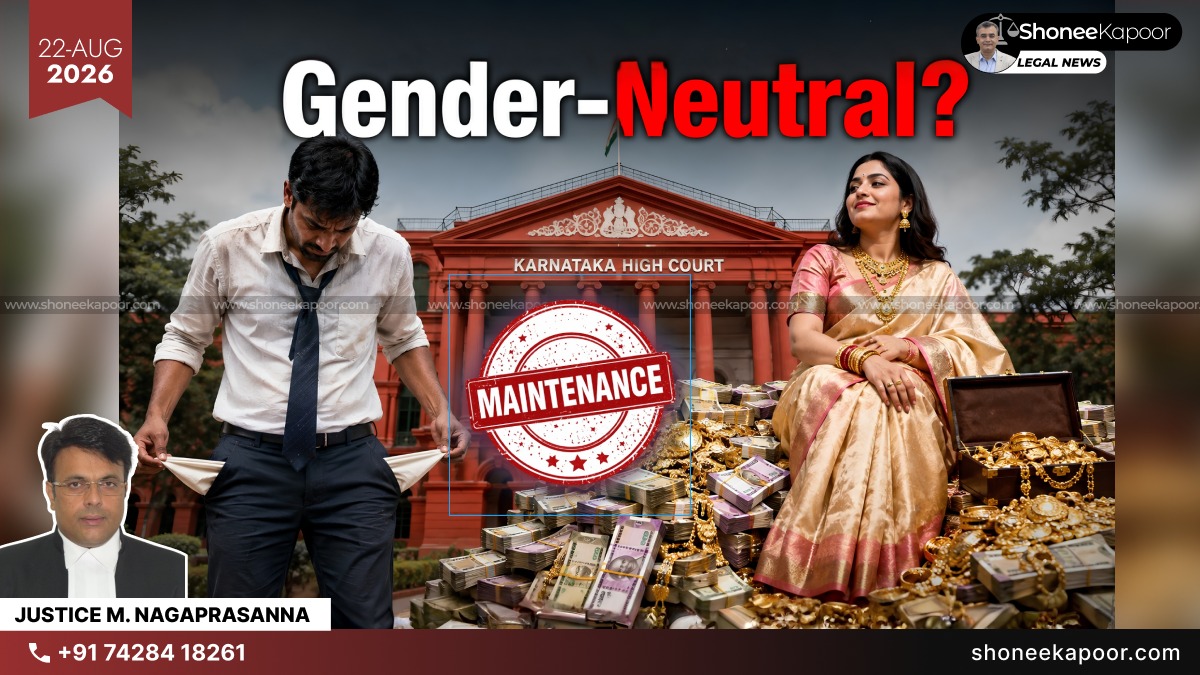
Section 24 HMA Is Gender-Neutral, But Able-Bodied Husband Cannot Claim Maintenance From Wife As It Would Prompt Idleness: Karnataka High Court
Can an unemployed husband claim maintenance from his wife under Section 24 of the Hindu Marriage Act is gender-neutral? The Karnataka High Court answered this while rejecting a husband’s ₹2 lakh monthly maintenance claim and directing him to pay maintenance to his wife instead.
BENGALURU: The Karnataka High Court has held that an able-bodied husband who has no physical or mental disability cannot ordinarily claim maintenance from his wife merely because he is unemployed.
Justice M. Nagaprasanna made the observation while deciding a petition arising out of matrimonial proceedings between a husband and wife under the Hindu Marriage Act.
The dispute reached the High Court after the Family Court granted the wife interim maintenance of ₹10,000 per month along with ₹25,000 towards litigation expenses. At the same time, the Family Court rejected the husband’s application seeking ₹2,00,000 per month as maintenance and ₹30,000 towards litigation expenses from his wife.
The husband argued that he had become unemployed after the onset of the Covid-19 pandemic and had been unable to find another job for around two years. On this basis, he contended that he was not financially capable of maintaining his wife and instead needed financial support from her.
He also submitted that the wife’s parents were financially well-off. According to him, the wife had initiated several legal proceedings against him and his family members, forcing him to bear substantial litigation expenses.
However, the High Court was not persuaded by these arguments.
While dealing with the gender-neutral language of Section 24 of the Hindu Marriage Act, the Court observed:
“Merely because Section 24 of (Hindu Marriage) Act is gender neutral for grant of maintenance, it would be promoting idleness notwithstanding the fact that the husband has no impediment or handicap to earn.”
The Court therefore recognised that Section 24 does not restrict interim maintenance only to wives. In law, either spouse can seek maintenance. However, according to the Court, gender neutrality by itself does not mean that an able-bodied husband who is capable of earning automatically becomes entitled to financial support from his wife.
This distinction became important in the present case because the husband claimed that his unemployment itself was sufficient to justify maintenance.
Rejecting that argument, the Court observed:
“The contention that the petitioner has no job and has no means to maintain himself and, therefore, is not in a position to maintain the wife and in turn wants maintenance from the wife, is unacceptable as it is fundamentally flawed.”
The High Court further held that losing a job during the Covid-19 period could not automatically establish that a person had lost his ability to earn.
The Court said:
“Merely because he has lost his job on the onset of Covid19, it cannot be held that he is incapable of earning. Therefore, it can be irrefutably concluded that the husband by his own conduct has decided to lead a leisurely life by seeking maintenance from the hands of the wife.”
The ruling therefore placed a significant burden on the husband to demonstrate something beyond unemployment. Although Section 24 permits both spouses to seek interim financial support, the Court treated the husband’s earning capacity as crucial while examining his claim.
The Court further observed:
“In the considered view of this Court, such an application cannot be granted, as the husband cannot afford to incapacitate himself and sustain an application under Section 24 of the Act to claim maintenance from the hands of the husband. This would be an anathema to the spirit of Section 24 of the Act. Therefore, the husband cannot seek any maintenance unless he would demonstrate such a disability either physical or mental which incapacitates him from earning money by finding a job for himself.”
Thus, despite the statutory provision being gender-neutral, the Court held that an able-bodied husband must ordinarily earn for himself unless he can establish a physical or mental condition that genuinely prevents him from working.
The case also highlights the practical difference between a statutory right to apply for maintenance and an actual entitlement to receive it. A husband may legally move an application under Section 24, but the Court can examine his qualifications, health, earning capacity and surrounding circumstances before deciding whether financial assistance from the wife is justified.
The High Court further noted that an able-bodied husband has a duty to maintain himself, his wife and his child, if any.
Emphasising the expectation that a person capable of working should make efforts to earn rather than remain financially dependent, the Court remarked:
“It is better to wear out, than rust out.”
The High Court ultimately upheld the Family Court’s decision granting ₹10,000 per month as interim maintenance and ₹25,000 towards litigation expenses to the wife while rejecting the husband’s claim for ₹2 lakh per month and ₹30,000 towards litigation expenses.
The petition was accordingly dismissed.
ALL LAWS AND SECTIONS MENTIONED IN THE JUDGMENT
| LAW / PROVISION | WHAT IT MEANS | HOW IT APPEARS IN THIS CASE |
|---|---|---|
| Section 24, Hindu Marriage Act, 1955 | Allows either wife or husband who lacks sufficient independent income to seek maintenance pendente lite and litigation expenses during matrimonial proceedings. | This is the main provision in dispute. Both spouses filed applications under Section 24. The High Court expressly recognised that it is gender-neutral. |
| Section 13(1)(i-a), Hindu Marriage Act | Divorce on the ground of cruelty. | The husband had instituted matrimonial proceedings relying, inter alia, on this ground. |
| Section 13(1)(i-b), Hindu Marriage Act | Divorce on the ground of desertion for the statutory period. | Also invoked in the husband’s matrimonial petition. |
| Section 9, Hindu Marriage Act | Restitution of conjugal rights. A spouse may seek restoration of marital cohabitation where the other has withdrawn without reasonable excuse. | The wife had separately initiated proceedings under Section 9. |
| Article 227, Constitution of India | Gives High Courts supervisory jurisdiction over subordinate courts and tribunals. | The husband approached the Karnataka High Court under Article 227 challenging the Family Court order. |
| Section 498A, IPC | Cruelty by husband or relatives of husband against a married woman. | The husband stated that a criminal case had also been registered against him and family members under this provision. |
| Section 323, IPC | Punishment for voluntarily causing hurt. | Mentioned among the offences alleged in the criminal proceedings referred to by the husband. |
| Section 504, IPC | Intentional insult with intent/knowledge that it may provoke breach of peace. | Part of the criminal case referred to in the maintenance proceedings. |
| Section 506, IPC | Punishment for criminal intimidation. | Also mentioned as an offence alleged against the husband/family. |
| Section 3, Dowry Prohibition Act, 1961 | Punishment for giving or taking dowry, subject to the statutory scheme and exceptions. | Mentioned as one of the provisions invoked in the criminal case referred to by the husband. |
| Section 4, Dowry Prohibition Act, 1961 | Punishment for demanding dowry. | Mentioned with Section 3 in the criminal proceedings. |
| Section 125, CrPC | Summary maintenance remedy for specified dependants, including wife and children, intended to prevent destitution. | Discussed through the Supreme Court judgment in Anju Garg, relied upon by the High Court. |
| Article 15(3), Constitution of India | Permits the State to make special provisions for women and children. | Mentioned inside the Supreme Court passage quoted by the High Court concerning Section 125 CrPC. |
| Article 39, Constitution of India | Directive Principles dealing, among other things, with livelihood, equal justice-related social objectives and protection of citizens. | Referred to in the Supreme Court extract reproduced in this judgment. |
CASE DETAILS
| PARTICULAR | DETAILS |
|---|---|
| Case Title | XXX v. XXX |
| Court | High Court of Karnataka at Bengaluru |
| Case Number | Writ Petition No. 24226 of 2022 (GM-FC) |
| Decision Date | 10 January 2023 |
| Bench / Coram | Hon’ble Mr Justice M. Nagaprasanna |
| Petitioner | Husband, name masked |
| Respondent | Wife, name masked |
| Counsel for Petitioner/Husband | Sri M.K. Shivaraju / Sri Shivaraju M.K., Advocate |
| Counsel for Respondent/Wife | Sri R. Madhu / Sri Madhu R., Advocate |
| Jurisdiction Invoked | Article 227 of the Constitution of India |
| Original Matrimonial Case | M.C. No. 78 of 2021 |
| Impugned Order | Order dated 31 October 2022 |
| Court passing impugned order | 4th Additional Senior Civil Judge, Bengaluru Rural District, Bengaluru |
| High Court Result | Writ petition dismissed |
KEY TAKEAWAYS
- Section 24 HMA is gender-neutral: husband or wife can legally seek interim maintenance.
- Husband sought ₹2 lakh/month, but his claim was rejected while wife received ₹10,000/month plus litigation expenses.
- Being unemployed was not enough: Court said an able-bodied husband is presumed capable of earning.
- Court demanded proof of physical or mental incapacity before accepting his maintenance claim.
- The uncomfortable question: if maintenance law is gender-neutral, should earning capacity and dependency be tested by the same yardstick for both spouses?
Related Reading
 High Court
Husband Convicted Of Dowry Death Despite Wife’s Dying Declaration Saying Burns Were Accidental; Punjab & Haryana High Court Acquits After 22 Years
 High Court
Husband Burnt Himself Trying To Save His Wife—Still Got Life Imprisonment; Allahabad High Court Acquits Him After Finding Dying Declaration Unreliable
 High Court
Woman Hid Child Custody Settlement, Filed Habeas Corpus Plea Against Father: AP High Court Fines Mother ₹50,000
 Supreme Court

Share Your Thoughts
Comments are moderated before publication.