
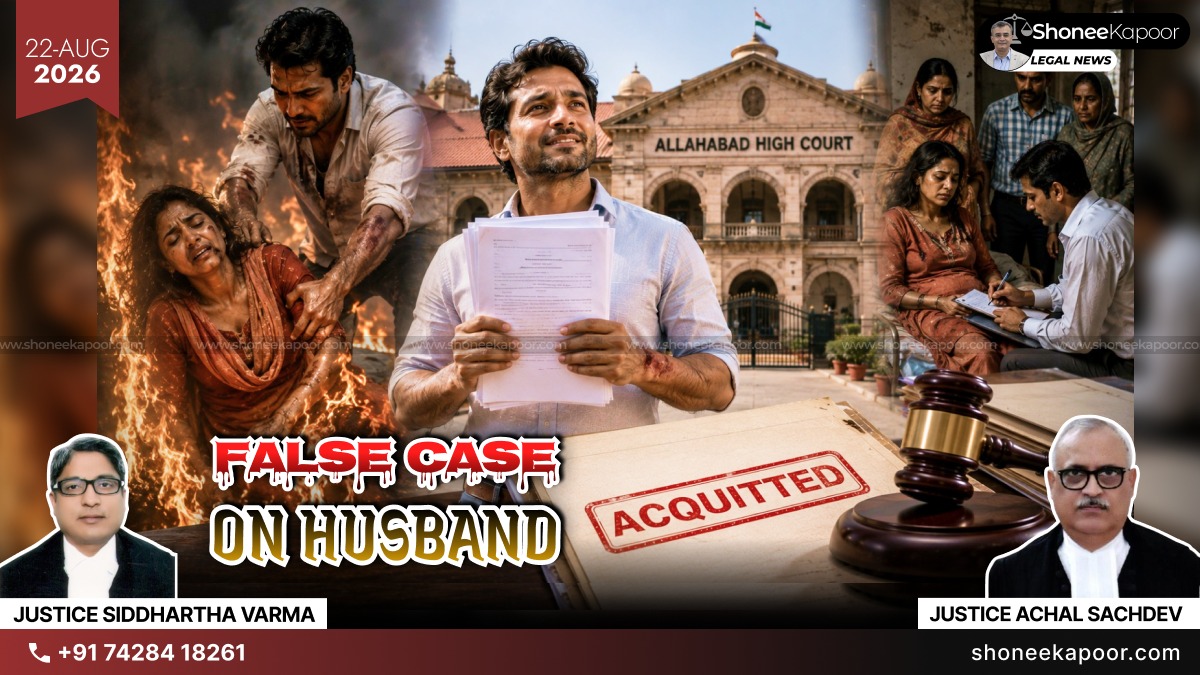
Husband Burnt Himself Trying To Save His Wife—Still Got Life Imprisonment; Allahabad High Court Acquits Him After Finding Dying Declaration Unreliable
A husband suffered burns while trying to save his wife, yet was convicted and sentenced to life imprisonment. What did the Allahabad High Court find in the dying declaration and defence evidence that finally led to his honourable acquittal?
ALLAHABAD: The Allahabad High Court has acquitted a husband who had been sentenced to life imprisonment under Section 304 IPC in connection with the burning death of his wife, after finding serious doubt over the prosecution case and the reliability of the dying declaration.
A Division Bench of Justice Siddhartha Varma and Justice Achal Sachdev allowed the criminal appeal filed by Jagan and set aside the August 8, 2018 judgment of the Additional District & Sessions Judge, , Moradabad. The trial court had convicted Jagan under Section 304 IPC and imposed a fine of ₹50,000.
The case arose from an incident dated December 23, 2015. According to the FIR lodged by Triveni's brother Durgadas, Jagan allegedly poured kerosene on his wife and set her on fire. Police initially registered an FIR under Section 326 IPC. A dying declaration was later recorded after a doctor certified Triveni fit to make a statement. After her death, the police proceeded under Sections 304 and 326 IPC.However, an important fact emerged during the cross-examination of the deceased's brother. He admitted that the Magistrate had recorded Triveni's statement while family members, including his son, wife and aunt, were present.
The High Court said:
“In view of the fact that the dying declaration was got recorded in the presence of all the family members, no importance could be attached to it”.
The Court also found significant evidence that Jagan himself had suffered burn injuries while trying to save his wife. Defence doctor Dr. Pawan Kumar stated that his injuries could have occurred while attempting to extinguish the fire on a burning person. Another defence witness stated that Triveni had been taken to hospital by Jagan's mother.
The Bench noted:
“…there was sufficient evidence to the fact that the husband had tried to save his wife and in the process he had also got burnt”.
The evidence further showed that the couple had been married for around 18 years and had no children. The dispute between the families was connected with the proposed adoption of a child. Triveni's side wanted a child from her parental family to be adopted, while Jagan wanted his brother's child to be adopted. Jagan had maintained in his Section 313 CrPC statement that this dispute led to arguments and that Triveni had set herself on fire.
The High Court observed:
“The incident had occurred on account of there being a tussle in the family as to which child of which family had to be adopted”.
The Bench also considered the long duration of the marriage and observed that
“it could not in any manner be presumed that there was any kind of demand etc. of dowry from the side of the first informant.”
The Court therefore had to decide whether Triveni had set herself on fire or whether it was the “misdeed of the accused.”
Another factor favouring the defence was Jagan's conduct immediately after the incident. Evidence showed that he suffered burns while attempting to save Triveni, she was taken for treatment, and the family was even taking her towards Delhi for advanced medical care when she died.
Jagan's counsel also relied on the Supreme Court decisions in Sanjay Kumar Sharma v. State of Bihar, 2026 SCC OnLine SC 357 and Mohan Lal and Others v. State of Haryana, (2007) 9 SCC 151, arguing that the presence and interaction of relatives before a dying declaration can become relevant while judging whether the declaration was voluntary and reliable.
After considering the entire evidence, the High Court concluded:
“…it could not with any certainty be said that the deceased was put on fire after pouring kerosene oil by the accused. Having held thus, we are of the view that definitely the husband could not be outrightly blamed for the incident”.
The appeal was accordingly allowed, the trial court judgment was set aside, and Jagan was “honourably acquitted” of the charges. The Court further directed that if he was on bail, he need not surrender and his bail bonds and sureties would stand discharged.
EXPLANATORY TABLE OF LAWS AND SECTIONS
| Law / Section | What It Means | Application In This Case |
|---|---|---|
| Section 304 IPC | Punishes culpable homicide not amounting to murder. Part I can extend to life imprisonment or imprisonment up to ten years, along with fine, depending on the required intention. | Jagan was convicted under this provision by the trial court and sentenced to life imprisonment with ₹50,000 fine. The High Court later set aside the conviction. |
| Section 326 IPC | Punished voluntarily causing grievous hurt by dangerous weapons or means, including certain dangerous substances or methods. | The original FIR was registered under Section 326 IPC, and the police later submitted a report under Sections 304 read with 326 IPC. |
| Section 313 CrPC | Gives an accused an opportunity to personally explain circumstances appearing against him in the prosecution evidence. | Jagan stated that the dispute concerned adoption of a child and maintained that his wife had set herself on fire and that he was innocent. |
| Section 354(3) CrPC | Requires the criminal court to record reasons for the sentence imposed; the provision additionally requires special reasons where a death sentence is imposed instead of life imprisonment. | The defence invoked this provision while challenging the manner in which the trial court awarded the life sentence. |
| Section 235(2) CrPC | Requires the accused to be heard on the question of sentence after conviction in a Sessions trial. | Jagan's counsel argued that the sentencing procedure had not been properly followed before imposing life imprisonment. |
CASE DETAILS
| Particular | Details |
|---|---|
| Case Title | Jagan v. State of U.P. |
| Case Number | Criminal Appeal No. 5067 of 2018 |
| Court | High Court of Judicature at Allahabad |
| Neutral Citation | 2026:AHC:174860-DB |
| Date of Judgment | 19 August 2026 |
| Bench | Justice Siddhartha Varma and Justice Achal Sachdev |
| Trial Court | Additional District & Sessions Judge, Fast Track Court No. 3, Moradabad |
| Trial Case | Session Trial No. 566 of 2016 |
| Counsel for Appellant | Lav Srivastava, Neeja Srivastava, Prarabadh Jain, Rajan Srivastava, Rajeev Nayan Singh, Santosh Kumar Gupta, Senior Advocate; at hearing, Senior Advocate V.P. Srivastava assisted by Advocate Prarabadh Jain |
| Counsel for State | Amit Sinha, A.G.A. |
KEY TAKEAWAYS
- Dying declaration was not enough- The High Court found it unsafe to rely on when family members were present.
- The husband got burnt trying to save his wife-Yet he still ended up facing a life sentence.
- Eight years after conviction, the Court found the prosecution case uncertain- A man's liberty was lost before the doubt was finally acknowledged.
- Husband does not mean automatic culprit- allegation is not evidence, and sympathy cannot replace proof beyond reasonable doubt.
- Jagan was finally honourably acquitted- for men, a false or doubtful criminal narrative can itself become the punishment long before the court corrects it
Related Reading
 High Court
Husband Convicted Of Dowry Death Despite Wife’s Dying Declaration Saying Burns Were Accidental; Punjab & Haryana High Court Acquits After 22 Years
 High Court
Section 24 HMA Is Gender-Neutral, But Able-Bodied Husband Cannot Claim Maintenance From Wife As It Would Prompt Idleness: Karnataka High Court
 High Court
Woman Hid Child Custody Settlement, Filed Habeas Corpus Plea Against Father: AP High Court Fines Mother ₹50,000
 Supreme Court

Share Your Thoughts
Comments are moderated before publication.