
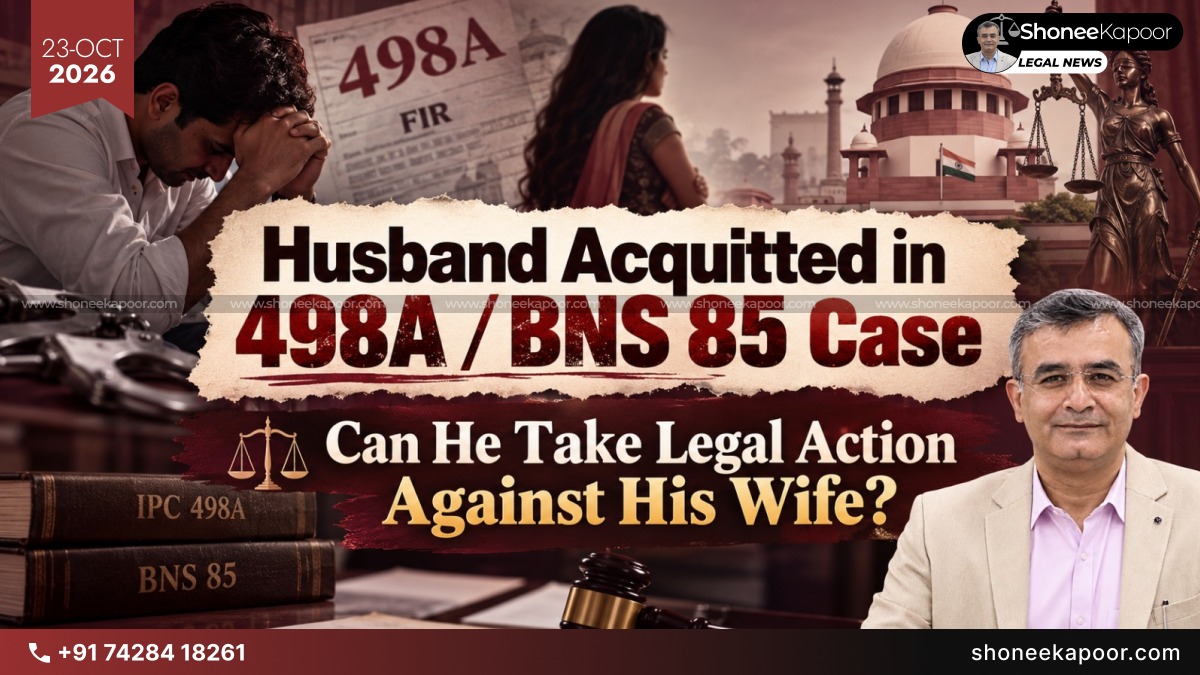
Husband Acquitted in 498A / BNS 85 Case: Can He Take Legal Action Against His Wife?

Written and analysed by Vaibhav Ojha
Head Of Legal CommunicationsNEW DELHI: 498A Acquittal Ends the Case, But Who Pays for the Husband’s Lost Years?
Years of criminal litigation. Lost reputation. Legal expenses. Mental harassment. Finally, the husband is acquitted. But can he now take legal action against the wife who accused him?
YES.
Indian law provides several remedies, including divorce, compensation, criminal action for knowingly false accusations, perjury and defamation. But there is one important condition: acquittal alone does not prove that the wife deliberately filed a false case.
Here is what the law and the Supreme Court actually say.
5 LEGAL ACTIONS A HUSBAND CAN TAKE AFTER 498A ACQUITTAL
1. Seek Divorce on Grounds of Mental Cruelty
A knowingly false criminal complaint can constitute matrimonial cruelty under Section 13(1)(ia) of the Hindu Marriage Act, 1955.
In K. Srinivas v. K. Sunita (2014), the Supreme Court found that the wife had knowingly filed a false criminal complaint and granted the husband divorce.
The Court held that even one such false complaint can constitute matrimonial cruelty.
Similarly, in Rani Narasimha Sastry v. Rani Suneela Rani (2019), the Supreme Court granted divorce after considering the husband's 498A prosecution, subsequent acquittal and surrounding matrimonial circumstances.
Legal takeaway: A husband can seek divorce where false criminal allegations and their impact establish cruelty.
2. File a Civil Suit for Malicious Prosecution
A husband may seek monetary damages when a prosecution was initiated maliciously and without reasonable or probable cause.
He must establish the required elements, including favourable termination of the prosecution, malice, absence of reasonable cause and legally compensable harm.
Important 2026 judgment: In Ram Ugrah Sharma v. Kanchan Mala (12 March 2026), the Delhi High Court held that a malicious prosecution suit was premature while an appeal against the acquittal remained pending.
Limitation alert: Article 74 of the Limitation Act generally prescribes one year for a malicious prosecution damages suit. Courts have differed on when that period begins if an acquittal is appealed. Seek case-specific advice promptly.
3. Pursue Action for Knowingly False Criminal Accusations
Section 248 BNS, corresponding to Section 211 IPC, criminalises false accusations made with knowledge that no lawful ground exists and with intent to cause injury.
Under Section 248(a), punishment may extend to five years' imprisonment, a fine up to ₹2 lakh, or both.
However, intentional falsity and the statutory ingredients must be established. Where the alleged offence relates to court proceedings, Section 215 BNSS imposes restrictions requiring an appropriate court complaint.
An unsuccessful prosecution is not automatically a punishable false prosecution.
4. Seek Perjury Proceedings for Deliberately False Evidence
If a wife intentionally gives false evidence on oath or fabricates evidence for judicial proceedings, the applicable provisions may include Sections 227–229 BNS, corresponding to the earlier IPC false-evidence provisions.
Under Sections 215 and 379 BNSS, the husband can request the concerned court to consider initiating appropriate proceedings.
The court must find that action is expedient in the interests of justice.
Contradictions alone are insufficient. Deliberate false evidence must be established.
5. Initiate Defamation Proceedings Where Legally Justified
Where false and reputation-damaging imputations satisfy the legal requirements, a husband may consider criminal defamation under Section 356 BNS, corresponding to Sections 499–500 IPC.
A criminal defamation complaint ordinarily follows Section 222 BNSS.
However, good-faith accusations to lawful authorities are protected under statutory exceptions. Acquittal does not automatically defeat those protections.
WHAT DID THE SUPREME COURT AND HIGH COURTS ACTUALLY SAY?
Raj Talreja v. Kavita Talreja (2017): The Supreme Court distinguished justified complaints from patently false allegations. It granted divorce after examining complaints found false, including police findings concerning self-inflicted injuries.
K. Srinivas v. K. Sunita (2014): The Supreme Court expressly found that the wife had filed a false criminal complaint and treated that conduct as cruelty.
Lokesh Sinha v. Kusumlata Sinha (29 September 2026): The Chhattisgarh High Court refused divorce because the husband failed to establish cruelty independently of his 498A acquittal.
Actual Courtroom Positions in the 2026 Case
The judgment records the following submissions and findings, rather than a verbatim spoken exchange:
Husband's argument: His acquittal in the 498A case demonstrated false allegations amounting to mental cruelty.
Wife's argument: Acquittal by itself did not establish cruelty or deliberate falsity.
High Court's finding: The entire matrimonial evidence had to be examined; acquittal alone could not establish that the allegations were false.
The distinction is crucial: winning a criminal trial and proving malicious prosecution are two different legal battles.
WHAT SHOULD A HUSBAND DO IMMEDIATELY AFTER ACQUITTAL?
Obtain the certified acquittal judgment, witness depositions and relevant case records. Identify whether the court recorded benefit of doubt, lack of evidence, material contradictions or affirmative findings of fabrication.
Preserve documentary proof of financial losses, reputational damage and any independently verifiable false allegations. Review appeal status, limitation and the applicable procedural route before initiating further proceedings.
Also remember: Section 273 BNSS (earlier Section 250 CrPC) allows a Magistrate, in qualifying cases, to consider compensation for accusations made without reasonable ground at the stage of discharge or acquittal, subject to the prescribed procedure. It is not an automatic post-acquittal award.
ACQUITTAL SHOULD NOT BE THE END OF ACCOUNTABILITY
A man may spend years proving that the prosecution cannot establish his guilt. Yet his acquittal does not automatically restore his reputation, finances or peace of mind.
My position is straightforward: genuine victims deserve protection, but anyone who deliberately weaponises criminal law must also face lawful consequences.
The right approach is not blind retaliation. It is evidence-backed legal action.
An acquittal ends the criminal accusation at that stage. Accountability for a knowingly false accusation requires its own proof.
FAQ’S
1. Can a husband file a case against his wife after 498A acquittal?
Yes, if the facts satisfy the requirements of an independent legal remedy.
2. Does 498A acquittal prove the wife filed a false case?
No. Acquittal alone does not establish intentional fabrication.
3. Can a husband claim compensation for a false 498A case?
Yes, through a legally sustainable malicious prosecution claim or other applicable remedy.
4. Can a husband obtain divorce after a false dowry case?
Yes, if the allegations and surrounding conduct establish matrimonial cruelty.
5. Can a wife face imprisonment for filing a false 498A case?
Potentially, if a separate criminal offence is proved and conviction follows.




Share Your Thoughts
Comments are moderated before publication.