



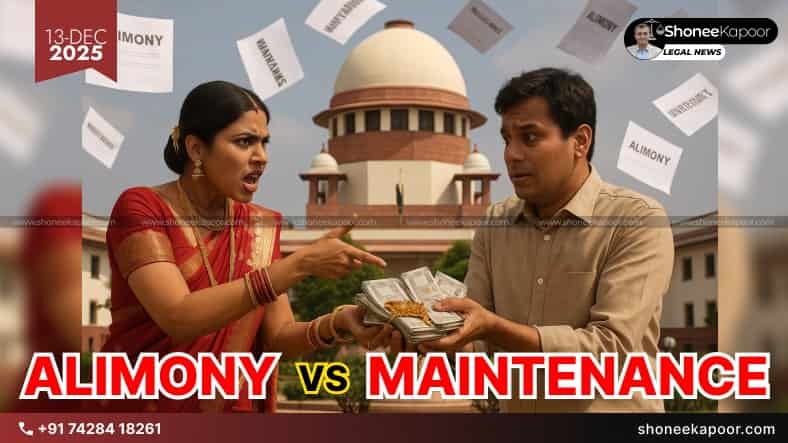
Alimony and maintenance are not the same, but Indian courts often blur the line, creating lifelong financial pressure on men. This detailed legal news article explains the difference in simple Indian English and exposes how misuse happens in real life.
NEW DELHI: In India, divorce is no longer just an emotional breakdown of a marriage. For many men, it becomes a long financial punishment that continues for years, sometimes for life.
Words like “alimony” and “maintenance” are used daily in courts, media debates, and social media arguments, but very few people actually understand the legal difference between them. This confusion is one of the biggest reasons why men suffer silently in matrimonial disputes.
In 2025, the debate over alimony and maintenance in Indian family courts has reached a boiling point. As headlines flash massive monthly payouts and balancing acts in courtrooms across the country, ordinary men are left grappling with the real impact of these laws — often tilted against them despite constitutional ideals of equal treatment.
What Is Maintenance — The Ongoing Burden
Maintenance in India refers to periodic financial support ordered by courts. It can be awarded:
- During the marriage, if a spouse cannot support themselves.
- During separation & litigation (interim maintenance).
- Even after divorce, under some statutes.
Legal frameworks like Section 125 of the CrPC and provisions under personal laws allow spouses — usually wives — to demand monthly payments to sustain their living and legal costs. Courts regularly emphasize dignified life and standard of living as benchmarks for maintenance awards.
Recent Groundbreaking Maintenance Facts (2025)
- In Bombay High Court, maintenance orders were raised as high as ₹3.5 lakh per month after the husband was found to have suppressed income.
- In Delhi courts, even employed wives earning over ₹1.2 lakh per month were granted enhanced maintenance approaching ₹1.5 lakh to match marital standard of living.
- Bengaluru courts have insisted husbands must pay maintenance even when the wife earns a significant salary, emphasizing maintenance is a legal duty, not charity.
What Is Alimony — The Long-Term Pay-Out
Alimony is generally post-divorce financial support, often structured as:
- A lump sum payout, or
- Permanent periodic payments designed to secure long-term financial stability after the marriage legally ends.
Unlike maintenance, alimony under laws like Section 25 of the Hindu Marriage Act typically arises once the divorce decree is passed. It is aimed at ensuring both former spouses can rebuild financial independence.
2025 Supreme Court Shake-Up on Alimony
A landmark ruling in May 2025 set new norms:
- Permanent alimony was raised to ₹50,000/month, with automatic 5% increases every two years.
- Courts emphasized standard of living during marriage, inflation, and future security as deciding factors.
- In some cases, courts ordered transfer of the husband’s home to secure alimony rights.
These procedural changes have increased public scrutiny, as critics argue the laws now demand more from men than ever — with limited consideration for their financial obligations outside the marital dispute.
Key Legal Precedents Shaping the Debate
Rajnesh vs Neha (2020/2021) — A Supreme Court milestone on maintenance.
This judgment provided structured guidelines on:
- How interim maintenance is calculated,
- Basis for disclosure of assets,
- Timelines for family courts to decide,
- Who qualifies for maintenance based on actual need and ability to pay.
While hailed as clarity in law, in practice lower courts still routinely grant interim maintenance without rigorous financial audits or equal scrutiny of the claiming spouse’s income. Critics say this often results in one-sided financial orders hurting men’s ability to sustain businesses, support elderly parents, or meet children’s needs from previous relationships.
Another crucial case, M.V. Leelavathi v. C.R. Swamy, affirmed that when granting permanent alimony, courts must balance the payer’s capacity with the recipient’s security — a fairness principle often lost in litigation.
How Courts Are Applying These Laws — The Real Story
Maintenance has become a default weapon, not a carefully calibrated legal remedy:
- Men facing allegations — often without independent evidence — are ordered massive monthly payments even at interim stages.
- Courts give enormous weight to standard of living during marriage, often ignoring changes in that standard over time or the husband’s new family responsibilities.
- Women with independent income are still granted maintenance if their income doesn’t match the husband’s lifestyle, a criterion rarely extended to men in reverse scenarios.
Meanwhile, alimony orders can dwarf maintenance, especially after lengthy litigation — a warning signal for men entering divorce proceedings without expert legal strategy.
Is the Law Being Misused? Voices from the Ground
There’s growing concern among legal activists, especially men-rights advocates, that:
- Maintenance laws are often weaponised in contested divorces rather than used as genuine protection.
- Interim awards are granted on minimal pretext, putting men under enormous financial stress long before substantive hearings.
- Courts sometimes fail to enforce full financial disclosure, tilting decisions toward the claimant by default.
- The pressure of monthly orders effectively sidelines men’s recovery, business continuity, and mental wellbeing.
These concerns focus less on denying genuine support and more on ensuring due process, transparency, and parity of scrutiny — the cornerstone of any fair legal system.
Conclusion — The Legal Divide Between the Terms
In simple terms:
Maintenance = Periodic support, can be awarded before, during, or after divorce.
Alimony = Post-divorce long-term support, often higher and harder to overturn.
Both are rooted in law, but current application trends reveal a disproportionate burden on men, magnified by procedural gaps and judicial interpretation practices. Advocates and legal reformers call for clearer standards, balanced application, and gender-neutral enforcement so that justice serves all, not just one side.
As alimony and maintenance debates rage across courtrooms and social media, one truth stands out: laws meant to protect can be misused if human biases go unchecked — and Indian family law in 2025 is a battleground testing that truth.
Misuse Patterns Identified
Misuse #1 — Interim Awards Without Financial Evidence
Women often file for interim maintenance immediately after filing suits — and courts grant monthly payments without verifying income/lifestyle parity.
Result: Men’s finances are frozen, bank accounts garnisheed, even when final verdict later reduces or denies maintenance.
Misuse #2 — DV Act Exploitation
Protective laws like the DV Act allow maintenance irrespective of civil status — courts sometimes overlap maintenance with protection claims, turning routine spousal support into punitive orders.
Misuse #3 — Presumption of Dependency
Despite Rajnesh vs Neha insisting on actual inability, lower benches often presume dependency, making men default payers.
Explanatory Table: Laws & Sections Governing Maintenance and Alimony in India
| Law / Statute | Section | What It Provides | Practical Impact on Men |
| Code of Criminal Procedure, 1973 (now BNSS) | Section 125 CrPC / Section 144 BNSS | Monthly maintenance to wife, children, and parents if they cannot maintain themselves | Summary proceedings, often interim orders passed quickly without full income scrutiny |
| Hindu Marriage Act, 1955 | Section 24 | Interim maintenance and litigation expenses during pendency of matrimonial proceedings | Used to secure immediate monthly payments even before evidence is tested |
| Hindu Marriage Act, 1955 | Section 25 | Permanent alimony after divorce (lump sum or periodic) | Long-term or lifelong financial obligation, difficult to modify later |
| Protection of Women from Domestic Violence Act, 2005 | Section 20 | Monetary relief including maintenance, medical expenses, and losses | Parallel proceedings increase financial pressure on husbands |
| Hindu Adoption and Maintenance Act, 1956 | Section 18 | Wife’s right to maintenance during subsistence of marriage | Overlaps with other laws, leading to multiple claims |
| Muslim Women (Protection of Rights on Divorce) Act, 1986 | Section 3 | Reasonable and fair provision and maintenance | Often litigated alongside Section 125 claims |
| Civil Procedure Code, 1908 | Order XXI | Enforcement of maintenance and alimony orders | Leads to attachment, arrest, and coercive recovery |
Key Takeaways
- Maintenance and alimony were meant to prevent destitution, not to become lifelong financial punishment for men, yet courts often apply them mechanically.
- Interim maintenance is frequently granted without strict income verification, forcing men to pay first and prove their innocence later.
- Even educated and earning wives continue to receive maintenance on the vague excuse of “standard of living,” while men’s liabilities are ignored.
- Supreme Court has clearly said maintenance is “not meant to punish the husband,” but lower courts rarely follow this principle in practice.
- True justice demands gender-neutral scrutiny, mandatory financial disclosure from both sides, and an end to the assumption that only men must provide.
What The Law Should do
- Family law must be gender-neutral.
- Alimony and maintenance must be based on verified financial standings, not assumptions.
- Courts must refuse to grant interim awards without detailed income disclosure.
- Both spouses should be treated equally when it comes to dependency.

Leave A Comment