


Some years back, I was sucked into the labyrinth of Indian Matrimonial laws and a false 498a in particular. To be fair, before it hit me, it was difficult for me to fathom the wide spread misuse of dowry laws and specially 498a in India.
CONSULTATION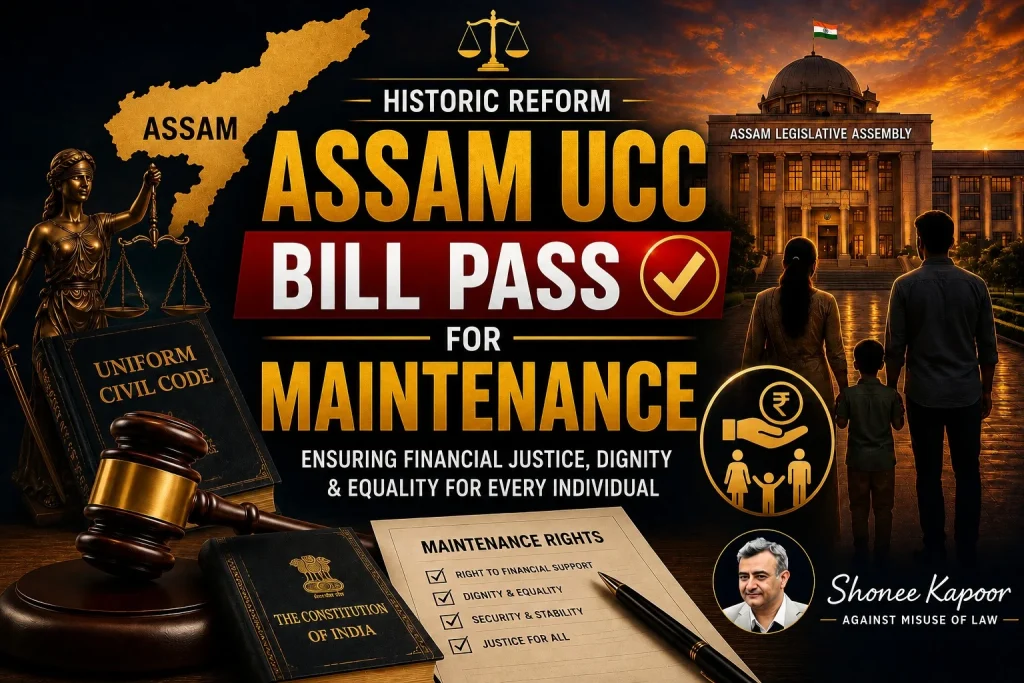
The Assam UCC Bill Pass for Maintenance has emerged as a significant topic of discussion following the Assam Government’s proposal to introduce a Uniform Civil Code (UCC). The proposed legislation seeks to establish a common legal framework governing marriage, divorce, maintenance, inheritance, adoption, and other family matters. Although a comprehensive Assam UCC has not yet been enacted, the proposed reforms aim to create uniform maintenance laws that apply equally across communities, ensuring fairness, transparency, and stronger legal protection for financially dependent spouses, children, and parents.
Maintenance is a legal obligation requiring a person with sufficient financial means to provide monetary support to a spouse, child, or parent who is unable to maintain themselves. Indian law currently provides maintenance through various statutes, depending on the religion and circumstances of the parties.
The proposed Assam Uniform Civil Code aims to simplify this framework by introducing a uniform set of rules governing maintenance, irrespective of personal laws.
Different personal laws currently prescribe different rights and procedures relating to maintenance. The proposed UCC seeks to remove inconsistencies and establish equal legal standards for all eligible persons.
The objectives include:
Although the final provisions of the Assam UCC are yet to be enacted, maintenance under a uniform framework may extend to:
The exact eligibility conditions will depend upon the final legislation.
When determining maintenance, courts generally examine:
These principles are likely to continue under any future uniform legal framework.
The proposed Assam UCC may continue to recognize two forms of maintenance:
Temporary financial assistance awarded during the pendency of legal proceedings to ensure that the dependent party can meet basic living expenses.
Financial support granted after the conclusion of matrimonial proceedings, depending on the facts and circumstances of each case.
The welfare of children is expected to remain a central consideration under the proposed UCC.
Parents may continue to be responsible for:
The child’s best interests are likely to remain the guiding principle in maintenance decisions.
Indian law already recognizes the responsibility of children to maintain their parents in appropriate circumstances. The proposed Assam UCC may continue to reinforce these obligations by providing a uniform legal mechanism for claiming maintenance.
If enacted, the Assam Uniform Civil Code may offer several advantages:
At present, maintenance claims in Assam continue to be governed by existing central statutes and applicable personal laws, including provisions under the Bharatiya Nagarik Suraksha Sanhita (BNSS), the Hindu Marriage Act, the Special Marriage Act, and other relevant legislation. The proposed Assam Uniform Civil Code has not yet replaced these laws.
The Assam Government has announced its intention to introduce a Uniform Civil Code. However, a comprehensive UCC governing maintenance has not yet been enacted.
If the proposed legislation is enacted, it is expected to create a common legal framework governing maintenance across communities, subject to the final provisions of the law.
The final legislation will determine eligibility. Existing Indian laws already provide maintenance rights in certain circumstances based on financial dependency and statutory provisions.
Yes. The welfare of children is expected to remain a priority under any future maintenance framework.
Generally, pending cases continue under the law applicable when they were filed unless a new statute provides otherwise.
The Assam UCC Bill Pass for Maintenance reflects the State Government’s effort to create a more uniform and transparent system of family law. Although the legislation is still awaited, the proposed reforms are expected to simplify maintenance laws, strengthen financial protection for spouses, children, and parents, and promote equality before the law. Until the Uniform Civil Code is formally enacted, maintenance disputes in Assam will continue to be governed by existing personal laws and central legislation.
