
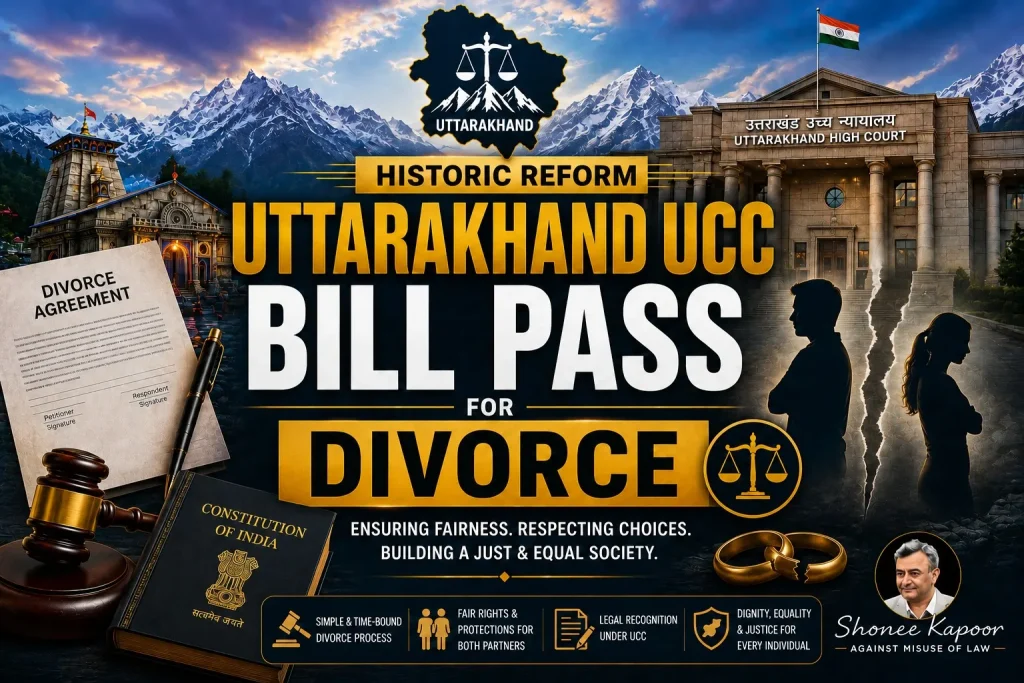
Uttarakhand UCC Bill Pass for Divorce: Complete Guide to Divorce Under the Uniform Civil Code

Written and analysed by Shonee Kapoor
Legal Consultant, Author & Men's Rights Activist
How the Uttarakhand Uniform Civil Code (UCC) governs divorce, mutual consent divorce, contested divorce, maintenance, child custody, and matrimonial rights under a uniform legal framework.
Uttarakhand UCC Bill Pass for Divorce
The Uttarakhand UCC Bill Pass for Divorce marked a historic milestone in India’s family law system by introducing a uniform legal framework for marriage, divorce, maintenance, succession, and live-in relationships. As the first Indian State to implement a Uniform Civil Code, Uttarakhand has established common divorce laws that apply irrespective of religion, subject to the provisions of the Act. The Code aims to simplify matrimonial disputes, ensure equal legal rights for spouses, and create a transparent and consistent process for obtaining a divorce.
What Is Divorce Under the Uttarakhand UCC?
Divorce is the legal dissolution of a valid marriage through a decree of the competent Family Court. The Uttarakhand Uniform Civil Code provides a common legal framework for divorce by replacing different personal law procedures with a uniform system for persons covered by the Act.
The objective is to ensure fairness, equality, and consistency while protecting the rights of both spouses and children.
Objectives of the Uniform Divorce Law
The divorce provisions under the Uttarakhand UCC seek to:
- Establish equal legal standards for all eligible citizens.
- Simplify divorce procedures.
- Reduce unnecessary litigation.
- Protect the financial rights of spouses.
- Safeguard children’s welfare.
- Promote gender equality and legal certainty.
Types of Divorce
The Uniform Civil Code recognizes different methods for dissolution of marriage.
Mutual Consent Divorce
Where both spouses agree that the marriage has irretrievably broken down, they may jointly approach the Family Court seeking dissolution of marriage in accordance with the prescribed legal procedure.
Contested Divorce
Where one spouse seeks divorce without the consent of the other, the matter is decided by the Family Court after considering the evidence and the statutory grounds available under the law.
Grounds for Divorce
Depending on the provisions of the Uniform Civil Code and the facts of each case, divorce may be sought on legally recognized grounds, including:
- Cruelty.
- Adultery.
- Desertion.
- Mental disorder in circumstances recognized by law.
- Conversion where applicable.
- Other statutory grounds provided under the Code.
Each case is decided on its own facts and evidence presented before the court.
Divorce Procedure
The general divorce process under the Uttarakhand UCC involves:
- Filing of a divorce petition before the competent Family Court.
- Service of notice to the opposite party.
- Mediation or reconciliation, where appropriate.
- Recording of evidence.
- Hearing before the Court.
- Passing of a decree of divorce if legal requirements are satisfied.
- Registration of the divorce in accordance with the applicable provisions of the UCC.
Maintenance After Divorce
The Uniform Civil Code contains provisions relating to maintenance and financial support for eligible spouses.
While determining maintenance, the court may consider:
- Income of both parties.
- Financial capacity.
- Standard of living.
- Age and health.
- Needs of dependent children.
- Other relevant circumstances permitted by law.
The objective is to ensure financial fairness after the dissolution of marriage.
Child Custody
The welfare of the child remains the paramount consideration in custody disputes.
The Family Court may consider:
- Best interests of the child.
- Educational needs.
- Emotional well-being.
- Parenting ability.
- Financial stability.
- Wishes of the child, where appropriate.
The court may grant custody, shared parenting, or visitation depending on the facts of each case.
Property and Financial Rights
The UCC seeks to provide greater clarity regarding financial obligations arising after divorce. Courts may determine issues relating to maintenance, matrimonial responsibilities, and other legal rights in accordance with the provisions of the Code.
Registration of Divorce
One of the important features of the Uttarakhand UCC is the registration of divorce. The official UCC portal provides a dedicated mechanism for the registration of divorce and decrees of nullity in accordance with the Rules.
Benefits of the Uttarakhand UCC
The Uniform Civil Code offers several advantages:
- Uniform divorce laws.
- Equal legal treatment.
- Simplified legal procedures.
- Greater transparency.
- Better protection of women and children.
- Reduced procedural complexity.
- Consistency in family law matters.
Current Legal Position
The Uttarakhand Uniform Civil Code is currently in force and governs marriage, divorce, maintenance, succession, wills, and live-in relationships for persons covered by the Act. Divorce proceedings and their registration are carried out in accordance with the Code and the Uniform Civil Code Rules, 2025.
FAQ’s
Yes. Uttarakhand is the first Indian State to implement a Uniform Civil Code that provides a common legal framework for divorce and other family law matters.
Yes. Eligible spouses may seek divorce by mutual consent in accordance with the provisions of the Uniform Civil Code and applicable procedural law.
Yes. Eligible spouses may seek maintenance, and the court determines the amount based on the facts and legal provisions applicable to the case.
The Family Court decides custody primarily on the basis of the child’s welfare and best interests.
Yes. The Uttarakhand UCC provides for the registration of divorce through the prescribed legal process and the official UCC framework.
Conclusion
The Uttarakhand UCC Bill Pass for Divorce represents a landmark reform in Indian family law by establishing a uniform and transparent divorce framework. The Code provides equal legal standards for spouses, simplifies divorce procedures, protects the interests of children, and creates a structured system for maintenance and registration of divorce. Individuals seeking a divorce under the Uttarakhand Uniform Civil Code should understand their legal rights and comply with the procedures prescribed under the Act and the Uniform Civil Code Rules.





Share Your Thoughts
Comments are moderated before publication.