



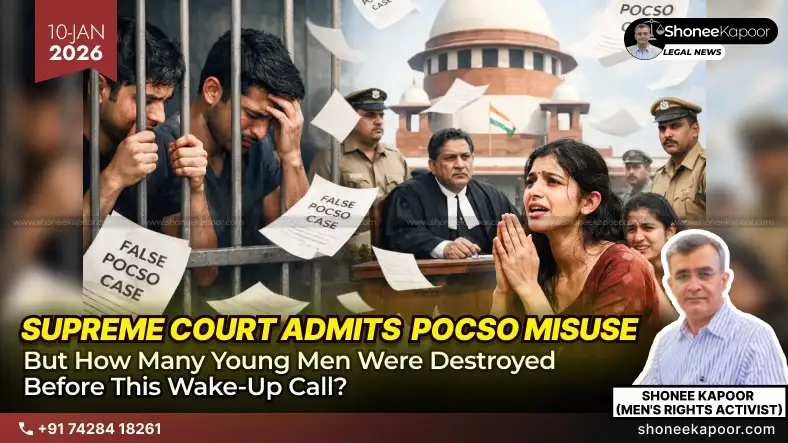
The Supreme Court of India has openly acknowledged rampant misuse of the POCSO Act against consensual adolescent relationships. Calling for a Romeo–Juliet clause, the Court signalled urgent reform to stop criminalising young boys for normal teenage relationships.
NEW DELHI: The Supreme Court in State of Uttar Pradesh v Anurudh & Anr urged the Centre to consider a “Romeo Juliet clause” in POCSO to protect genuine adolescent relationships and condemned misuse of the law to settle scores.
What the Supreme Court actually held (and why it matters)
In a reportable judgment dated 9 January 2026, a Bench of Justice Sanjay Karol and Justice N. Kotiswar Singh decided Criminal Appeal @ SLP (Crl) 10656 of 2025, reported as 2026 INSC 47.
The Court did two big things in one stroke:
- Set aside the Allahabad High Court’s sweeping directions that effectively tried to create a mandatory “medical age determination protocol” in all POCSO cases at the bail stage.
- Formally urged the Union Government to consider steps to curb misuse of such laws—explicitly including a “Romeo–Juliet clause” to exempt “genuine adolescent relationships” and a mechanism to prosecute those who weaponise these laws to settle scores.
This isn’t “dilution” of child protection. This is the Supreme Court admitting a hard truth: a zero-context strict liability framework is producing perverse outcomes, where consensual teen relationships are being pushed into the same bucket as predatory sexual offences.
The case background in simple words
The State of Uttar Pradesh challenged the Allahabad High Court’s order dated 29 May 2024 in CRMBA No. 4880 of 2024. The FIR (No. 622/2022, PS Kotwali, Orai, District Jalaun) involved allegations under IPC Sections 363/366 and POCSO Sections 7/8.
While granting bail, the High Court went further and issued broad directions—essentially telling police and courts that medical age determination should be ensured and produced at bail stage across POCSO investigations, and that medical age could prevail over other age documents in bail proceedings.
The Supreme Court made it crystal clear: this kind of “policy-making” cannot be done inside Section 439 bail jurisdiction.
Why the Allahabad HC approach was struck down: “Mini-trials” and jurisdictional overreach
The Supreme Court’s core legal finding is straightforward:
- Section 439 CrPC bail jurisdiction is not a legislative workshop.
- A bail court cannot run “mini-trials”, cannot issue mandatory investigative protocols contradicting the statutory scheme, and cannot exceed what the law permits under the bail framework.
This matters for men (and especially young boys) because bail-stage overreach has real-world consequences:
- Arrest first, label forever.
- Bail hearings becoming quasi-trials, where “age disputes” and “document credibility” get prematurely litigated without full evidence.
The Supreme Court restored balance: trial is the forum for conclusive age determination and evidentiary appreciation, not the bail court.
The Court’s legal roadmap on “age determination” (and why medical tests cannot be automatic)
The judgment walks through the relevant statutory framework:
- Section 27 POCSO (medical examination of a child to be in accordance with Section 164A CrPC)
- Section 94 JJ Act, 2015 (hierarchy of age proof; medical/ossification only in absence of primary documents)
- Section 29 POCSO (presumption)
And then the crucial doctrinal anchor: Jarnail Singh v State of Haryana (2013) 7 SCC 263, where the Supreme Court held that the age determination method (then Rule 12 JJ Rules) can guide age determination even for a child victim.
But here is what activists, lawyers, and parents must understand: The Supreme Court did not say medical evidence is useless. It said the High Court cannot mandate medical age determination “as a matter of course” at bail stage, and that mechanical reliance on radiology is not conclusive.
That protects due process—because medical age estimation has margins of error, and “mandatory medical tests in every case” can become another tool of coercion and fishing inquiries.
The most important paragraph for India: POCSO being used to “settle scores”
Now to the part that should shake the conscience of the system.
The Supreme Court acknowledges that misuse/misapplication of POCSO exists, including misrepresenting the age of the victim to invoke stringent provisions, and using the law as a weapon to target relationships.
It also notes the uncomfortable class reality: on one side are real child victims denied justice due to fear/poverty/stigma; on the other side are people with privilege and resources who can manipulate the law to their advantage.
This is precisely why men’s rights groups have been demanding reform: Because in the “teen relationship” category, the accused is disproportionately a boy, and the complaint is often driven by family opposition, breakup retaliation, or social pressure—not child protection.
What is a “Romeo–Juliet clause” and why India needs it inside POCSO
A “Romeo–Juliet clause” is a close-in-age exception to statutory rape laws, designed to prevent harsh criminalisation of consensual relationships where both parties are adolescents or near in age.
The Supreme Court explicitly asked the Law Secretary (GoI) to consider steps including introduction of such a clause to protect “genuine adolescent relationships.”
This is not theoretical. Indian academic work has also discussed the need and design of Romeo–Juliet style safeguards in India.
My position is clear: If India truly wants to protect children, it must stop treating adolescent sexuality as a crime by default. Protection must target exploitation and coercion—not mutual teenage relationships.
What the Supreme Court ordered (operational outcome)
The Court’s operative directions include:
- Appeal allowed; HC directions set aside.
- The effect of setting aside extends to related Allahabad HC decisions referred to (including Aman and Monish) insofar as connected directions were concerned.
- Bail already granted was left undisturbed (subject to judicial review if any), and the Court clarified prospective effect so past bails obtained following the impugned approach are not negatively impacted.
- Copy of judgment to be sent for follow-up action within the Allahabad HC system, and circulated to the Law Secretary for reform consideration.
This “prospective” protection is important—because it prevents chaos and retaliatory cancellations in already-decided matters.
What went wrong earlier: the human cost men have been paying
Let’s speak plainly.
Before this judgment, the ground reality in many teen-relationship disputes has been:
- POCSO slapped as a relationship-ending weapon after family disapproval.
- Immediate arrest and social death, even before facts are tested.
- Bail hearings turning into age-document battles, with inconsistent approaches.
- “Consent” becoming irrelevant even when the relationship is clearly mutual, because POCSO is structured around age, not intent.
When the accused is a teenage boy, the system often treats him as disposable collateral. The Supreme Court’s call for a Romeo–Juliet clause is, therefore, not just legal reform—it is damage control for an entire generation.
What should Parliament do now (a reform blueprint that can actually work)
If the Government is serious, the Romeo–Juliet reform must be:
- Close-in-age window (example: 2–3 years) with safeguards.
- Clear consent indicators and strict action where coercion/force/grooming exists.
- No benefit if the accused is in a position of trust/authority (teacher/guardian/employer).
- Fast preliminary scrutiny to filter malicious complaints early.
- Penalty mechanism for malicious invocation, as the Supreme Court itself suggested.
Without penalties for abuse, any law becomes a marketplace weapon.
Conclusion: This is a pro-child, pro-justice decision—and men should pay attention
The Supreme Court has done something rare: it protected the purpose of POCSO while also acknowledging its misuse and calling for a legislative safety valve.
A Romeo–Juliet clause is not “anti-women” or “anti-child.” It is anti-misuse.
It draws a line between:
- Predation, and
- Peer adolescent relationships.
India cannot keep pretending these are the same. This judgment is the strongest mainstream judicial push yet towards rational reform.
If you want real child safety, support reforms that target exploiters—and stop sacrificing young men to satisfy moral policing and revenge litigation.
Click Here To Read Detailed Supreme Court Ruling On This Case
Explanatory Table: Laws & Sections Involved In The Case
| Law / Provision | What It Deals With | How It Was Misused / Clarified by SC |
| POCSO Act, 2012 | Protection of children from sexual offences | Used mechanically to criminalise consensual teen relationships |
| Section 7 & 8, POCSO | Sexual assault & punishment | Invoked even in peer, consensual adolescent cases |
| Section 29, POCSO | Presumption of guilt | Places heavy burden on accused boys even before trial |
| Section 27, POCSO | Medical examination of child | SC clarified it cannot be forced as a routine at bail stage |
| Section 164A, CrPC | Medical examination procedure | Must follow statutory safeguards, not blanket directions |
| Section 439, CrPC | Bail jurisdiction of High Courts | Cannot be used to issue policy-level or legislative directions |
| Section 94, Juvenile Justice Act, 2015 | Age determination hierarchy | Medical tests only when documents are unavailable |
| IPC 363 / 366 | Kidnapping / abduction | Frequently added to pressure accused in relationship cases |
Key Takeaways
- The Supreme Court has formally acknowledged that POCSO is being misused to criminalise consensual adolescent relationships, largely harming young men.
- Courts cannot turn bail hearings into mini-trials or issue blanket directions like mandatory medical age tests under POCSO.
- Treating teenage boys as sexual offenders for peer relationships is legal overreach, not child protection.
- The call for a Romeo–Juliet clause is an admission that strict liability without context has destroyed young lives.
- Real child safety requires punishing misuse of POCSO, not protecting those who weaponise it to settle personal scores.
FAQs
The Court acknowledged that POCSO is often misused to target consensual adolescent relationships.
A legal safeguard protecting close-in-age, consensual teenage relationships from harsh criminal prosecution.
No. It reaffirmed child protection while calling out misuse and demanding balance.
No. The Supreme Court held such directions exceed bail jurisdiction.
Because teenage boys are disproportionately arrested, jailed, and stigmatised under POCSO for consensual relationships.
Disclaimer
This content is for general legal awareness and public-interest commentary only. It does not constitute legal advice, does not intend to prejudice any individual case, and relies on publicly available judicial records and news reports. Readers should consult a qualified legal professional for case-specific advice.
Leave A Comment