


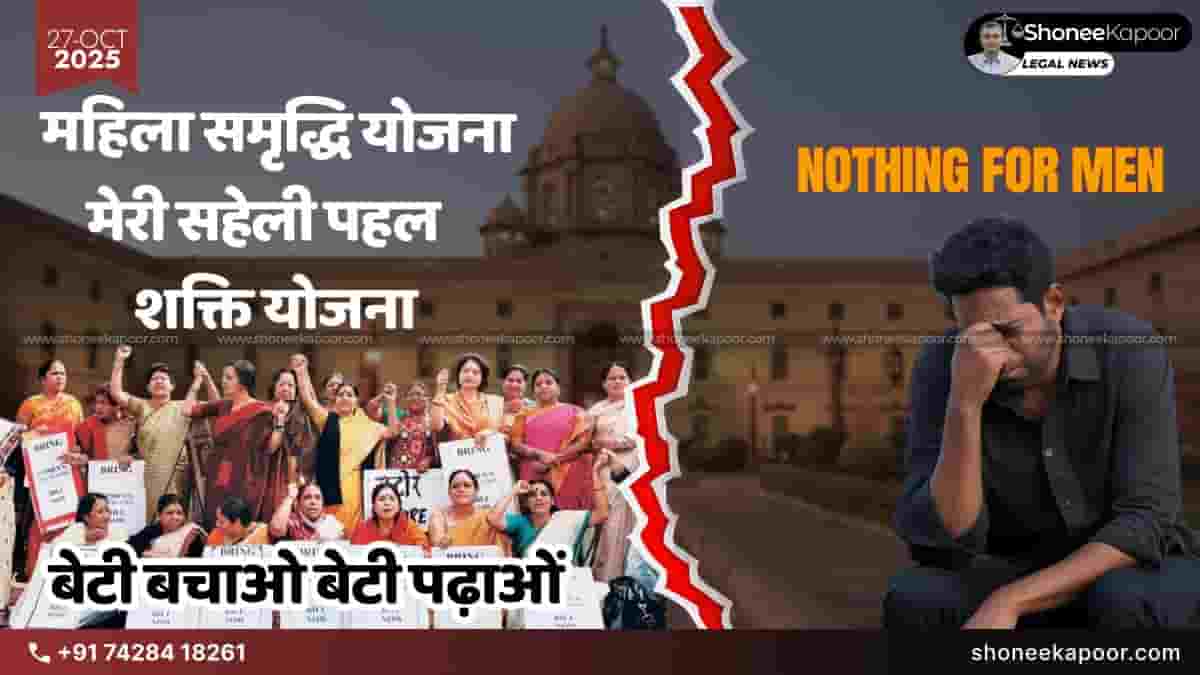
This article dives into India’s political silence on men’s rights uncovering why false cases, unfair maintenance, and gender-biased laws never make it to the Parliament floor.
Imagine losing your freedom, reputation, and family not because you are guilty, but because the law assumed you were. Millions of Indian men silently endure false 498A cases, biased maintenance orders, and custody battles where the system Favors gender over justice. Yet, step into the halls of Parliament, and you will hear nothing. No debates. No reforms. Just silence. This isn’t neutrality it’s selective blindness, and this article digs deep into why the voices of men remain ignored in India’s legal and political landscape.
The Politics of Ignoring Men’s Rights in India
In India, men’s legal suffering is evident, but it is hardly acknowledged in the political sphere. Thousands of men are denied fair custody rights, forced to pay maintenance, or forced into fictitious 498A cases each year, but Parliament views these as anomalies rather than systemic problems. Men’s rights advocacy is a delicate political balance. Lawmakers are afraid of being called “anti-women” or charged with compromising the safety of women. Because of this, even Members of Parliament who are aware of the pervasive abuse of the law avoid making changes that would balance justice by keeping quiet during public discussions.
The issue is made worse by the institutional void. Men lack a Men’s Commission, a ministry, and dispersed advocacy groups, in contrast to women, who have a dedicated ministry, the National Commission for Women (NCW), and robust civil society support. Millions of men lack a voice in the halls of power due to a lack of representation, and their struggles are either disregarded or written off as unimportant. In reality, laws intended to protect the weak have turned into instruments of harassment, and the absence of parliamentary discussion guarantees that this disparity will continue unchecked. Half of the population is not heard in a democracy where justice ought to be blind.
Men’s Rights Acknowledged by Courts, Erased by Politicians
Despite Parliament’s silence, the Indian judiciary has often acknowledged the plight of men who are caught in false cases, unfair maintenance orders, and custody disputes. Courts have not hesitated to state the obvious: men are frequently punished by the current legal system before guilt is proven, trapping them in drawn-out, stressful, and occasionally disastrous proceedings. The misuse of Section 498A IPC is specifically mentioned in the Law Commission of India’s 243rd Report (2012), which also highlights the rising number of false complaints made against innocent husbands and their families. The report cautioned that innocent men are suffering in silence, even though protection for actual victims is vital.
The Supreme Court ruled in Arnesh Kumar v. State of Bihar (2014) that police cannot use Section 498A to make automatic arrests and that harassment prevention measures must be in place. This historic ruling recognises that abuse of the legal system can destroy lives.
In Rajnesh Sharma v. Neha (2020), the Delhi High Court emphasised that men cannot be viewed as nothing more than cash cows for spousal demands and clarified how maintenance calculations should be fair and equitable.
Men are exposed to systemic bias because Parliament will not enact reforms in spite of these judicial interventions. Legislators are the only ones who can alter the rules of the game; courts can issue warnings, dismiss cases, or establish procedural safeguards. The irony is glaring: lawmakers ignore the issue while judges act to protect men. Millions of men will continue to bear the consequences of laws that were meant to protect society but have instead turned into tools of harassment due to this disconnect between the legislature and the judiciary. Politicians act as though men’s suffering doesn’t exist, but the law acknowledges it.
Parliament’s Deafening Silence: Men’s Rights Ignored Despite Alarming Data
India’s Parliament has been repeatedly presented with compelling evidence of the misuse of Section 498A IPC, yet legislative action remains conspicuously absent. Here’s the stark reality:
Rising Incidence of False Cases:
2011–2013: Over 31,000 cases under Section 498A were found false or mistaken after police investigations. Specifically, 10,193 in 2011, 10,235 in 2012, and 10,864 in 2013
2015: The National Crime Records Bureau (NCRB) reported 113,403 cases of “cruelty by husband or his relatives”, accounting for 29.8% of all crimes against women.
Judicial Acknowledgement vs. Legislative Inaction
Law Commission Report No. 243 (2012): Explicitly highlighted the misuse of Section 498A, describing it as a form of “legal terrorism”. Despite this, no legislative reforms have been enacted to address the concerns.
Supreme Court Observations: In cases like Sushil Kumar v. Union of India (2005), the Court criticised the misuse of Section 498A, urging the legislature to investigate how frivolous complaints can be appropriately dealt with.
Lok Sabha Debates: In 2015, Minister of State for Home Affairs Haribhai Parathibhai Chaudhary acknowledged that 31,292 cases of alleged cruelty under Section 498A were found false or mistaken after police investigations between 2011 and 2013. Despite this acknowledgement, no legislative measures were introduced to amend or review Section 498A.
Rajya Sabha Committee on Petitions: The committee has discussed the misuse of Section 498A but has yet to propose any concrete legislative reforms to address the issue of
Prolonged Legal Battles: Individuals falsely accused under Section 498A often endure lengthy legal proceedings, leading to financial and emotional distress. For instance, a recent case saw a husband acquitted after a 26-year legal battle, highlighting the severe consequences of misuse
Erosion of Trust: The lack of legislative action undermines public trust in the legal system, as individuals perceive a failure to protect against misuse of the law. Despite mounting evidence and judicial acknowledgement of the misuse of Section 498A, Parliament’s inaction continues to leave countless men vulnerable. The time for mere acknowledgement has passed; it’s time for legislative reform to ensure justice for all.
Political Hypocrisy: Equality for Women, Silence for Men?
On paper, India takes pride in advancing gender equality. Politicians openly support female empowerment, girl child education, and women’s safety, but they routinely overlook the male victims of these laws. There are obvious double standards:
- Ministry of Women & Child Development: Receives over ₹5,000 crores annually for programmes like Beti Bachao Beti Padhao, Women Helpline, and One Stop Centres for women in distress.
- National Commission for Women (NCW): Advocates nationwide for women’s rights, lobbying for legislation, investigating complaints, and filing PILs to protect women.
- National Commission for Protection of Child Rights (NCPCR): Focuses on girl-child welfare and education.
In contrast, there isn’t a Men’s Commission, a Ministry for Men, a dedicated helpline, or a nationwide initiative to assist men who have been the targets of unfair custody and maintenance laws, false accusations, or domestic violence.
MPs Champion Women’s Safety Bills While Ignoring Men’s Bills. Women-centric laws are regularly passed by parliament:
- Act to Protect Women from Domestic Abuse (2005)
- Act to Prevent Sexual Harassment of Women at Work (2013)
- Following the Nirbhaya case, the Criminal Law (Amendment) Act (2013) was passed.
In the meantime, bills pertaining to men’s rights are rarely introduced, discussed, and frequently put on hold. MPs are either silenced or written off as politically dangerous when they try to bring up the abuse of laws such as 498A IPC or biassed maintenance provisions.
NGOs, commissions, and a dedicated ministry all support women’s issues. For men’s issues: No budgetary support, no official advocacy platform, and lack of representation on committees.
There is no denying the irony: the state makes significant investments in women’s empowerment, which is crucial, but ignores men who suffer under the same laws. Politics thrives on half the truth, justice becomes optional, and equality becomes selective.
Millions of men remain financially, socially, and emotionally vulnerable. False cases and biased enforcement go unchecked, while public and political attention are reserved almost exclusively for women’s issues. Courts and commissions repeatedly warn about misuse of laws, yet Parliament continues to ignore reforms, exposing a blatant political hypocrisy.
High-profile Cases That Expose Bias
Ordinary men’s legal struggles are frequently concealed, but high-profile cases draw attention to these problems. The media pays attention when public figures and celebrities are the targets of unfounded allegations, slanted maintenance claims, or custody disputes, but systemic change is still lacking.
Divorce Case of Shikhar Dhawan: The cricket player’s divorce was granted due to mental cruelty, demonstrating that even well-known men can become the targets of marital disputes. However, the courts’ leniency is frequently the exception rather than the rule.
Aamir Khan Divorce Controversy: The media craze surrounding his split revealed the harsh scrutiny and legal challenges men encounter, demonstrating how prejudice in society exacerbates legal susceptibility.
According to NCRB data from 2015, over 10,000 498A cases were discovered to be false or to be errors of fact or law, but there is still little public awareness of this. Thousands more men are dragged into prolonged legal battles, enduring financial and emotional devastation. The millions of “invisible” men who are ensnared in the legal system fathers battling for custody of their children, husbands wrongfully accused of cruelty, and men compelled to pay maintenance regardless of its fairness are reflected in these well-publicized cases. If celebrity isn’t enough to shield you, consider the millions of men whose suffering and voices go unheard.
This emphasises the harsh reality that while ordinary men are silenced and celebrity cases receive attention, the legal system nevertheless treats them all, frequently unfairly.
Why Parliament Won’t Act? Politics Over Justice
The Indian Parliament’s silence on men’s rights is not coincidental; rather, it is calculated, calculated, and politically advantageous. Millions of men are left vulnerable as lawmakers consistently avoid debate despite courts and commissions highlighting the misuse of laws.
Political Risk and Fear of Backlash
Men’s rights advocacy is viewed as politically risky. MPs worry about being criticised in the media, called anti-women, or charged with compromising women’s safety. Because of this, even people who are aware of systematic legal abuse would rather remain silent than take action.
No Vote Bank Incentive
Women’s issues gain political support and organised lobbying, which helps them win votes. In contrast, men’s issues lack a ministry to voice their concerns, a dedicated advocacy channel, and an organised political constituency. Men’s rights, in the opinion of politicians, just do not translate into votes.
Gender Bias
The idea that men cannot be victims because they are “privileged” is reinforced by cultural narratives. Male suffering is therefore written off as unimportant or trivial. Because recognising male distress challenges long-held beliefs about gender and protection, this social framing enables legislators to overlook reforms.
Institutional Vacuum
Men lack a central organisation to gather information, suggest reforms, or advocate for change, in contrast to women who have the National Commission for Women (NCW), specialised ministries, and robust support from NGOs. Their problems stay unseen in the halls of power if they are not represented.
Breaking the Bias: Steps Towards Real Men’s Rights
India’s legal system is at a turning point. Despite commissions warning of systemic imbalance, statistics confirming abuse of laws, and courts acknowledging men’s suffering, Parliament says nothing. Not only is change required, it is urgent. Only through societal recognition, political bravery, and structural change can men’s rights be guaranteed.
- By default, women are framed as victims in current laws. Men who experience emotional, mental, or financial abuse would have equal legal protection under a gender-neutral framework on domestic violence. This is anti-injustice, not anti-women.
- Just as the NCW advocates for women, India needs a central body dedicated to men’s rights. This commission could: Collect reliable data on false accusations, maintenance disputes, and custody issues, Propose legislative reforms to ensure fairness and Serve as a voice for men in policy-making and public awareness campaigns.
- Courts have repeatedly highlighted the misuse of laws like 498A. Parliament must: Fast-track quashing of false cases, Enforce safeguards against arbitrary arrests, Ensure fair assessment of maintenance obligations based on income and contribution.
- Legal changes are not enough on their own. The fact that men can also become victims of the law must be recognised by society. Activism, social discourse, and media campaigns can all contribute to a change in perception, removing the stigma associated with fighting for male justice.
For decades, India’s Parliament has celebrated women’s empowerment, passed laws to protect them, and built ministries, commissions, and programs yet it has systematically ignored the suffering of men. Millions of fathers, husbands, and sons continue to face false accusations, financial ruin, and emotional torment, while lawmakers remain silent, fearful, or indifferent. This is not equality; this is selective justice. The irony is brutal: the law that promises protection has become a weapon against half the population, and those entrusted with reform; our elected representatives are too busy preserving political convenience to act. If justice remains silent, society must scream because men cannot wait forever for a Parliament that refuses to see them.
Leave A Comment