
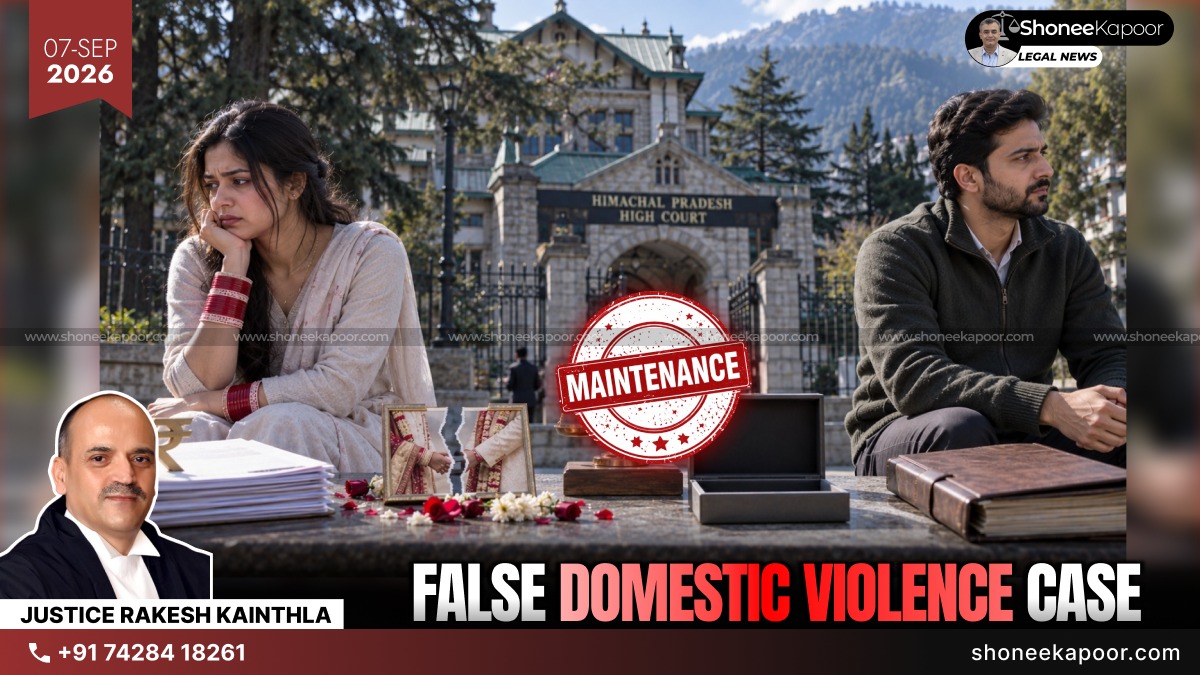
Wife Has Equal Income But Sought Maintenance In Just 6 Days Of Marriage: HP High Court Rejects Plea, Says Domestic Violence Not Proved

Curated by NEWS DESK
Editorial DeskCan a financially independent wife earning almost as much as her husband claim ₹40,000 monthly maintenance after the marriage lasted only six days? The Himachal Pradesh High Court refused relief after finding that the domestic violence allegations were not proved and both spouses had nearly equal financial standing.
HIMACHAL PRADESH: The Himachal Pradesh High Court has dismissed a wife’s plea seeking ₹40,000 per month as interim maintenance from her husband after noting that she failed to prove her allegations of domestic violence.
Justice Rakesh Kainthla also considered that both the husband and wife were working as Assistant Professors and had almost equal financial standing. The couple had separated only six days after their marriage.
The Court said:
“The wife is not entitled to any maintenance or any other relief on failure to prove the domestic violence, and learned courts below had rightly held that the applicant, having failed to prove the domestic violence, was not entitled to maintenance.”
The couple married in October 2023. According to the husband, his wife stayed at the matrimonial home for only around five days and treated him like a stranger. He alleged that she refused to cohabit with him, misbehaved with him and his family and even refused to participate in wedding photography.
The husband also maintained that the wife was herself employed as an Assistant Professor and alleged that the complaint filed against him was false.
The wife, however, alleged that her husband mistreated her, forced her to sleep on the floor, taunted her for bringing insufficient dowry, locked the kitchen and denied her access to food.
The trial court examined the circumstances and noted that the parties had been living separately since October 28, 2023, merely six days after marriage.
Importantly, a compromise deed executed in November 2023 recorded that the husband and wife had mutually agreed to live separately because of a misunderstanding. The courts found that this compromise contained no reference to domestic violence.
The trial court also accepted the husband’s version that he was treated like a stranger and was not allowed to consummate the marriage. It further found that the wife was financially independent and could maintain herself. Her maintenance application was therefore dismissed.
The wife challenged that order before the appellate court, but her appeal was also dismissed. She thereafter approached the Himachal Pradesh High Court in revision.
Before the High Court, she again relied upon her allegations of domestic violence and sought ₹40,000 monthly maintenance, claiming that her husband was an Assistant Professor in a government college earning approximately ₹1 lakh per month.
Her legal-aid counsel, Advocate Vijay Panchta, argued that she had faced continuous taunts and harassment at her matrimonial home and that, being the legally wedded wife, she was entitled to maintenance.
The High Court, however, found no evidence supporting the allegations of cruelty and also relied upon the compromise between the parties.
The Court observed:
“It is undisputed that the parties had entered into a compromise. Both the learned courts below referred to the compromise and found that the parties had agreed to separate from each other due to misunderstanding between them.”
The High Court ultimately found no reason to interfere with the lower courts' concurrent findings. It dismissed the wife’s revision petition and upheld the finding that she had failed to establish domestic violence and was therefore not entitled to maintenance or other relief on the case presented before the courts.
EXPLANATORY TABLE OF LAWS AND SECTIONS
| Law / Provision | What It Means | Relevance In This Case |
|---|---|---|
| Protection of Women from Domestic Violence Act, 2005 | Provides civil and monetary remedies to an aggrieved woman who establishes domestic violence in a domestic relationship. | The wife sought relief on allegations of domestic violence. The courts found that she failed to establish those allegations. |
| Section 20, Protection of Women from Domestic Violence Act, 2005 | Empowers a Magistrate to grant monetary relief, including maintenance, to meet expenses and losses suffered as a result of domestic violence. | The dispute concerned the wife’s claim for monetary maintenance based on alleged domestic violence. |
| Interim Monetary Relief under the DV Act | Courts can grant appropriate interim relief during the proceedings where the statutory requirements and facts justify it. | The wife sought ₹40,000 per month as interim maintenance, which the trial court and appellate court rejected, and the High Court ultimately did not grant. |
| Revisional Jurisdiction | Allows a superior court to examine the legality, correctness or propriety of an order passed by a subordinate court within the applicable statutory framework. | After losing before the courts below, the wife approached the Himachal Pradesh High Court through a revision petition. |
CASE DETAILS
| Particulars | Details |
|---|---|
| Case Title | Wife v. Husband |
| Court | High Court of Himachal Pradesh |
| Bench/Judge | Justice Rakesh Kainthla |
| Date of Order | September 3, 2026 |
| Proceeding | Revision petition concerning rejection of interim maintenance |
| Maintenance Claimed | ₹40,000 per month |
| Counsel for Petitioner-Wife | Advocate Vijay Panchta, Legal Aid Counsel |
KEY TAKEAWAYS
- A husband cannot be treated like an ATM merely because a marriage legally exists.
- The marriage lasted only six days, yet a ₹40,000 monthly maintenance claim still reached the High Court.
- When both spouses earn almost equally, forcing one side to financially maintain the other becomes difficult to justify.
- Allegations of domestic violence cannot become an automatic ticket to maintenance; they must be proved with evidence.
- Men also deserve protection from exaggerated financial claims arising out of extremely short and failed marriages.
Share Your Thoughts
Comments are moderated before publication.