
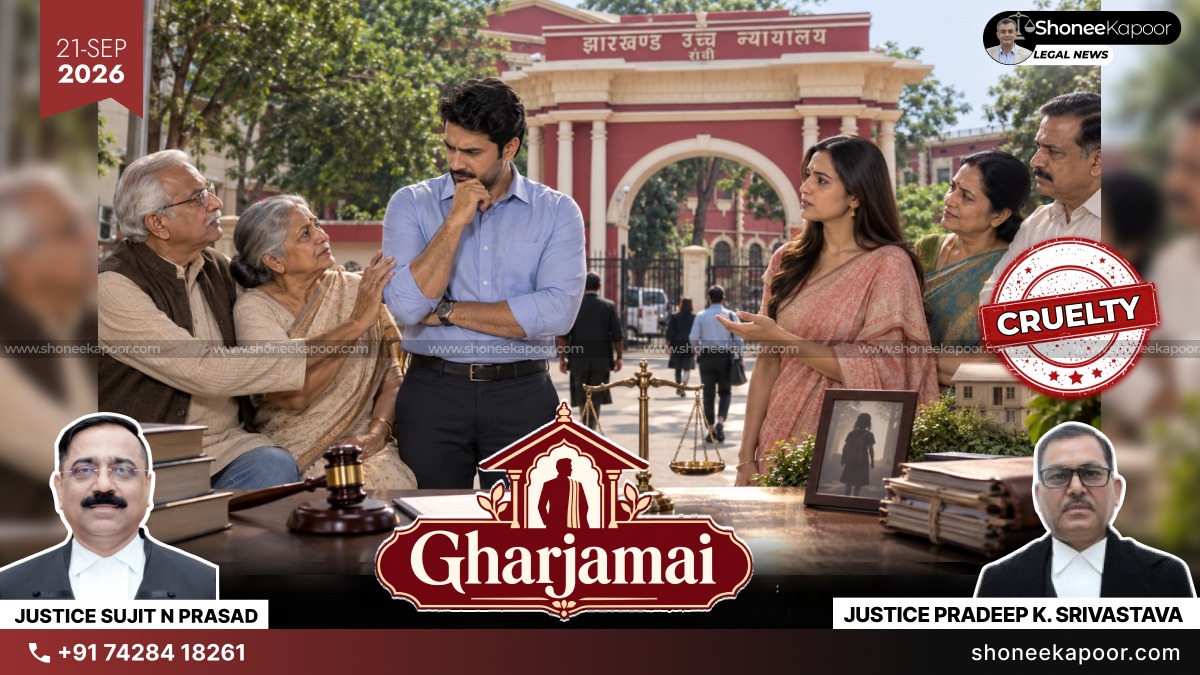
Wife Wanting Husband To Leave Aged Parents & Become ‘Gharjamai’ Is Not Cruelty? Jharkhand High Court Answers

Curated by NEWS DESK
Editorial DeskRANCHI: The Jharkhand High Court has dismissed a husband’s appeal seeking divorce on the ground of matrimonial cruelty, holding that his wife’s mere wish that he should live with her parents as a “gharjamai” cannot by itself constitute cruelty under the Hindu Marriage Act, 1955.
A Division Bench of Justice Sujit Narayan Prasad and Justice Sanjay Prasad upheld the Family Court’s decision refusing the husband a divorce. The parties were married on 21 November 2008 at Patna according to Hindu rites and customs. The couple had a daughter.
According to the husband, the marriage initially remained peaceful, but problems later started when his wife frequently visited her parental home. He alleged that his wife and her parents wanted him to leave his own parents and permanently live with them in Patna as a gharjamai.
The husband refused, stating that his parents were old and no one else could look after them. He claimed that the situation caused him mental pressure and social stigma. He further alleged that from February 2013, his wife stopped returning to the matrimonial home, started working in Patna and continued insisting that he should live with her family.
The wife did not appear before the Family Court despite service of notice, and the divorce proceedings went ex parte. However, the Family Court still found that the husband had failed to establish cruelty and dismissed his divorce petition.
The husband challenged this decision before the Jharkhand High Court.
While examining cruelty under Section 13(1)(ia) of the Hindu Marriage Act, the High Court said matrimonial cruelty must involve sufficiently serious conduct. Ordinary disagreements, incompatibility or routine friction between spouses cannot automatically become grounds for divorce.
The Court observed:
“In many marriages each party can, if it so wills, discover many a cause for complaint but such grievances arise mostly from temperamental disharmony. Such disharmony or incompatibility is not cruelty and will not furnish a cause for the dissolution of marriage.”
The High Court then examined the husband’s grievance regarding his wife frequently visiting her parental home. It held:
“…visiting parental house is as good as a right to every bride and it cannot be termed cruelty.”
On the husband’s principal allegation regarding the demand that he become a gharjamai, the Court noted that the concept of a gharjamai was an old practice prevailing in society. More importantly, it found no evidence showing that the husband had actually been forced or compelled to live at his in-laws’ house.
The Bench held:
“Mere wish of respondent-wife that the appellant-husband should live as Gharjamai will not constitute cruelty for the purpose of Hindu Marriage Act.”
Thus, the Court distinguished between a spouse merely expressing a wish about where the couple should live and conduct serious enough to legally constitute matrimonial cruelty.
The High Court also found an important evidentiary problem in the husband’s case. Although the wife did not contest the proceedings before the Family Court, the husband still had to prove the cruelty he alleged. An ex parte proceeding did not automatically establish his allegations.
After considering the evidence, the High Court concluded that the husband had failed to substantiate the alleged cruelty. It observed:
“The issue of cruelty as has been alleged by the appellant-husband against his wife could not be proved, and the learned Family Judge has rightly observed that visiting the parental house is as good as a right to every bride and mere wish of respondent-wife that the appellant husband should live as Gharjamai will not constitute cruelty for the purpose of Hindu Marriage Act.”
The Court therefore found no reason to interfere with the Family Court’s decision and dismissed the husband’s appeal, leaving the refusal of divorce intact.
EXPLANATORY TABLE OF LAWS AND SECTIONS
| Law / Section | What It Means | Relevance To The Case |
|---|---|---|
| Section 13(1)(ia), Hindu Marriage Act, 1955 | Allows divorce where one spouse has treated the other with cruelty after marriage. | The husband sought divorce alleging that the wife’s conduct, including wanting him to live as a gharjamai, caused him mental cruelty. The Court held that the alleged conduct was not proved and a mere wish to make him a gharjamai was insufficient. |
| Section 19, Family Courts Act, 1984 | Provides for appeals to the High Court against specified judgments and orders of a Family Court. | The husband approached the Jharkhand High Court challenging the Family Court judgment refusing him divorce. |
| Section 7(1), Family Courts Act, 1984 | Gives Family Courts jurisdiction over matrimonial and specified family disputes. | The original divorce proceedings were decided by the Family Court. |
| Section 96, Code of Civil Procedure, 1908 | Contains the general framework for appeals from original civil decrees. | The judgment referred to the appellate principles applicable while examining the Family Court decree. |
CASE DETAILS
| Particular | Details |
|---|---|
| Case Title | Rahul Choubey v. Poonam Pathak |
| Court | High Court of Jharkhand at Ranchi |
| Case No. | F.A. No. 86 of 2022 |
| Neutral Citation | 2026:JHHC:28010-DB |
| Bench | Justice Sujit Narayan Prasad and Justice Sanjay Prasad |
| Judgment By | Justice Sujit Narayan Prasad |
| Reserved On | 25 August 2026 |
| Pronounced On | 15 September 2026 |
| Counsel For Husband/Appellant | Advocate Shekhar Prasad Gupta |
| For Wife/Respondent | Advocate Atanu Banerjee, Amicus Curiae |
| Result | Husband’s appeal dismissed; Family Court’s refusal to grant divorce upheld |
KEY TAKEAWAYS
- Wife stayed absent, but the husband still had to prove cruelty.
- Wife wanted him to leave his aged parents and become a gharjamai. The court said mere wish is not cruelty.
- Husband alleged mental pressure, but could not prove force or compulsion.
- Wife frequently visiting her parental home was not treated as cruelty.
- Even in an ex parte case, there is no automatic divorce for the husband. His appeal was dismissed.
Share Your Thoughts
Comments are moderated before publication.