
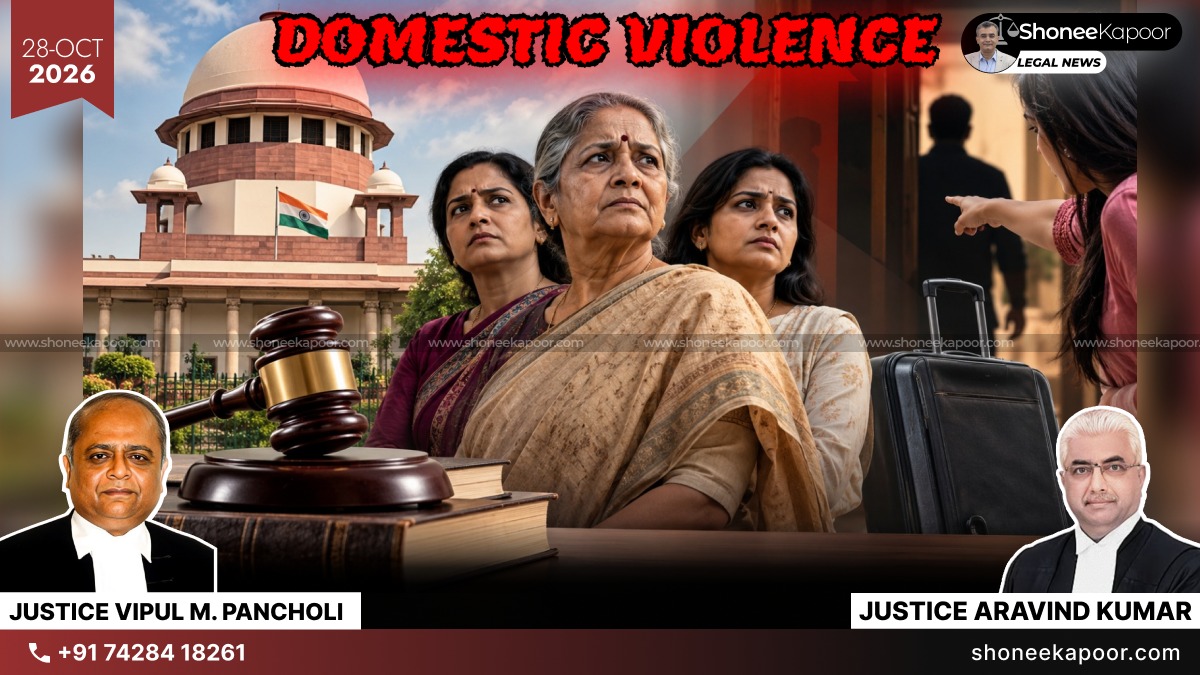
Husband’s Female Relatives Cannot Be Evicted From Shared Household Over His Non-Appearance In Domestic Violence Case: Supreme Court

Curated by NEWS DESK
Editorial DeskNEW DELHI: The Supreme Court of India has held that a husband's female relatives cannot be evicted from a shared household merely because he fails to appear in proceedings under the Protection of Women from Domestic Violence Act, 2005.
A Bench of Justice Aravind Kumar and Justice Vipul M. Pancholi examined the legal protection available to women under Section 19(1)(b) of the Domestic Violence Act.
The case concerned a criminal appeal filed by Shahjahan and other female relatives, including the complainant's mother-in-law and sisters-in-law, challenging orders affecting their right to reside in the shared household.
The dispute arose during domestic violence proceedings filed by the complainant. The husband's failure to appear became a ground for action against his female family members, despite the separate legal protection available to them.
The Magistrate had ordered the removal of the female relatives from the shared household. The matter eventually reached the Supreme Court after High Court proceedings involving the attachment of property.
The Supreme Court examined Section 19(1)(b) of the Domestic Violence Act, 2005, which allows a Magistrate to direct a respondent to leave the shared household while passing a residence order.
However, the provision expressly prohibits such removal orders against women.
The Bench highlighted the statutory wording:
“Provided no order under clause (b) shall be passed against any person who is a woman,”
The Supreme Court treated this proviso as decisive, making it clear that a mother-in-law or sister-in-law cannot be evicted under Section 19(1)(b) merely because the complainant's husband failed to appear in court.
The Court found that the Magistrate had erred in ordering the removal of the husband's female relatives from the residential premises.
The Supreme Court clarified that a wife's domestic violence complaint does not automatically justify removing every member of her husband's family from the shared household. Residence orders must follow the restrictions imposed by law.
The Court consequently held that the mother-in-law and sisters-in-law could not be removed from their shared household merely because the husband failed to appear in domestic violence proceedings.
EXPLANATORY TABLE OF LAWS AND SECTIONS
| Law / Section | What It Means | Relevance |
|---|---|---|
| Section 2(s), DV Act, 2005 | Defines a shared household. | Helps determine which residence the Act covers. |
| Section 12, DV Act | Allows applications for relief before a Magistrate. | Governs applications seeking domestic violence remedies. |
| Section 17, DV Act | Protects women's rights to reside in a shared household. | Relevant to the residence rights of female family members. |
| Section 19(1)(b), DV Act | Allows removal of a respondent from the shared household, but expressly excludes women from this particular order. | Central statutory safeguard behind the reported ruling. |
| Section 23, DV Act | Permits interim and ex parte orders in appropriate circumstances. | Relevant to orders made when proceedings have not been fully contested. |
CASE DETAILS
| Particular | Details |
|---|---|
| Case Title | Husband’s Female Relatives’ Eviction in DV Case |
| Court | Supreme Court of India |
| Bench | Justice Aravind Kumar and Justice Vipul M. Pancholi |
| Case Type | Criminal Appeal |
| Appellants | Mother-in-law and Sisters-in-law of the Complainant |
| Issue | Whether female relatives can be evicted from a shared household due to the husband's non-appearance in domestic violence proceedings |
| Supreme Court Finding | Female relatives cannot be removed from the shared household merely because the husband failed to appear |
| Result | Supreme Court held that the Magistrate had erred in ordering the removal of the female relatives |
KEY TAKEAWAYS
- Husband’s Family Cannot Be Punished: His non-appearance cannot justify evicting his mother or sisters.
- DV Act Has Legal Limits: Section 19(1)(b) expressly protects female relatives from eviction orders under this provision.
- No Collective Punishment: Legal proceedings against a husband cannot automatically deprive his family members of their rights.
- In-Laws Have Rights Too: A wife’s domestic violence complaint does not override the statutory protection given to her female in-laws.
- Safeguard Against Legal Overreach: The Supreme Court reinforces that domestic violence proceedings must not be used to unlawfully remove a husband’s female relatives from their home.
Share Your Thoughts
Comments are moderated before publication.