
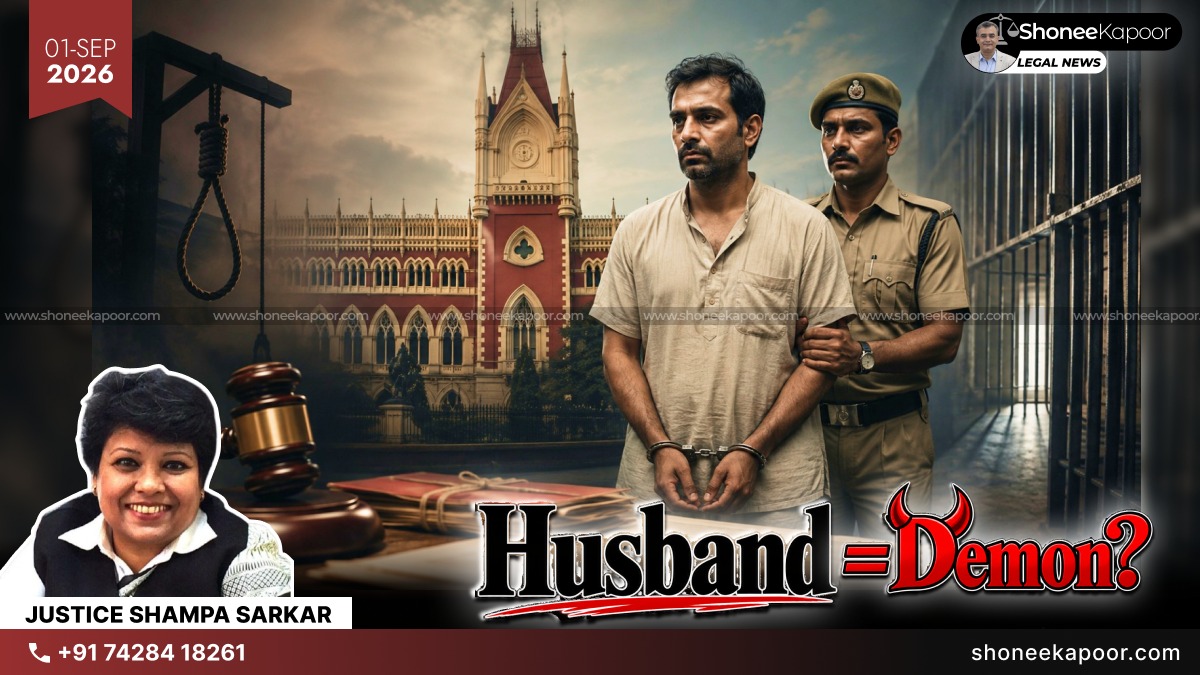
Man Called A “Demon” And Sentenced To Death Over Marriage Vows? Calcutta High Court Says Trial Court Failed To Properly Examine Reform

Curated by NEWS DESK
Editorial DeskCan a man be sentenced to death after being called a “demon” without properly examining whether he can reform? The Calcutta High Court upheld the murder conviction but found that key mitigating factors were ignored before imposing the death penalty.
JALPAIGURI: The Calcutta High Court has set aside the death sentence awarded to a man convicted of murdering his wife, holding that the Trial Court failed to properly examine his possibility of reformation and rehabilitation before sending him to the gallows.
A Division Bench of Justice Shampa Sarkar and Justice Smita Das De upheld the conviction of Sujit Dey Bhowmik under Sections 302 and 307 IPC, but commuted his death sentence to rigorous imprisonment for life. The High Court found that the prosecution had proved the murder and attack on the wife’s family members beyond reasonable doubt.
The case arose from an incident dated June 20, 2023. According to the prosecution, Sujit attacked his wife, Mitali Dey Bhowmik, with an axe at her parental home following a quarrel. Their seven-year-old son was present. When the woman’s mother and grandmother tried to intervene, they were also attacked.
The Trial Court convicted Sujit for murder and attempt to murder. It sentenced him to death under Section 302 IPC and imposed life imprisonment with a fine of ₹1 lakh under Section 307 IPC. However, the court acquitted him of the charges under Sections 498A and 326 IPC. The court also acquitted two other accused, Dilip Dey Bhowmik and Sadhan Dey Bhowmik, of the Section 498A charge.
While imposing the extreme punishment, the Trial Court placed significant reliance on the Vedic Mantras and marital vows exchanged during a Hindu marriage. It reasoned that Sujit had forgotten the “love, affection, contribution and sacrifice” of his wife and treated the crime as falling within the “rarest of ‘rare’” category. It also described him as a “demon” whose mind could not be changed even through training and spiritual lectures in prison.
The High Court disagreed with this approach to sentencing.
“The learned Judge stressed on the Vedic Mantras chanted by the spouses at the time of marriage and arrived at the conclusion that, as the appellant did not hesitate to murder his wife and chose to forget the love, affection, contribution and sacrifice of his spouse, this was a rarest of ‘rare’ case to award death penalty...Thus, according to the trial court, the appellant was a ‘demon ’, and his mind could not be changed even if he was given training and spiritual lectures in the correctional home. We do not agree to the death penalty. Every person guilty of commission of a grave offence can undergo transformation,” the Court said.
The Bench found a significant procedural irregularity in the sentencing exercise. The Trial Court had not called for Sujit’s prison conduct report or examined his mental condition and possibility of rehabilitation before imposing the death sentence.
The report later obtained from the Probation Officer showed that Sujit’s conduct in custody was satisfactory, he was undergoing counselling and there was a possibility of reform. He had no previous criminal antecedents, had a minor son and was also responsible for an elderly mother. The Trial Court also did not consider his socio-economic background.
The High Court further noted that the incident might not have been pre-determined or premeditated. Sujit, his wife and other family members had taken morning tea together, and the incident happened about half an hour after breakfast following a quarrel. These circumstances were relevant while deciding whether a convicted man should receive the irreversible punishment of death.
The Bench stressed that
“Rigorous imprisonment for life is the rule and death sentence is an exception.”
It found that the Trial Court had failed to extract and properly balance the mitigating circumstances and that its special reasons for awarding death were “entirely based on the rituals of a Hindu Marriage.”
Relying on the Supreme Court’s decisions on capital punishment, including Bachan Singh v. State of Punjab, Machhi Singh v. State of Punjab, Manoj v. State of Madhya Pradesh and Aman Singh v. State of Bihar, the High Court reiterated that courts must consider both the crime and the circumstances of the offender before imposing the extreme penalty.
The Court noted that in death penalty cases, information regarding reformation and rehabilitation, prison conduct and psychiatric or psychological evaluation must be considered, while the accused must also receive a meaningful opportunity to respond to such material.
The High Court did not dilute the seriousness of the offence. It specifically recorded that killing his wife in front of their seven-year-old son and attacking her family members were serious aggravating circumstances. However, those circumstances had to be balanced against the absence of criminal antecedents, satisfactory prison conduct, socio-economic background and possibility of reform.
Accordingly, while the conviction under Sections 302 and 307 IPC remained intact, the High Court refused to confirm the death sentence and commuted it to rigorous imprisonment for life. The Court directed that the period already spent in custody be set off against the substantive sentence under Section 428 CrPC.
EXPLANATORY TABLE OF LAWS AND SECTIONS
| Law / Section | What It Means | Relevance In This Case |
|---|---|---|
| Section 302 IPC | Punishment for murder; provides for death or imprisonment for life and fine. | Sujit was convicted for murdering his wife. The Trial Court awarded death; the High Court maintained the conviction but commuted the punishment to rigorous imprisonment for life. |
| Section 307 IPC | Punishment for attempt to murder. | Sujit was convicted for attacking the victim’s family members and was awarded life imprisonment with a ₹1 lakh fine. |
| Section 498A IPC | Punishment for cruelty by husband or relatives of husband against a married woman. | Sujit was acquitted of this charge. Dilip Dey Bhowmik and Sadhan Dey Bhowmik were also acquitted under Section 498A. |
| Section 326 IPC | Deals with voluntarily causing grievous hurt by dangerous weapons or means. | The Trial Court acquitted Sujit of this charge. |
| Section 235(1) CrPC | Permits acquittal after trial before a Court of Session where the accused is found not guilty. | The accused were acquitted of the relevant Section 498A/326 charges under this provision. |
| Section 235(2) CrPC | Requires the convicted accused to be heard on the question of sentence. | Sujit’s convictions under Sections 302 and 307 IPC resulted in sentencing under this framework. |
| Section 161 CrPC | Deals with examination of witnesses by police during investigation. | The Investigating Officer also recorded the appellant’s statement concerning the alleged recovery of the axe. |
| Section 164 CrPC | Provides for recording statements/confessions before a Magistrate. | The Court recorded statements of important prosecution witnesses, including the minor son, under this provision. |
| Section 313 CrPC | Gives an accused an opportunity to personally explain incriminating evidence appearing against him. | Sujit was examined under this provision; the judgment noted his response regarding recovery of the weapon. |
| Section 27, Indian Evidence Act | Makes a limited portion of information received from an accused in custody admissible when it distinctly relates to a discovered fact. | The defence questioned the alleged disclosure and recovery of the axe under this provision. |
| Section 65B, Indian Evidence Act | Governs certification and admissibility of electronic records. | It was invoked regarding electronic material concerning photographs/footage connected with the recovery. |
| Section 428 CrPC | Allows detention already undergone during investigation/trial to be set off against the term of imprisonment. | The High Court ordered Sujit’s detention already undergone to be set off against his substantive punishment. |
CASE DETAILS
| Particular | Details |
|---|---|
| Case Title / Death Reference | State of West Bengal v. Sujit Dey Bhowmik |
| Connected Appeal | Sujit Dey Bhowmik v. State of West Bengal |
| Court | High Court at Calcutta, Circuit Bench at Jalpaiguri |
| Jurisdiction | Criminal Appellate Jurisdiction |
| Criminal Appeal | C.R.A. (DB) 32 of 2025 |
| Bench | Justice Shampa Sarkar and Justice Smita Das De |
| Trial Court | Additional Sessions Judge, 3rd Court, Jalpaiguri |
| Sessions Case | Sessions Case No. 11 of 2024 |
| Counsel in D.R. 3/2025 | Mr Aniruddha Biswas, Mr Subham Chanda, Mr Monoj Saha and Mr Kanak Mishra |
| Counsel for Appellant in CRA(DB) 32/2025 | Mr. Anirban Banerjee |
| Counsel for State | Mr Aditi Shankar Chakraborty (erstwhile APP), Mr Abhijit Sarkar and Dr Arjun Chowdhury |
KEY TAKEAWAYS
- A man was branded a “demon” and sentenced to death without properly examining his chance of reform.
- The Calcutta High Court upheld the conviction, but rejected death based on moral outrage and marital rhetoric.
- The Trial Court relied heavily on Hindu marriage vows and what the husband allegedly failed to honour.
- No criminal past, good jail conduct, counselling and possibility of reform were ignored.
- The Court reiterated: life imprisonment is the rule, death is the exception. Even a guilty man cannot be sent to the gallows through emotional sentencing.
Share Your Thoughts
Comments are moderated before publication.