
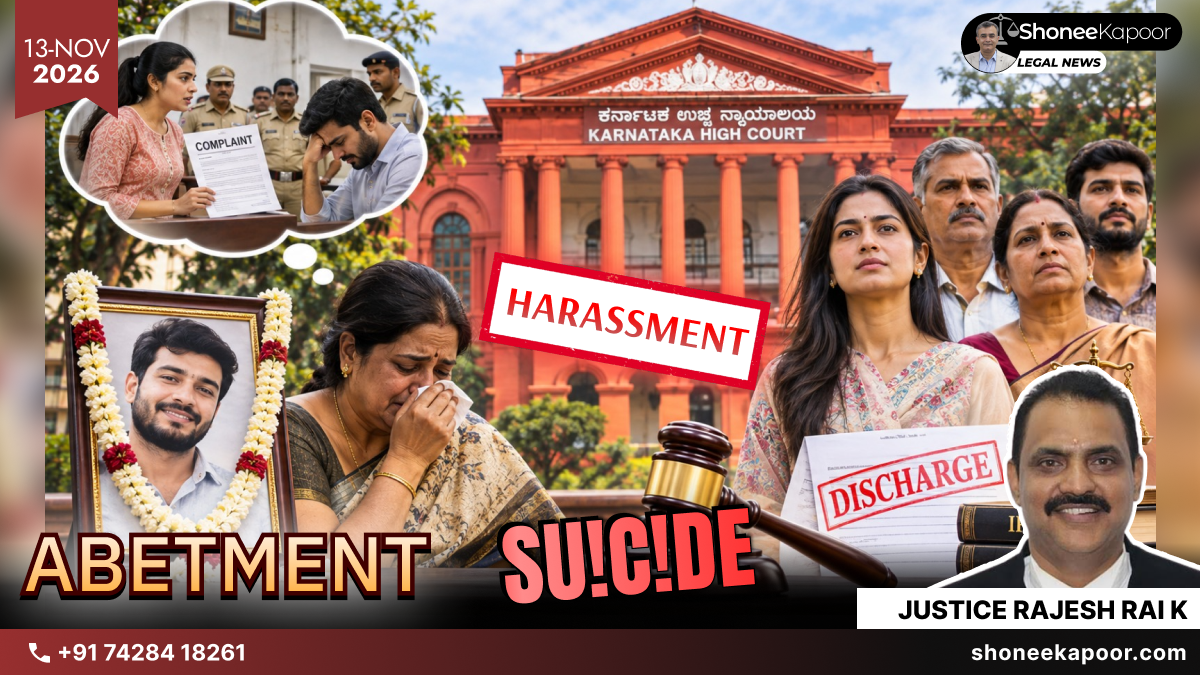
Wife Filing Harassment Complaints Against Husband Amounts To Abetment Of Suicide? Karnataka High Court Answers

Curated by NEWS DESK
Editorial DeskKARNATAKA: The Karnataka High Court has discharged a wife and three of her family members in a husband's suicide case, holding that merely filing a harassment complaint against a husband does not amount to abetment of suicide under Section 306 IPC without evidence of instigation or criminal intent.
Justice Rajesh Rai K, in an order dated 29 October 2026, set aside the Sessions Court's decision refusing discharge to the accused, finding that the essential ingredients of abetment of suicide were missing.
The couple married in 2020, and their relationship remained cordial for about a year before matrimonial disputes began. They later shifted to a rented house in Bengaluru.
In January 2022, the wife went to her parental home and did not return. On 4 March 2022, she filed a harassment complaint against her husband and mother-in-law at the Shivajinagar Women Police Station.
Police summoned the parties and advised them to resolve their disputes. The husband and his mother subsequently obtained anticipatory bail on 18 April 2022.
According to the husband's mother, when they visited the police station to comply with bail conditions, police officers allegedly threatened to send them to jail. The husband was also allegedly told that he had committed an offence under Section 377 IPC.
The following day, 19 April 2022, the husband died by suicide. His mother alleged that the wife's complaint and subsequent police threats had driven him to take the extreme step.
Police registered a case under Section 306 read with Section 34 IPC against the wife and three of her family members. After investigation, a chargesheet was filed.
The accused sought discharge under Section 227 CrPC, but the Sessions Court rejected their application on 25 October 2024. They subsequently approached the Karnataka High Court.
Before the High Court, the accused argued that there was no direct act of instigation or intentional assistance linking them to the husband's suicide. They also pointed out that the police officers who allegedly threatened him had not been made accused.
The complainant opposed their discharge, alleging that the wife had filed a false complaint and threatened to implicate the husband under Section 377 IPC. She relied on witness statements alleging harassment by the accused.
After examining the records, the High Court found that the original complaint specifically referred to alleged police threats, rather than any direct instigation by the wife or her family.
The Court also noted that an alleged threat by the wife's mother occurred in February 2022, nearly two months before the husband's death. There was insufficient proximity between that allegation and the suicide.
Referring to the Supreme Court's judgment in Geo Varghese v. State of Rajasthan, the Court reiterated:
"Mere allegation of harassment of the deceased by another person would not be sufficient in itself"
The High Court further relied on Mariano Anto Bruno v. Inspector of Police, where the Supreme Court held:
"To convict a person under Section 306 IPC, there has to be clear mens rea to commit offence."
The Court also referred to Nipur Aneja v. State of Uttar Pradesh, emphasising the need to prevent unnecessary criminal prosecutions without sufficient supporting material.
Applying these principles, the High Court held that a wife's harassment complaint alone cannot establish abetment of her husband's suicide unless the prosecution demonstrates intentional instigation or assistance.
The Court further observed that continuing criminal proceedings based on frivolous or vexatious allegations can seriously damage an accused person's reputation.
Finding no prima facie evidence of abetment, the Karnataka High Court allowed the petition, set aside the Sessions Court's order and discharged the wife and her three family members from the offences under Section 306 read with Section 34 IPC.
Read Also:- Anticipatory Bail Application Format Under Section 482 BNSS: PDF & Affidavit
EXPLANATORY TABLE OF LAWS AND SECTIONS
| Law / Section | What It Means | Application In This Case |
|---|---|---|
| Section 306 IPC | Punishes abetment of suicide with imprisonment up to 10 years and fine. | No prima facie evidence of abetment was found. |
| Section 107 IPC | Defines abetment through instigation, conspiracy or intentional aid. | Essential ingredients were missing. |
| Section 34 IPC | Establishes joint criminal liability for acts done with common intention. | Invoked with Section 306 IPC. |
| Section 377 IPC | Criminalised specified sexual acts, subject to constitutional limitations. | Alleged threat of prosecution was mentioned. |
| Section 227 CrPC | Allows discharge where sufficient grounds to proceed are absent. | Discharge application ultimately allowed. |
| Section 482 CrPC / Section 528 BNSS | Recognises the High Court's inherent power to prevent abuse of the process of court. | Invoked to challenge the criminal proceedings. |
| Article 226, Constitution | Gives High Courts writ jurisdiction. | Discussed in the cited Supreme Court precedent. |
CASE DETAILS
| Particular | Details |
|---|---|
| Case Title | D v. State Of Karnataka & ANR |
| Court | Karnataka High Court, Bengaluru |
| Bench | Justice Rajesh Rai K |
| Judgment Date | 29 October 2026 |
| Neutral Citation | 2026:KHC:60154 |
| Case Number | Criminal Petition No. 13604 of 2024 |
| CNR Number | KAHC010687882024 |
| Petitioners' Counsel | Advocate Lokesha A.N. |
| State Counsel | Mahesha P., HCGP |
| Complainant's Counsel | Advocate Prakash M.H. |
| FIR Number | Crime No. 116/2022 |
| Sessions Case | S.C. No. 1557/2023 |
| Decision | Wife and three family members discharged from abetment of suicide charges. |
KEY TAKEAWAYS
- Wife's Complaint, Husband's Suicide: A harassment complaint preceded the husband's death, but the Court held that filing such a complaint alone does not establish abetment.
- Husband Faced Alleged Police Threats: A day after allegedly being threatened with jail, the husband died by suicide. The allegations raised serious questions about police conduct.
- Harassment Alone Is Not Abetment: Section 306 IPC requires evidence of instigation or intentional aid. Mere allegations cannot replace proof of criminal intent.
- Husband Lost His Life, Questions Remain: The Court examined the alleged police threats but found insufficient evidence to prosecute the wife and her relatives for abetment.
- Wife and Three Relatives Discharged: Despite the husband's tragic death, the Karnataka High Court found no prima facie case of abetment against the four accused and discharged them.
Share Your Thoughts
Comments are moderated before publication.