
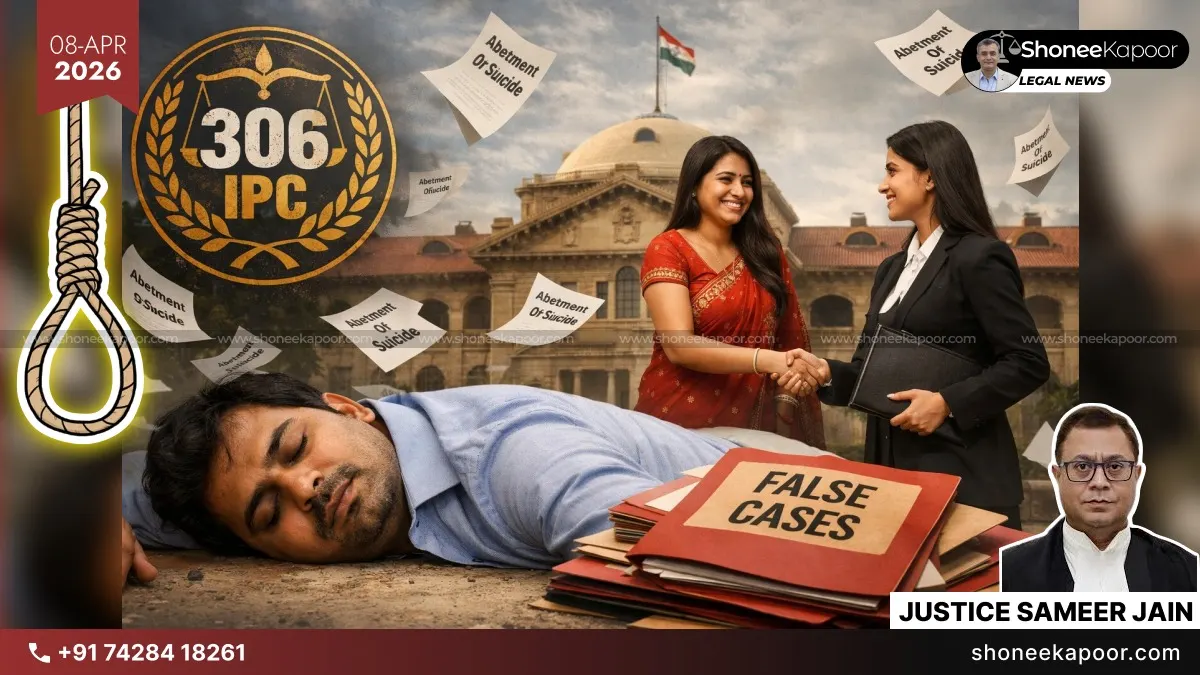
306 IPC | Filing False Cases Against Husband Not Abetment Of Suicide: Allahabad High Court Grants Relief To Wife

Curated by NEWS DESK
Editorial DeskCan filing multiple cases push someone to suicide—and still not be a crime? Allahabad High Court answers this, but leaves a bigger question on accountability unanswered.
PRAYAGRAJ: The Allahabad High Court has held that merely filing cases against a husband, even if those cases are alleged to be false, does not automatically amount to abetment of suicide under Section 306 IPC.
The Court made it clear that for an offence under Section 306 IPC, there must be clear “mens rea” (guilty intention). Just filing complaints or legal cases, by itself, is not enough to prove that the accused intended the husband to take his own life.
A single-judge bench of Justice Sameer Jain quashed the criminal proceedings against the wife and her family members. The Court found that there was no material on record to show that they had any intention to instigate or force the husband to commit suicide.
The Court observed:
“…in view of this Court merely by lodging cases even false cases it cannot be said that applicants were having mens rea to abet the deceased to commit suicide”.
The Court also noted that even if the husband was under stress due to these cases, it cannot be assumed that suicide was the only option available to him.
The case arose from an FIR filed by the father of the deceased in August 2022. He alleged that the wife was pressuring his son for a share in ancestral property. When he refused, she and her relatives allegedly started harassing him and filed multiple false cases.
It was claimed that due to these legal battles, the deceased had to leave his job and was living under extreme stress. In July 2022, he died by suicide using a firearm.
During investigation, police recovered a suicide note. In the note, the deceased mentioned that he was under severe distress due to alleged harassment and false cases filed by the wife and her family over the past two years, which pushed him towards suicide.
Based on this, police filed a charge-sheet under Section 306 IPC, and the trial court took cognizance and issued summons.
The wife and her family then approached the High Court seeking quashing of the proceedings.
Their counsel argued that even if a husband commits suicide because of cases filed by his wife, that alone does not make the wife legally liable for abetment. It was also argued that for Section 306 IPC to apply, it must be shown that the deceased had no other option except suicide, which was not proven in this case.
On the other hand, the State and the complainant argued that the level of harassment was such that the deceased was left with no choice but to end his life.
After examining the law, the High Court emphasized that abetment of suicide requires clear instigation or active involvement. Simply being involved in legal disputes or filing cases does not meet this threshold.
The Court also relied on the Supreme Court judgment in Amalendu Pal vs State of West Bengal, stating that even if a person is under stress, it cannot be assumed that suicide was the only option.
Further, referring to Kamaruddin Dastagir Sanadi vs State of Karnataka, the Court noted that disputes in matrimonial life are common, and suicide depends largely on the mental condition of the individual.
The Court concluded that there was no evidence showing any guilty intention on the part of the wife or her relatives. Therefore, the charge-sheet was legally unsustainable.
Accordingly, the High Court quashed the charge-sheet and all pending criminal proceedings against the wife and her family members.
While the ruling clarifies the legal threshold for abetment of suicide, it also reflects how courts strictly interpret “mens rea,” even in situations where prolonged legal disputes and allegations may have serious personal consequences.
Explanatory Table – Laws & Sections Involved
| Law / Section | Provision | Key Legal Requirement | Court’s Interpretation in This Case |
| Section 306 IPC | Abetment of Suicide | Must prove instigation, conspiracy, or intentional aid | Mere filing of cases, even if false, does not establish abetment |
| Section 107 IPC (implicit) | Definition of Abetment | Requires instigation or intentional aiding | No evidence of active instigation found |
| Mens Rea (Legal Principle) | Guilty intention | Essential element for criminal liability | Not established against wife or relatives |
| Amalendu Pal v. State of West Bengal (SC) | Precedent on 306 IPC | Suicide must be direct result of accused’s actions | Applied to hold no direct nexus here |
| Kamaruddin Dastagir Sanadi v. State of Karnataka (SC) | Matrimonial disputes principle | Domestic discord common; suicide depends on mental state | Reinforced absence of liability |
Case Details
- Case Title: Wife & Ors. vs State of Uttar Pradesh & Anr. (Exact title as per order copy)
- Court: Allahabad High Court
- Bench: Justice Sameer Jain (Single Judge Bench)
Key Takeaways
- Filing multiple cases, even if false, is not enough to prove abetment of suicide under Section 306 IPC.
- Courts require clear mens rea—intent to push a person towards suicide—not just legal harassment or disputes.
- A suicide note blaming harassment is not sufficient unless direct instigation is proven.
- Prolonged litigation pressure and personal distress still fall outside criminal liability without strict legal proof.
- The burden of proof remains so high that systemic pressure on men often goes legally unrecognized.
This Could Change Your Case-Get FREE Legal Advice-Click Here!
Disclaimer: The views and opinions expressed in this article are those of the Indian courts and do not necessarily reflect the official policy or position of “ShoneeKapoor.com” or its affiliates. This article is intended for informational and educational purposes only. The content provided is not legal advice, and viewers should not act upon this information without seeking professional counsel. Viewer discretion is advised.
Related Articles
Legal Mistakes Men Make During Divorce: Costly Errors That Destroy Cases
Costly legal mistakes Indian men make during divorce, maintenance, custody, 498A/BNS cruelty cases and evidence colle...
Delhi Judge Aman Sharma Suicide Case: Real Truth Exposed With Timeline
Full timeline of Delhi Judge Aman Sharma suicide case, family allegations, FIR under BNS Section 108, legal position ...
Anticipatory Bail Application Format Under Section 482 BNSS: PDF & Affidavit
Download anticipatory bail application format under Section 482 BNSS with affidavit, grounds, court procedure, condit...
Share Your Thoughts
Comments are moderated before publication.