
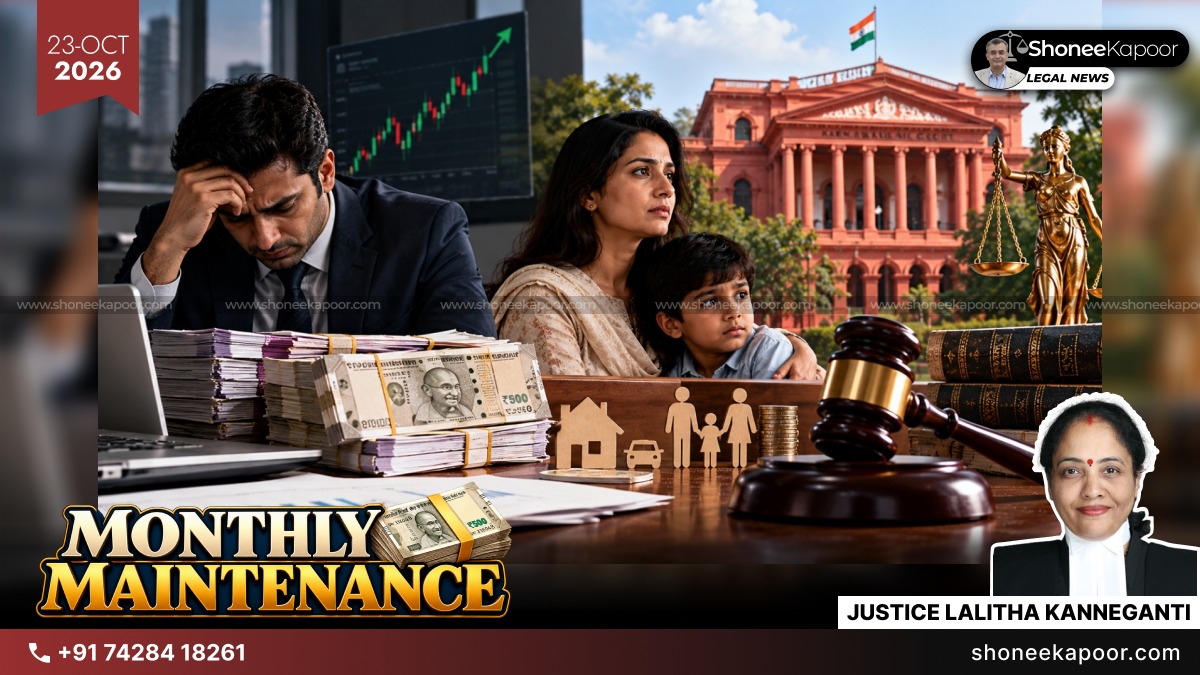
Husband’s Share Sale Earnings Count As Income For Maintenance: Karnataka High Court Raises Wife And Son's Monthly Maintenance To ₹1.2 Lakh

Curated by NEWS DESK
Editorial DeskKARNATAKA: The Karnataka High Court has increased the monthly maintenance a husband must pay to his wife and minor son from ₹50,000 to ₹1.2 lakh, holding that earnings from selling company shares must also count as income, even if the amount isn't received every month.
Justice Lalitha Kanneganti, in an order dated September 24, 2026, allowed the wife's petition for higher maintenance and dismissed the husband's petition to reduce it.
The dispute arose after the Bengaluru Family Court, on January 8, 2026, directed the husband to pay ₹50,000 monthly towards maintenance for his wife and minor son from August 2025, along with their school fees.
The wife, who earlier earned around ₹83,450 monthly, had lost her job due to company restructuring. She sought ₹1,75,438 monthly maintenance, citing household expenses, loan EMIs, childcare and medical needs.
The husband, employed with a private technology company, argued that the maintenance amount was excessive. He submitted that his monthly expenses were around ₹1.97 lakh, including housing loans and financial responsibilities towards his elderly parents and other dependants.
His counsel further argued that after taxes, expenses, and the interim maintenance payment of ₹40,000, he was left with only around ₹50,363 per month.
The husband also maintained that ₹28.42 lakh received through stock-related benefits should not be treated as regular salary because such earnings were variable. He submitted that money received from selling shares had been used to repay property loans.
However, the wife argued that the husband's financial records showed annual earnings of around ₹20 lakh to ₹28 lakh from selling shares, which should be included while calculating his actual financial capacity.
Rejecting the husband's argument, the High Court observed:
"This Court has perused the income tax returns, and every year he is getting an amount of Rs. 20 to 28 lakhs by selling the shares, and it is part of the husband's income, though he may not be getting it every month. That has to be considered as his income."
The Court also considered the wife's medical records showing that she suffered from glaucoma and an autoimmune disease, affecting her ability to work. It noted her claimed monthly expenses of ₹1,75,438, including ₹47,106 towards loan EMIs.
The High Court found that the earlier maintenance amount was insufficient for the wife and child, despite the husband's existing financial commitments.
Accordingly, the Court enhanced maintenance to ₹1,20,000 per month, payable from the date of the Family Court's order dated January 8, 2026.
The husband was also directed to pay ₹30,000 per month for the earlier period, reimburse the child's educational expenses for 2024–25, and continue paying school expenses.
The Court directed payment of arrears within four weeks of receiving the order. It also clarified that either party could seek modification if circumstances changed, including if the husband could no longer pay.
EXPLANATORY TABLE OF LAWS AND SECTIONS
| Law / Section | What It Means | Application in This Case |
|---|---|---|
| Section 38, Special Marriage Act, 1954 | Provides for interim maintenance and educational expenses of minor children in proceedings under the Act. | Cited in the judgment in connection with the wife's maintenance claim for herself and her minor son. |
| Articles 226 and 227, Constitution of India | Give High Courts writ jurisdiction and supervisory powers over subordinate courts. | Both spouses challenged the Family Court's maintenance order before the High Court. |
| Section 151, Code of Civil Procedure, 1908 | Recognises the court's inherent powers to pass orders necessary for justice. | The wife was permitted to file an appropriate application if the husband failed to pay the arrears. |
CASE DETAILS
| Particular | Details |
|---|---|
| Case Title | X v. Y |
| Court | Karnataka High Court, Bengaluru |
| Bench | Justice Lalitha Kanneganti |
| Date of Order | September 24, 2026 |
| Case Numbers | WP No. 5358/2026 (GM-FC) and WP No. 4253/2026 (GM-FC) |
| Neutral Citation | 2026:KHC:53083 |
| CNR Number | KAHC010110232026 |
| Wife's Counsel | Advocates Nishan G.K. and Vijaylaxmi; Advocate Skand Arun Kumar |
| Husband's Counsel | Senior Advocate B.V. Shankar Narayana Rao, Advocate Dharani Krishna D. |
| Final Decision | Wife's petition allowed; husband's petition dismissed; monthly maintenance enhanced to ₹1.2 lakh |
KEY TAKEAWAYS
- Husband's Maintenance Burden More Than Doubled: Karnataka High Court increased monthly maintenance from ₹50,000 to ₹1.2 lakh for the wife and minor son.
- Stock Sale Earnings Count as Income: The Court included ₹20–28 lakh earned annually from selling shares, despite such income not being received every month.
- Husband's Financial Liabilities Did Not Prevent Enhancement: Housing loans, elderly parents' expenses and other financial responsibilities were insufficient to secure a reduction.
- Husband's Plea Rejected, Wife's Plea Allowed: Despite claiming that only ₹50,363 remained monthly after expenses and deductions, the husband faced a higher maintenance order.
- Financial Burden Extends Beyond Monthly Maintenance: The husband must also pay school expenses and maintenance arrears, though he can seek modification if his financial circumstances change.
Share Your Thoughts
Comments are moderated before publication.