
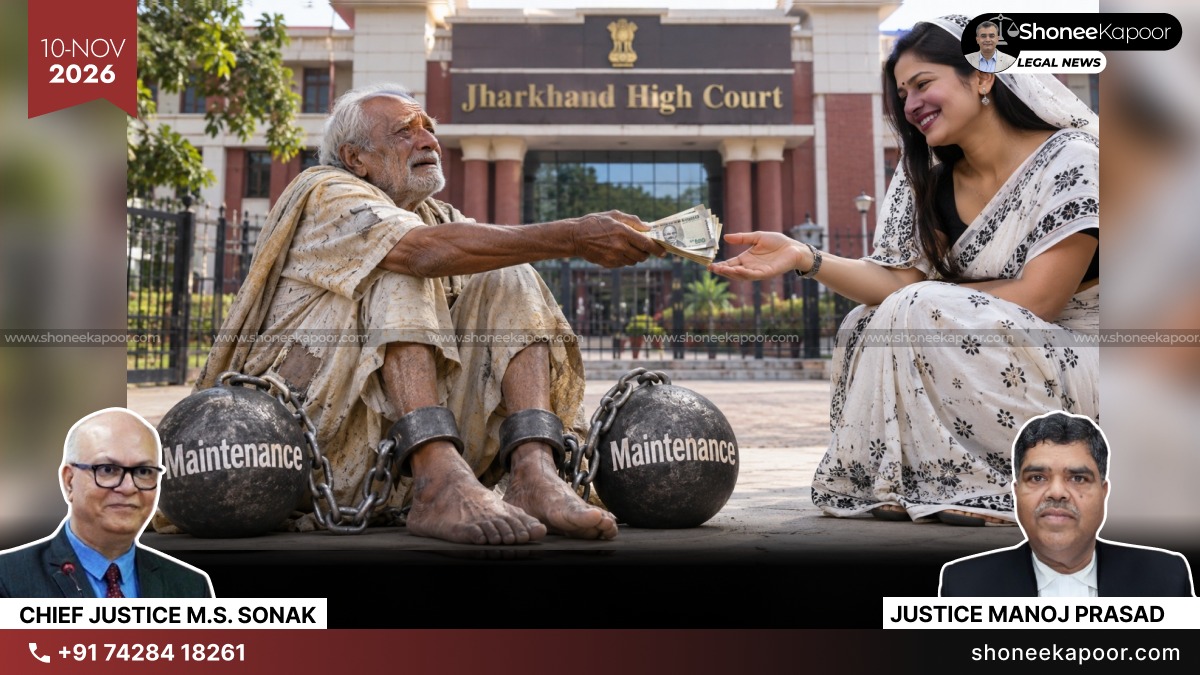
84-Year-Old Father-In-Law Must Pay ₹17,000 Monthly Maintenance Despite Old Age And Illness: Jharkhand High Court

Written and analysed by Vaibhav Ojha
Head Of Legal CommunicationsRANCHI: The Jharkhand High Court has ruled that an elderly father-in-law cannot escape his legal responsibility to maintain his widowed daughter-in-law and dependent grandchildren merely because of his advanced age. The Court upheld a monthly maintenance order of ₹17,000 against an approximately 84-year-old man, despite his argument that he and his wife were both above 80 years old and suffering from age-related illnesses.
A Division Bench of Chief Justice M.S. Sonak and Justice Manoj Prasad, in Roshan Lal Saw v. Nilam Kumari & Others, dismissed the appeal challenging the Family Court, Dhanbad's maintenance order dated June 11, 2024.
The dispute began after Nilam Kumari's husband, Suraj Kumar, died on October 27, 2020, while undergoing medical treatment in Hyderabad. Suraj was the only son of Roshan Lal Saw. Following his death, Nilam sought maintenance for herself and her two minor sons under Sections 19 and 20 of the Hindu Adoptions and Maintenance Act, 1956.
Nilam alleged that her father-in-law had stopped providing financial support after her husband's death. She claimed that she had no independent income, had received no share in her deceased husband's estate and was struggling to meet her children's educational expenses.
She further alleged that her father-in-law received a pension exceeding ₹32,000 per month, possessed fixed deposits worth over ₹80 lakh and had other sources of income. On this basis, she demanded ₹75,000 per month as maintenance.
However, Roshan Lal Saw disputed these allegations. He submitted that he was over 83 years old and his wife, who was also above 80, was financially dependent on him. Both were suffering from age-related health problems.
He admitted receiving a pension of approximately ₹32,000 but denied having fixed deposits worth ₹80 lakh. He maintained that his retirement benefits had been spent constructing a house and that his agricultural property was not generating income.
Importantly, the elderly father-in-law claimed that he had already been maintaining his daughter-in-law and grandsons, including paying the children's educational expenses. The Family Court also recorded that he was meeting their school expenses.
Despite these submissions, the Family Court directed him to pay ₹7,000 per month to his widowed daughter-in-law and ₹5,000 each to his two minor grandsons until they attained majority, making the total maintenance ₹17,000 per month.
The maintenance was made payable from September 24, 2021, creating an additional financial liability through accumulated arrears.
Challenging the order, Roshan Lal approached the Jharkhand High Court. He argued that the Family Court had failed to properly consider his age, medical condition, financial responsibilities towards his elderly wife and the educational expenses he was already bearing.
The High Court examined Sections 19, 20, 21 and 22 of the Hindu Adoptions and Maintenance Act, 1956. It explained that these provisions deal with maintenance of widowed daughters-in-law, children and other legally recognised dependants.
The Bench also referred to the Supreme Court's decision in Kanchan Rai v. Geeta Sharma & Others, 2026 INSC 54, concerning maintenance rights of widowed daughters-in-law and the interpretation of statutory provisions relating to dependants.
The Supreme Court had observed:
“22. In view of the language so used in Section 21 (vii) of the Act and guided by the settled principles reiterated above, there is hardly any scope to interpret that the words “any widow of his son” used therein would mean “widow of his predeceased son” only. The courts cannot add or subtract any word from the text of the statute. The provisions of the statute cannot be re-written by the courts by assuming or inferring something which is not implicit from the plain language of the statute.”
The Supreme Court further explained that maintenance rights cannot depend merely on whether the husband died before or after his father.
“23. Even otherwise, any such restrictive interpretation would fail the test of constitutional validity under Article 14 of the Constitution. The classification sought to be made between widowed daughters-in-law based solely on the timing of the husband’s death, namely, (a) those whose husbands died during the lifetime of the father-in-law, and (b) those whose husbands died after him; is manifestly unreasonable and arbitrary. Such a classification bears no rational nexus with the object and purpose of the Act, which is to secure maintenance to dependants who are unable to maintain themselves. In both situations, the women are similarly situated in so far as the object of the Act is concerned, having suffered widowhood, being without spousal support, and facing comparable financial vulnerability. Denial of maintenance to one category based on a fortuitous circumstance beyond their control is manifestly arbitrary and violative of the guarantee of equality before law under Article 14 of the Constitution.”
Addressing the constitutional right to dignity, the Supreme Court had stated:
“24. Any interpretation contrary to one opined above, would also infringe upon Article 21 of the Constitution, which guarantees the right to life with dignity. The right to life has been judicially expanded to include the right to livelihood and basic sustenance. Denying maintenance to a widowed daughter-in-law from the estate of her deceased father-in-law on a narrow or technical construction of the statute would expose her to destitution and social marginalization, thereby offending her fundamental right to live with dignity. The provisions of the Act must, therefore, be read purposively and in conformity with constitutional values, so as to advance social justice and protect the dignity of vulnerable dependants rather than defeat it.”
The Supreme Court had also referred to traditional Hindu law principles concerning family responsibilities:
“25. Section 4 of the Act has an overriding effect but it does not erase away fundamental principles of Hindu law particularly where some doubt is raised about the codified provisions. The Hindu law specially Manu Smriti vide Chapter 8, verse 389 says:
“न माता न पिता न स्त्री न पुत्रस्त्यागमर्हति।
त्यजन्नपतितानेतान राज्ञा दण्ड्यः शतानि षट्”।।
No mother, no father, no wife, and no son deserves to be forsaken. A person who abandons these blameless (relatives) should be fined six hundred (units) by the king. This verse emphasizes duty of the family head to support female family members.”
Returning to the present dispute, the Jharkhand High Court considered the father's argument that his advanced age prevented him from earning income from agricultural and ancestral properties. It also acknowledged that his elderly wife was dependent on him.
However, the Bench rejected the argument that old age alone could remove his maintenance responsibility.
The Court held:
“Be that as it may, the fact remains that the pious responsibility of maintaining the widowed daughter-in-law and the grandchildren does not get exonerated on account of the age of the present appellant. Nothing rebuts the claim that a monthly rental of more than Rs.18,000/- is paid to the present appellant or his wife, leading to a cumulative monthly income of more than Rs.50,000/-. Therefore, in view of the statutory mandate contained under the provisions of the Hindu Adoption and Maintenance Act, the appellant was under a legal obligation and pious duty to maintain his widowed daughter-in-law and grandchildren who are dependents.”
The Court noted that Roshan Lal received a pension exceeding ₹32,000 per month. A lease agreement also showed rental income of more than ₹18,000 per month in his wife's name.
Considering the combined income of over ₹50,000, the Bench held that the maintenance amount of ₹17,000 per month was not unreasonable.
During the proceedings, the respondents submitted that only ₹1.99 lakh had been paid against a claimed liability of ₹8.33 lakh, leaving approximately ₹6.34 lakh outstanding.
The High Court noted that no stay had been granted against the maintenance order. It therefore directed that any unpaid arrears must be cleared within two months of its November 3, 2026 judgment.
Ultimately, the High Court dismissed the elderly father's appeal and upheld the Family Court's order.
Read Also:- What is Article 21?
The judgment makes clear that advanced age and retirement do not automatically end a father-in-law's statutory maintenance obligations. At the same time, the case highlights how maintenance disputes can continue to impose substantial financial responsibilities on elderly family members, even where they claim to be supporting other dependants and meeting children's educational expenses.
ALL LAWS AND SECTIONS MENTIONED IN THE JUDGMENT
| LAW / SECTION | LEGAL PROVISION | RELEVANCE TO THIS CASE |
|---|---|---|
| Section 19, Hindu Adoptions and Maintenance Act, 1956 | Maintenance of widowed daughter-in-law | Governs the circumstances in which a Hindu father-in-law must maintain his widowed daughter-in-law. |
| Section 20, HAMA | Maintenance of children and aged parents | Invoked in the original maintenance proceedings concerning the two minor grandsons. |
| Section 21(iv), HAMA | Definition of dependants | Includes specified minor male descendants of a deceased person. |
| Section 21(vii), HAMA | Widows included as dependants | Includes the widow of a son or specified deceased male descendants, subject to non-remarriage. |
| Section 22, HAMA | Maintenance of dependants | Provides for maintenance of a deceased Hindu's dependants from the estate inherited by the heirs. |
| Section 4, HAMA | Overriding effect of the Act | Discussed in the Supreme Court judgment quoted by the High Court. |
| Section 19(1), Family Courts Act, 1984 | Appeal against Family Court judgment or order | Provision under which the father-in-law approached the High Court. |
| Article 14, Constitution of India | Equality before law | Cited in the Supreme Court ruling concerning equal treatment of widowed daughters-in-law. |
| Article 21, Constitution of India | Right to life and personal liberty | Cited regarding the right to livelihood, sustenance and dignity. |
CASE DETAILS
| PARTICULARS | DETAILS |
|---|---|
| Case Title | Roshan Lal Saw v. Nilam Kumari & Others |
| Court | Jharkhand High Court, Ranchi |
| Case Number | F.A. No. 229 of 2024 |
| Neutral Citation | 2026:JHHC:32181-DB |
| Bench | Chief Justice M.S. Sonak and Justice Manoj Prasad |
| Judgment Date | 03 November 2026 |
| Reserved On | 06 October 2026 |
| Appellant | Roshan Lal Saw, father-in-law, approximately 84 years old |
| Respondents | Nilam Kumari (widowed daughter-in-law), Sarthak Kumar Saw and Samar Kumar Saw (minor grandsons) |
| Counsel for Appellant | Mr. Mahesh Tewari, Advocate |
| Counsel for Respondents | Mr. Rakesh Kumar Gupta, Advocate |
KEY TAKEAWAYS
- Old Age No Escape: Even at 84, a father-in-law's maintenance obligation does not automatically end.
- Existing Support Not Enough: Despite paying his grandsons' school fees, he was ordered to pay ₹17,000 monthly.
- Elderly Wife's Dependency: His 80-plus-year-old wife's financial dependence did not prevent the maintenance order.
- Family Income Considered: His ₹32,000-plus pension and rental income in his wife's name were considered together.
- Heavy Arrears Burden: Respondents claimed ₹6.34 lakh remained unpaid; the Court directed clearance of outstanding arrears within two months.
Share Your Thoughts
Comments are moderated before publication.