
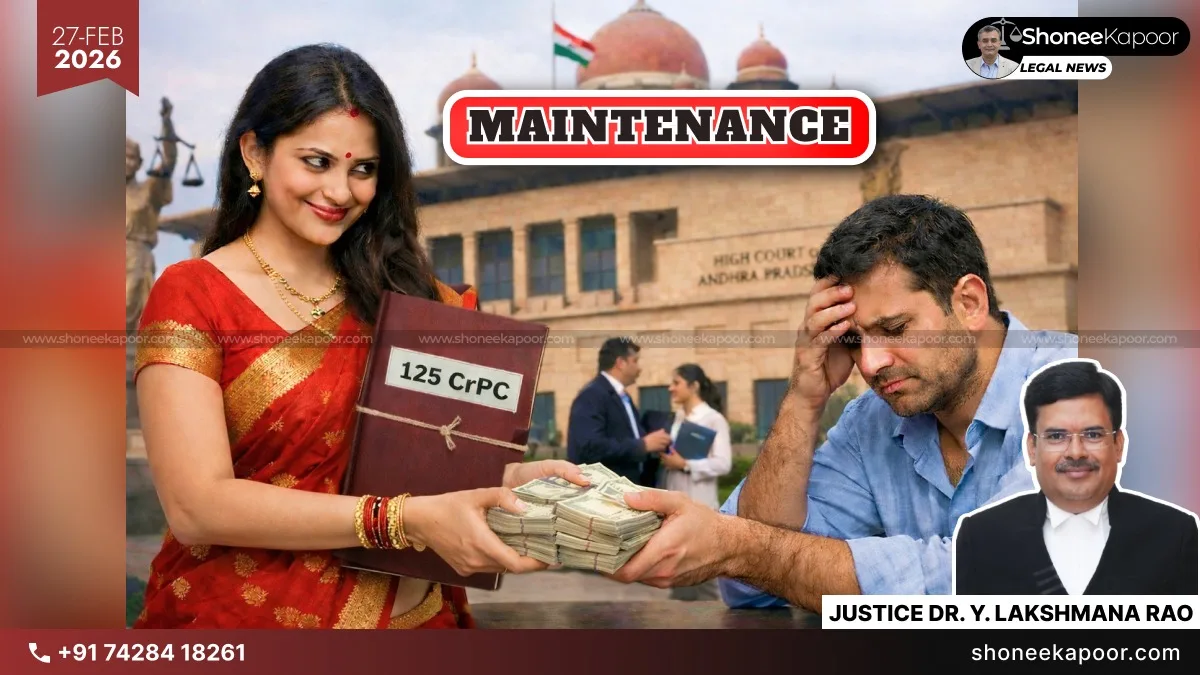
Maintenance U/S 125 CrPC Is A Continuing Liability, Not A One-Time Relief. Even If Husband Is Unemployed Or Having Financial Constraints: Andhra Pradesh High Court

Written and analysed by Vaibhav Ojha
Head Of Legal CommunicationsCan a husband escape maintenance by citing unemployment, financial strain, or parallel cases? The Andhra Pradesh High Court says NO – the obligation revives with every breach.
AMARAVATI: Justice Dr. Y. Lakshmana Rao of the Andhra Pradesh High Court dismissed a husband’s criminal revision challenging a Family Court order directing him to pay monthly maintenance to his wife and minor child. While the Court upheld the order, the judgment once again reflects how Section 125 CrPC is interpreted in a strongly one-sided manner against husbands.
The Court framed the core issue as:
“Whether the order in F.C.O.P.No.1088 of 2018 dated 09.03.2022, passed by the learned IV Additional District Judge-cum-Judge, Principal Family Court, Vijayawada is correct, legal, and proper with respect to its finding, or judgment, and there are any material irregularities? And to what relief?”
Ultimately, the Court found no reason to interfere.
The husband had argued that maintenance was granted without proper appreciation of evidence and that this was a second round of litigation after the withdrawal of an earlier case. However, the Court brushed aside these concerns, reiterating that “maintenance” includes food, clothing and shelter and is intended to prevent destitution.
The judgment emphasized that proceedings under Section 125 CrPC are summary in nature and technical objections should not defeat relief. It was observed that oral testimony alone was sufficient, and the absence of documentary proof was not fatal. This approach, however, raises serious concerns for men, because once allegations are orally accepted, the burden effectively shifts entirely onto the husband.
The Court made it clear that maintenance is not temporary or conditional, stating:
“The right to maintenance thereunder is not a one-time bounty but an ambulatory, recurring entitlement, crystallizing afresh upon each breach of obligation, untrammelled by the pendency or outcome of collateral matrimonial proceedings.”
Rejecting the argument that multiple cases amounted to harassment, the Court observed:
“Res judicata or constructive res judicata finds no foothold herein, as the right to sustenance is not extinguished by prior proceedings but accrues afresh with each instance of default.”
This effectively allows repeated litigation as long as default is alleged.
The judgment further stated that:
“Maintenance, in the contemplation of Indian jurisprudence, is a socio-legal obligation flowing inexorably from the status of marriage and the familial bond.”
The language reflects how the statutory duty is viewed as absolute, with limited space for examining financial stress or evidentiary weaknesses.
On quantum, the Court held that maintenance must be-
“Just and adequate, commensurate with the husband’s pecuniary resources, the dependents’ reasonable needs, and prevailing living standards, eschewing both niggardliness and extravagance.”
Yet in practice, many husbands struggle to prove real income constraints in summary proceedings.
While the order favoured the wife and child, the broader debate remains unresolved — whether Section 125 proceedings adequately protect husbands from weak evidence, repetitive litigation, and disproportionate financial burdens.
Explanatory Table: Laws And Sections Involved
| Law / Provision | Purpose | How Applied in This Case |
| Sections 397 & 401 CrPC | Provide revisional jurisdiction to High Court to examine legality, correctness, and propriety of lower court orders | Husband invoked these provisions to challenge the Family Court’s maintenance order before the High Court |
| Section 125 CrPC | Ensure financial support to wife, children, and parents unable to maintain themselves through a summary and speedy remedy | Family Court granted maintenance under this section, and the High Court upheld the order |
| Section 125(3) CrPC | Provide enforcement mechanism for maintenance orders, including recovery and imprisonment for default | Discussed to clarify that imprisonment is only a mode of enforcement and does not extinguish liability |
| Protection of Women from Domestic Violence Act, 2005 | Offer civil remedies including monetary relief and protection in domestic relationships | Court cited jurisprudence stating that DV Act relief can exist alongside maintenance under Section 125 CrPC |
| Section 20 DV Act | Provide monetary relief such as expenses and losses arising from domestic violence | Referenced to explain that monetary relief is distinct and can be additional to maintenance |
| Hindu Adoptions and Maintenance Act, 1956 | Impose statutory duty on individuals to maintain dependents based on familial relationship | Used by the Court to reinforce that maintenance obligation flows from marital and family status |
| Order XVIII Rule 4 CPC | Govern recording of chief examination through affidavit in civil proceedings | Husband alleged procedural irregularity in reliance on affidavit evidence, which the Court rejected due to summary nature of proceedings |
| Articles 15(3) & 39 Constitution of India | Enable protective measures and social justice policies for women and children | Court relied on these constitutional principles to justify liberal interpretation of maintenance provisions |
Case Details
- Case Title: Chinnan Krishore Kumar v. State of Andhra Pradesh & Others
- Case Number: Criminal Revision Case No. 1009 of 2022
- Court: High Court of Andhra Pradesh at Amaravati
- Bench: Justice Dr. Y. Lakshmana Rao
- Date of Order: 09 February 2026
- Counsels
- For Petitioner: M. Venu Gopal
- For Respondents: A.K. Kishore Reddy (Legal Aid Counsel)
Key Takeaways
- Maintenance under Section 125 CrPC is treated as a continuing and recurring liability, which means a man can face repeated litigation if default is alleged, even after earlier proceedings.
- Oral testimony alone can be considered sufficient in summary maintenance proceedings, making it harder for husbands to challenge claims purely on lack of documentary proof.
- Technical objections and procedural arguments are often rejected in maintenance cases, as courts prioritize “social justice” over strict evidentiary standards.
- Financial difficulty or unemployment is rarely accepted as a valid defence if the husband is considered able-bodied, placing a heavy presumption of earning capacity on men.
- The system views maintenance as a personal and almost absolute obligation arising from marriage, leaving limited space to examine misuse, exaggeration, or financial strain on the husband.
This Could Change Your Case-Get FREE Legal Advice-Click Here!
Disclaimer: The views and opinions expressed in this article are those of the Indian courts and do not necessarily reflect the official policy or position of “ShoneeKapoor.com” or its affiliates. This article is intended for informational and educational purposes only. The content provided is not legal advice, and viewers should not act upon this information without seeking professional counsel. Viewer discretion is advised.
Related Articles
Monthly Money to Wife Can Invite Income Tax Notice – But In Courts, It Turns Into Permanent Maintenance Against Husbands
Giving money to your wife every month is legal under tax law, but the same bank entries are increasingly being used b...
Can an Educated Wife Claim Maintenance from Her Husband? The Legal Reality No One Explains
Indian courts recognise education and earning capacity, yet husbands are still routinely ordered to pay maintenance.I...
Alimony vs Maintenance in India: The Real Legal Difference Every Man Must Know Before Divorce
Alimony and maintenance are not the same, but Indian courts often blur the line, creating lifelong financial pressure...
Relevant Judgements
Can an NRI Husband Be Forced to Pay Maintenance in India? Supreme Court Rules Explained for Overseas Indian Men
Living abroad does not automatically protect an NRI husband from maintenance claims in India.But can Indian courts pa...
Share Your Thoughts
Comments are moderated before publication.