
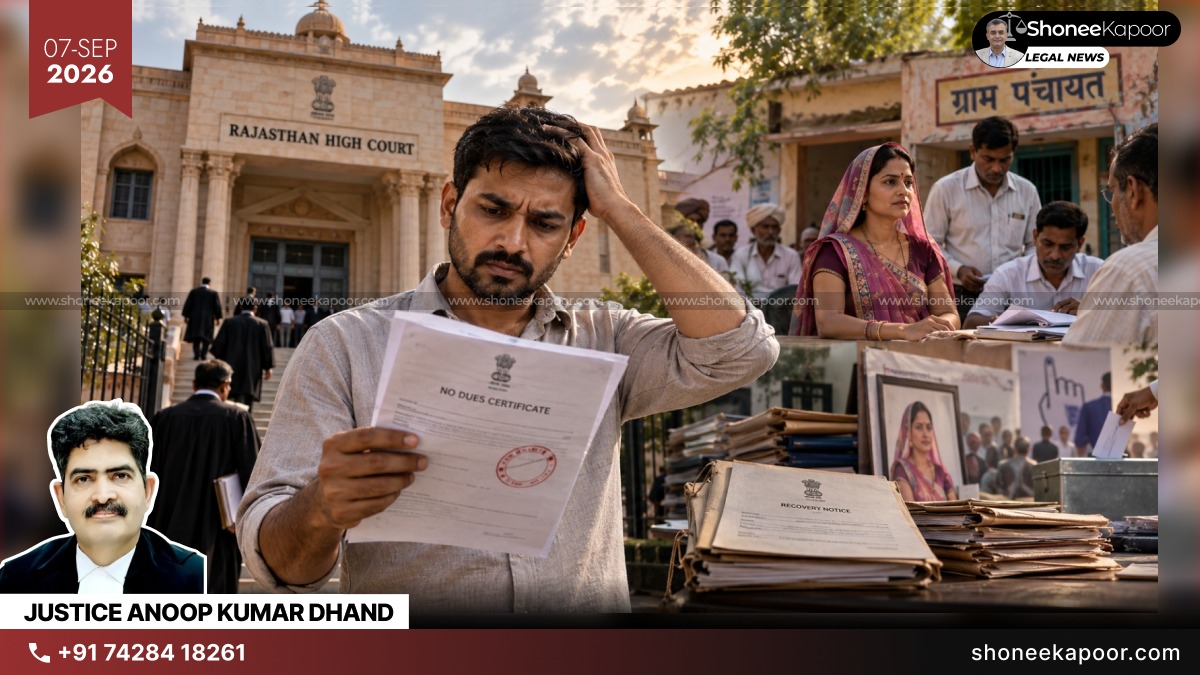
Husband Cannot Be Made Liable For Wife’s Dues: Rajasthan High Court

Curated by NEWS DESK
Editorial DeskCan a husband be made liable for dues arising from his wife’s tenure as Sarpanch without any proof of his own involvement? The Rajasthan High Court has held that a husband cannot be forced to clear such dues merely because of marriage.
RAJASTHAN: The Rajasthan High Court has held that a husband cannot be forced to pay dues recoverable from his wife for acts connected with her tenure as a Sarpanch unless there is proof that he was also involved in the relevant work or misconduct.
Justice Anoop Kumar Dhand, sitting at the Jaipur Bench, passed the order on September 2, 2026, while allowing a writ petition filed by Ramlaxman Meena. The Court described the authorities' action as a “classic example of non-application of mind.”
Meena wanted to contest the upcoming Panchayati Raj election from Gram Panchayat Falenda and required a no-dues certificate. However, the authorities refused to issue it because certain dues were allegedly recoverable from his wife, Laxmi Bai, relating to her tenure as Sarpanch from 1995 to 2000.
The authorities had earlier initiated recovery proceedings against her. When she allegedly failed to deposit the amount, attachment and auction proceedings were started against her property. She challenged those proceedings through S.B. Civil Writ Petition No. 11544/2009, in which the High Court passed an interim order on September 16, 2009 restraining the authorities from auctioning her property. That petition remained pending when the present order was passed.
The husband argued that his wife's alleged failure to clear the dues could not make him ineligible to contest the election under Section 19(m) of the Rajasthan Panchayati Raj Act, 1994. The State, however, argued that being the husband of the former Sarpanch, he was duty-bound to clear his wife's dues and could not receive a no-dues certificate until the amount was paid.
The High Court rejected this stand. It noted that a surety or guarantor may be made liable for another person's dues in an appropriate case, but the petitioner was neither a surety nor a guarantor for his wife. The recovery dispute was an independent matter between the State and the former Sarpanch.
The Court observed:
“A Public Representative himself/herself is alone liable and responsible for his/her disgraceful act or any misconduct. If at all any recovery proceedings are initiated against him/her, he/she alone is liable to clear the dues and deposit the amount pending against him/her. This Court fails to understand how recovery proceedings can be initiated against the family members of the erstwhile Sarpanch or any other Public Representative.”
The Court further made it clear that neither the Rajasthan Panchayati Raj Act, 1994 nor the Rajasthan Panchayati Raj Rules, 1996 authorises such recovery from the family members of a Sarpanch merely because the Sarpanch has not paid the amount.
It observed:
“There is neither such provision under the Panchayati Raj Act, 1994 nor the Panchayati Raj Rules, 1996, that contains any provision authorising the recovery of any such amount from the family members of the Sarpanch, in case the said amount is not paid or deposited by him/her… If any recovery of any amount is due against such person and if he/she fails to deposit the same, it cannot be treated as civil/penal liability for his/her family members to deposit the due amount.”
The Court even expressed “pity” over the authorities forcing the husband to clear dues allegedly owed by his wife.
Importantly, the High Court held that husband and wife are separate entities. One spouse cannot be held liable for the misconduct or acts of the other merely because they are married. In this case, the husband could not be held responsible for his wife's alleged dues unless an enquiry established that he was involved in the Panchayat work or the alleged misconduct during her tenure as Sarpanch.
The High Court refused to allow marital status alone to become the basis for transferring liability from a wife to her husband.
Calling the authorities' action unwarranted, the Court allowed the petition and directed them to immediately issue the no-dues/no-objection certificate so that Meena could contest the upcoming Panchayati Raj election.
EXPLANATORY TABLE OF LAWS AND SECTIONS
| Law / Section | What It Means | Application in this Case |
|---|---|---|
| Section 19(m), Rajasthan Panchayati Raj Act, 1994 | The provision was relied upon to determine the petitioner's eligibility to contest the Panchayati Raj election. | The husband argued that his wife's failure to pay her alleged dues could not bar his own eligibility under Section 19(m). |
| Rajasthan Panchayati Raj Act, 1994 | Governs the Panchayati Raj framework in Rajasthan. | The Court found no provision in the Act authorising recovery of a Sarpanch's dues from family members merely because of their relationship. |
| Rajasthan Panchayati Raj Rules, 1996 | Rules operating under the State's Panchayati Raj framework. | The Court similarly found no provision in the Rules permitting the authorities to recover such dues from the Sarpanch's family members. |
| Surety / Guarantor Liability | A surety or guarantor may, subject to law and the relevant obligation, be liable for another person's dues. | The Court specifically found that the husband was neither his wife's surety nor her guarantor for the recovery amount. |
| Separate Liability Of Spouses | Marriage by itself does not make one spouse liable for the other's misconduct or public liabilities. | The Court held that husband and wife are separate entities and liability could not be imposed on the husband without proof of his own involvement. |
CASE DETAILS
| Particular | Details |
|---|---|
| Case Title | Ramlaxman Meena v. State of Rajasthan & Ors |
| Court | High Court of Judicature for Rajasthan, Bench at Jaipur |
| Case Number | S.B. Civil Writ Petition No. 11020/2026 |
| Neutral Citation | 2026:RJ-JP:35465 |
| CNR | RJHC020551832026 |
| Bench | Justice Anoop Kumar Dhand |
| Decision Date | 02 September 2026 |
| Nature | Reportable |
| Petitioner Counsel | Mr Amit Jindal, assisted by Mrs Dipti Jindal and Mrs Reena Goyal |
| Respondents' Counsel | Mr Kapil Prakash Mathur, AAG, assisted by Mr Prateek Saxena |
| Result | Petition allowed; authorities directed to issue the no-dues/no-objection certificate forthwith |
KEY TAKEAWAYS
- Husband cannot be forced to pay his wife’s dues merely because they are married.
- The State tried to block a man’s right to contest elections over liabilities allegedly belonging to his wife.
- Rajasthan High Court said husband and wife are separate legal entities for such liability.
- Unless the husband’s own involvement is proved, his wife’s alleged misconduct cannot be transferred onto him.
- Marriage cannot become a shortcut to make a man financially or legally answerable for acts he did not commit.
Share Your Thoughts
Comments are moderated before publication.