
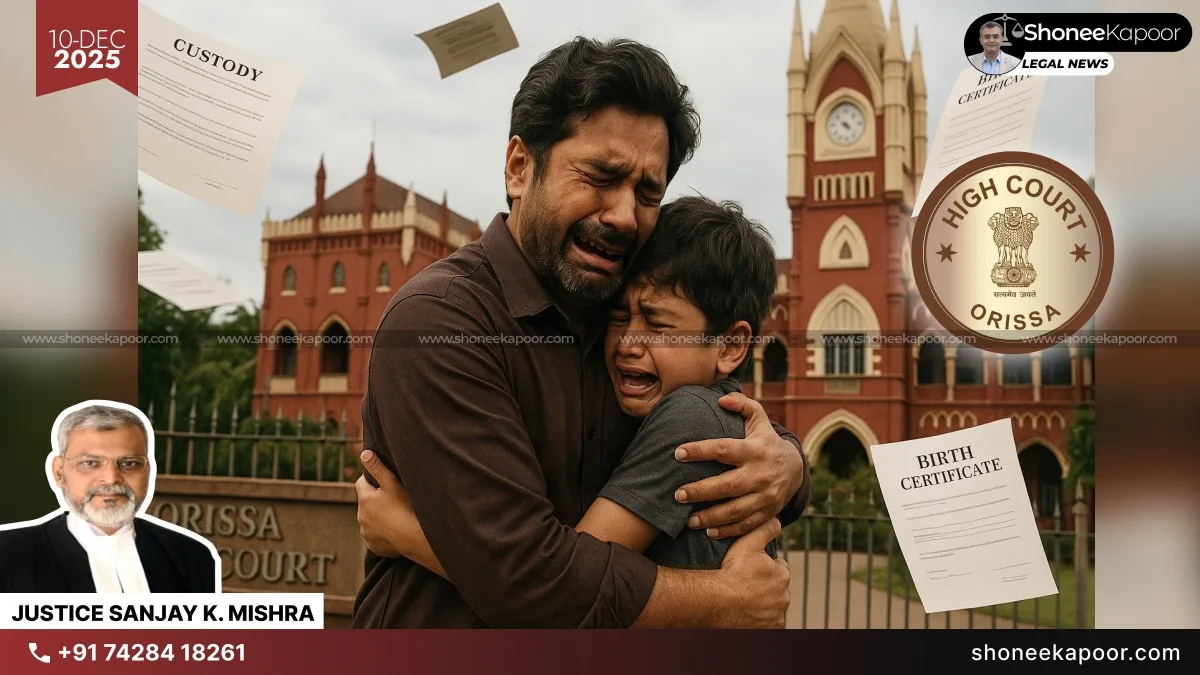
Orissa High Court: Father Cannot Be Denied Child Custody Just Because He Has No Birth Certificate Of Minor Child

Written and analysed by Shonee Kapoor
Legal Consultant, Author & Men's Rights ActivistThe Orissa High Court has ruled that a father cannot be refused custody of his minor child merely because he could not produce the child’s birth certificate. The Court stressed that admitted facts need not be proved and the welfare of the child must come first.
CUTTACK: The Orissa High Court has delivered an important judgment protecting a father’s right to child custody of his minor son, ruling that a man cannot be denied custody only because he is unable to produce the child’s birth certificate or his wife’s death certificate.
The Court said the welfare of the child must be treated as the most important factor, and technical defects cannot defeat a father’s natural guardianship.
The case came before Justice Sanjay Kumar Mishra, where the father (appellant) challenged the Family Court’s order rejecting his request for guardianship of his minor son. The appeal was filed under Section 19 of the Family Courts Act, 1984 and Section 47 of the Guardians and Wards Act, 1890.
Background of the Case
The appellant married Ranjulata on 19 June 2019 as per Hindu customs. Their married life was peaceful, and a male child was born. Shortly afterwards, the wife passed away due to a sudden cardiac arrest while staying with her parents.
After her death, the child’s maternal grandfather (Respondent No.1) kept the baby with him and allegedly did not allow the father to meet his own son. The father approached the Family Court seeking custody, claiming he was the natural guardian under the law.
However, the Family Court rejected the father’s application on the ground that he did not produce the birth certificate of the child or the death certificate of his wife.
The Family Court also held that he failed to prove his paternity through independent witnesses.
Family Court’s Observations
The High Court reproduced the Family Court’s reasoning, where it had stated:
“The burden of proof lies on the person who asserts a certain thing… the petitioner has not filed the birth certificate and death certificate of his son and wife respectively… to enable this Court to reach at a just and conclusive decision.”
Appeal Before the High Court
During the appeal, the father’s lawyer pointed out that the maternal grandfather himself had admitted in his written statement that the appellant was indeed the natural father and guardian of the child. Under Section 58 of the Indian Evidence Act, an admitted fact does not need to be proved again.
The High Court referred to the exact statement from the grandfather:
“The petitioner and the daughter of the present Respondent No.1… are legally married husband and wife… the couple was blessed with the male child namely Rashmi Ranjan.”
The Court then quoted Section 58 of the Evidence Act:
“No fact need be proved in any proceeding which the parties thereto… agree to admit at the hearing…”
High Court’s Findings
Justice Mishra held that the Family Court committed a serious error by ignoring this admission and insisting on certificates when the relationship was undisputed.
The Court stated:
“This Court is of the view that despite such admission… the learned Court below erred in law… Hence, the impugned judgment deserves interference.”
The Court then referred to the Supreme Court ruling in Nil Ratan Kundu v. Abhijit Kundu on the principle of child welfare, quoting:
“In selecting proper guardian of a minor, the paramount consideration should be the welfare and well-being of the child… the court is neither bound by statutes nor by strict rules of evidence…”
Application of Hindu Minority and Guardianship Act
Justice Mishra also stressed the legal position under Section 6 of the Hindu Minority and Guardianship Act, stating that the father is the natural guardian of a minor boy after the mother. The provision was quoted fully in the judgment.
Key Observations of the Court
The High Court made crucial observations regarding the welfare of the child:
“If no custody is granted to the Appellant, the Court would be depriving both the child and the father of each other’s love and affection…”
“…he would be unable to express his intelligent preferences… his choice cannot be ascertained at this stage.”
“Keeping in view the legal provisions… this Court finds that the learned Court below was not justified to reject such prayer for custody of the child on technical ground for not producing and proving the death certificate… as well as birth certificate…”
The Court added that delaying custody any further might harm the bond between father and son:
“…with the passage of time, he might develop more bonding with the Appellant… the Appellant might be completely deprived of his child’s love and affection.”
Final Directions of the Court
In the final order, the High Court held:
- The appeal is allowed.
- The Family Court’s judgment dated 12.07.2022 is set aside.
- The maternal grandfather must hand over the child’s custody to the father immediately.
- The grandfather may visit the child at the father’s residence after informing him in advance.
The Court concluded that the welfare of the minor child would be best served by living with his natural father, especially after the death of the mother.

Explanatory Table Of All Laws & Sections Used In This Case
| Law / Act | Section | What It Says (Simple Explanation) | How It Applies in This Case |
| Family Courts Act, 1984 | Section 19 | Allows appeals to the High Court against judgments of Family Courts. | The father filed this appeal under Section 19 to challenge the Family Court’s refusal to give child custody. |
| Guardians and Wards Act, 1890 | Section 47 | Gives High Courts power to examine Family Court decisions on guardianship matters. | Used as an additional provision to challenge the Family Court’s rejection. |
| Indian Evidence Act, 1872 | Section 58 | “Facts admitted need not be proved.” If the opposite party admits something, you don’t need documents. | The grandfather admitted the appellant is the child’s father. So the Court held that asking for birth certificate/death certificate was unnecessary. |
| Hindu Minority & Guardianship Act, 1956 | Section 6 | Father is the natural guardian of a minor boy; after the mother, father gets full guardianship rights. | High Court said: after the mother’s death, the father automatically becomes natural guardian—so custody cannot be denied. |
| Supreme Court Precedent | Nil Ratan Kundu vs Abhijit Kundu (2008) 9 SCC 413 | Child welfare is the paramount consideration, not technicalities or rigid evidence rules. | High Court relied on this principle to say the Family Court must prioritize welfare over documents. |
- Case Title: Ramakanta Majhi vs. Santan Majhi & Another GUAP No. 03 of 2022
- Court: High Court of Orissa, Cuttack
- Bench: Justice Sanjay Kumar Mishra
- Date of Hearing & Judgment: 01.12.2025
- Appellant Counsel: Mr. P.K. Sahoo, Advocate
- Respondents: No appearance
Key Takeaways
- Orissa High Court made it clear that a father cannot be denied custody just because he cannot produce a birth certificate or death certificate.
- When the maternal grandfather himself admitted the father’s paternity, the law does not require further proof.
- Welfare of the child comes first, and a natural father cannot be kept away on technical excuses.
- The Court recognised that delaying custody would emotionally disconnect the child from his own father.
- This judgment reaffirms that fathers have legal rights too, and those rights cannot be dismissed casually by lower courts.
This Could Change Your Case-Get FREE Legal Advice-Click Here!
Disclaimer: The views and opinions expressed in this article are those of the Indian courts and do not necessarily reflect the official policy or position of “ShoneeKapoor.com” or its affiliates. This article is intended for informational and educational purposes only. The content provided is not legal advice, and viewers should not act upon this information without seeking professional counsel. Viewer discretion is advised.
Related Articles
Child Custody Legal Guide: Can School Remove Father’s Name From Records?
Can a school remove a biological father’s name from child records after divorce or custody dispute? Read Indian law, ...
Child Custody Guide: At What Age Can a Child Choose Between Mother and Father in India?
Can a child decide whether to live with mother or father in India? Know the real law, child preference age, custody c...
जब माँ बच्चे को हथियार बना देती है: भारत में झूठा चाइल्ड एलियनेशन और पिता के खिलाफ कानूनी हिंसा
झूठे चाइल्ड एलियनेशन के मामले एक ऐसी गंभीर मानसिक प्रताड़ना को उजागर करते हैं, जिसमें बच्चे को झूठ और सुनियोजित षड्यं...
Share Your Thoughts
Comments are moderated before publication.