
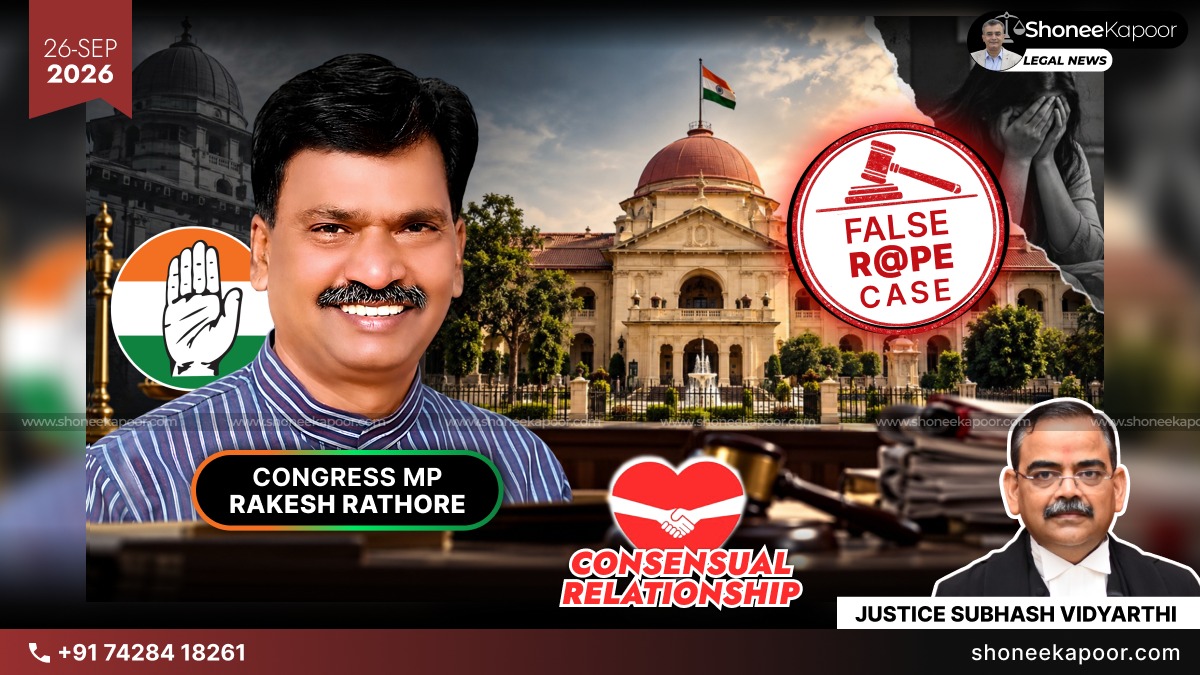
False Rape Case Against Congress MP | “Woman Had a Long-Standing Consensual Relationship”: Allahabad HC Discharges Rakesh Rathore

Curated by NEWS DESK
Editorial DeskUTTAR PRADESH: The Allahabad High Court, Lucknow Bench, has discharged Congress MP Rakesh Rathore in a rape case after finding that the prosecution material indicated a long-standing consensual extramarital relationship between two married and mature adults. The Court set aside the Trial Court order rejecting his discharge application.
The case arose from an FIR registered in Sitapur in January 2025. The complainant alleged that she came in contact with Rathore in 2018 through political activities. According to her case, he offered her political support, and she was later appointed district women’s president of the Tailik Mahasangh. Their closeness thereafter increased.
She alleged that Rathore raped her at his residence in March 2020 and thereafter continued physical relations with her by promising that he would divorce his wife and marry her. Allegations of threats, blackmail and wrongful confinement were also made. The FIR involved Sections 64(2), 69, 351(3) and 127(2) of the Bharatiya Nyaya Sanhita, 2023.
The prosecution material, however, also contained circumstances that became important while deciding whether there was sufficient ground to put Rathore through a criminal trial. The complainant was around 49 years old, politically active, married and had grown-up children. Rathore was also married. Material before the Court indicated a prolonged relationship, including the complainant's frequent visits to Rathore’s residence.
The complainant’s husband had stated that Rathore frequently called her to his residence and that she sometimes remained there until late at night. After considering these circumstances, the High Court observed:
“On the basis of the aforesaid circumstances, the prosecution material indicates a long-standing consensual extramarital relationship between two married and mature adults,”
The Court found this circumstance inconsistent with the allegation that the physical relationship had been established because of a promise of marriage.
The Court also examined the medical and electronic material. According to the case record, the medico-legal material did not record physical violence, restraint, use of a weapon or injury. The Court clarified that the absence of injury alone cannot decide a rape allegation, but it must be considered together with the other circumstances of the case.
An audio conversation between the parties was also part of the prosecution material. The Court found that the conversation indicated that the complainant herself was seeking marriage with Rathore, which did not support the allegation of continuous sexual exploitation through blackmail in the manner alleged.
The Court further noticed inconsistencies in the versions placed on record. Considering the long duration of the relationship, the marital status of both parties, the medical material, the electronic evidence, and the surrounding circumstances, it held that the prosecution material did not create a grave or strong suspicion sufficient to continue the criminal case.
Read Also:- Promise To Marry Articles
The High Court observed:
“Continuing criminal proceedings on the basis of such contradictory and unfounded allegations would amount to an abuse of the process of law and result in a failure of justice,”
The Trial Court had earlier rejected Rathore’s discharge application on 5 May 2025 and subsequently framed charges against him. The High Court held that the later framing of charges did not prevent it from examining whether the earlier order refusing discharge was legally sustainable.
Justice Subhash Vidyarthi consequently allowed the criminal revision, set aside the Trial Court’s order dated 5 May 2025 and allowed Rathore’s discharge application. He was discharged from the charges under Sections 64(2), 69, 351(3) and 127(2) BNS.
EXPLANATORY TABLE OF LAWS AND SECTIONS
| Law / Section | What It Means | Relevance To This Case |
|---|---|---|
| Section 64(2), BNS 2023 | Provides enhanced punishment for specified categories of rape. | Rathore was charged under this provision and was ultimately discharged. |
| Section 69, BNS 2023 | Deals with sexual intercourse by deceitful means or a promise to marry made without intention of fulfilling it, where the conduct does not amount to rape. | The prosecution alleged that physical relations were connected with Rathore’s promise to divorce his wife and marry the complainant. |
| Section 351(3), BNS 2023 | Provides punishment for aggravated forms of criminal intimidation covered by the provision. | The complainant alleged threats and blackmail. |
| Section 127(2), BNS 2023 | Provides punishment for wrongful confinement. | Wrongful confinement was among the offences alleged against Rathore. |
| Section 227, CrPC | Permits discharge where there is not sufficient ground for proceeding against the accused. | The High Court applied established discharge principles while examining whether sufficient material existed to continue the prosecution. |
| Section 442, BNSS 2023 | Deals with the High Court’s revisional powers. | The High Court examined the Trial Court’s refusal to discharge Rathore in criminal revision. |
| Section 346, BNSS 2023 | Contains provisions concerning the time schedule for completion of trial in specified circumstances. | The High Court held that it did not justify hurried framing of charges in the circumstances of this case. |
CASE DETAILS
| Particular | Details |
|---|---|
| Case Title | Rakesh Rathore v. State of U.P. Thru. Addl. Chief Secy. Home/Prin. Secy. Home, Lko. and Another |
| Court | Allahabad High Court, Lucknow Bench |
| Case No. | Criminal Revision No. 566 of 2025 |
| Judgment Date | 17 September 2026 |
| Bench | Justice Subhash Vidyarthi |
| Revisionist’s Counsel | Nadeem Murtaza, Siddhartha Sinha, Arun Sinha, Purnendu Chakravarty and Wali Nawaz Khan |
| Opposite Side / State Counsel | Abhilasha Rastogi, Priyanka Singh and G.A. |
| Impugned Order | Trial Court order dated 5 May 2025 rejecting discharge |
| Result | Revision allowed; discharge application allowed; revisionist discharged from all charges |
KEY TAKEAWAYS
- Consensual relationship, then rape case: The prosecution’s own material pointed to a long consensual relationship, yet the man still faced a serious rape prosecution.
- An allegation can drag a man into criminal trial: The Court found the material did not create the grave suspicion required to continue the case.
- Evidence matters, not just accusations: Medical records, electronic evidence and surrounding circumstances weakened the prosecution’s version.
- The process itself can become the punishment: The High Court said continuing proceedings on contradictory and unfounded allegations would amount to an abuse of the process of law.
- Why should a man lose years to a case that should not proceed? The Allahabad High Court discharged Rakesh Rathore from all charges instead of forcing him through a full criminal trial unsupported by sufficient material.
Share Your Thoughts
Comments are moderated before publication.