
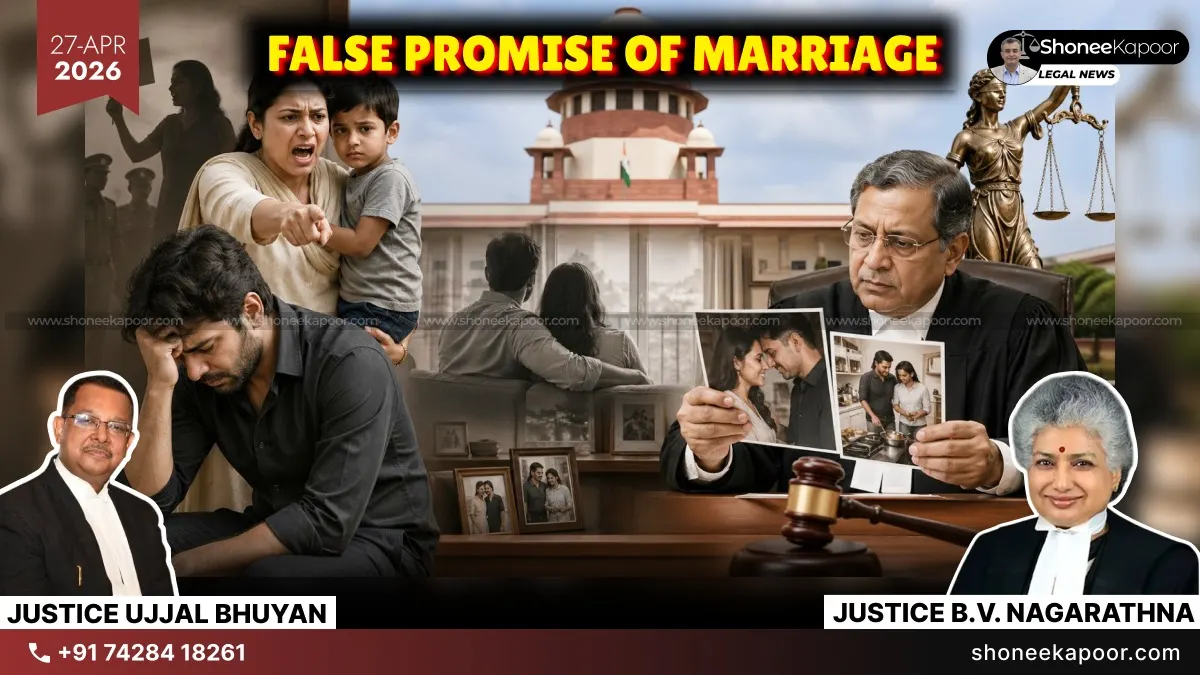
The Supreme Court of India raised broader concerns about increasing criminalisation of failed relationships in modern society.
If both adults lived together willingly for years, can it later be called exploitation just because the relationship breaks down?
NEW DELHI: The Supreme Court of India, while hearing a matter before Justice BV Nagarathna and Justice Ujjal Bhuyan, made important observations in a case where a woman challenged the quashing of her FIR against her former live-in partner.
The case involved allegations of sexual exploitation on a false promise of marriage after both parties reportedly lived together for around 15 years and had a child.
During the hearing, Justice BV Nagarathna directly questioned the basis of such criminal allegations after so many years of cohabitation. The Court said:
“Where is the question of offence when there is a consensual relationship? They are living together and she begets a child from him and then there is no marriage and then she says sexual assault? For how long they lived together? For 15 years they lived together”.
The woman’s lawyer argued that the man knew her through family contacts, allegedly misled her after she became a widow at a young age, and promised marriage. It was claimed that he was already married and had hidden that fact from her.
However, the Court repeatedly focused on the conduct of both adults and the nature of the long relationship. Justice Nagarathna asked:
“Why did she go and live with him before marriage? Now we ask these questions, they will say we are victim-shaming. What is this?”
This observation reflects an important legal concern. In many cases, when two consenting adults voluntarily enter a relationship and later separate, criminal charges are filed only after the relationship collapses. The Court appeared cautious against allowing criminal law to become a weapon in personal disputes.
Justice Nagarathna further made it clear that separation from a live-in relationship does not itself create a criminal offence. She observed:
“She lived with him. She had a child from him. He walks out because there is no marriage bond. Legal bond is not there. He walks out that is the risk in a live in relationship. So once he walks out, it doesn’t become a criminal offence”.
The Court also explained that marriage gives certain legal protections, but parties choosing live-in arrangements accept uncertainty. Justice Nagarathna said:
“These are all the vagaries of a relationship outside marriage…See, if there was marriage, the question of her rights would have been better. She could have filed regarding bigamy. She could have filed for maintenance. She would have got those reliefs. Now since there is no marriage, they live together. This is the risk. They can walk out any day. What do we do?”
The woman’s side continued to argue that the promise of marriage was false from the beginning and that the accused had taken advantage of her vulnerable condition. Allegations were also raised regarding other relationships, but the Court did not entertain unrelated claims and stayed focused on the present dispute.
Justice Nagarathna also questioned why the complaint was filed after many years. She remarked:
“Why at this point of time she has filed a complaint after how many years? See, they are all live in relationship. If they split, the lady has to file a complaint against on the man for sexual assault?”
The Court then shifted focus toward practical justice, especially the welfare of the child born from the relationship. Justice Nagarathna said:
“Even if he is put behind bars, what will she gain? We can think of some maintenance for the child. Child is now 7 years. So he (accused) has deserted her. Will you go for mediation? At least some monetary compensation can be made for the child”
The Supreme Court issued notice in the matter and listed it for further hearing, mainly to see whether settlement or mediation could help secure financial support for the child.
Explanatory Table: Laws And Provisions Involved
| Law / Provision | Purpose | How Applied In This Case |
| Section 69, Bharatiya Nyaya Sanhita, 2024 | Deals with sexual intercourse obtained through deceitful means, including false promise of marriage allegations | Woman alleged the relationship was based on false promise of marriage |
| Section 115(2), Bharatiya Nyaya Sanhita, 2024 | Provision relating to causing hurt / related offence | Included in FIR lodged against the man |
| Section 74, Bharatiya Nyaya Sanhita, 2024 | Provision concerning assault or use of criminal force against a woman / dignity-related offence | Included in FIR allegations |
| Bigamy (general legal remedy) | Action where a person marries again during subsistence of earlier valid marriage | Court observed such remedy may have been available if there had been marriage-related rights |
| Maintenance | Financial support for spouse/child under applicable laws | Court suggested child maintenance or compensation as practical relief |
| Live-in Relationship Principles | Rights and liabilities evolved through judicial precedents | Court discussed risks where parties live together without formal marriage |
Case Details
- Case Title: Prosecutrix of Crime No. 27/2025 v. State of Madhya Pradesh
- Case Number: Diary No. 16669 / 2026
- Court: Supreme Court of India
- Bench: Justice B.V. Nagarathna & Justice Ujjal Bhuyan
- Date of Hearing: 27 April 2026
- Nature of Matter: Challenge to Madhya Pradesh High Court order quashing FIR
Key Takeaways
- Long-term consensual relationships cannot be casually converted into criminal cases after breakup, especially when both adults lived together and had a child.
- Criminal law is increasingly being used as a pressure tactic after failed relationships, which courts are now beginning to question.
- Delay in filing complaints after years of cohabitation weakens credibility and raises serious doubts about intent.
This Could Change Your Case-Get FREE Legal Advice-Click Here!
Disclaimer: The views and opinions expressed in this article are those of the Indian courts and do not necessarily reflect the official policy or position of “ShoneeKapoor.com” or its affiliates. This article is intended for informational and educational purposes only. The content provided is not legal advice, and viewers should not act upon this information without seeking professional counsel. Viewer discretion is advised
