
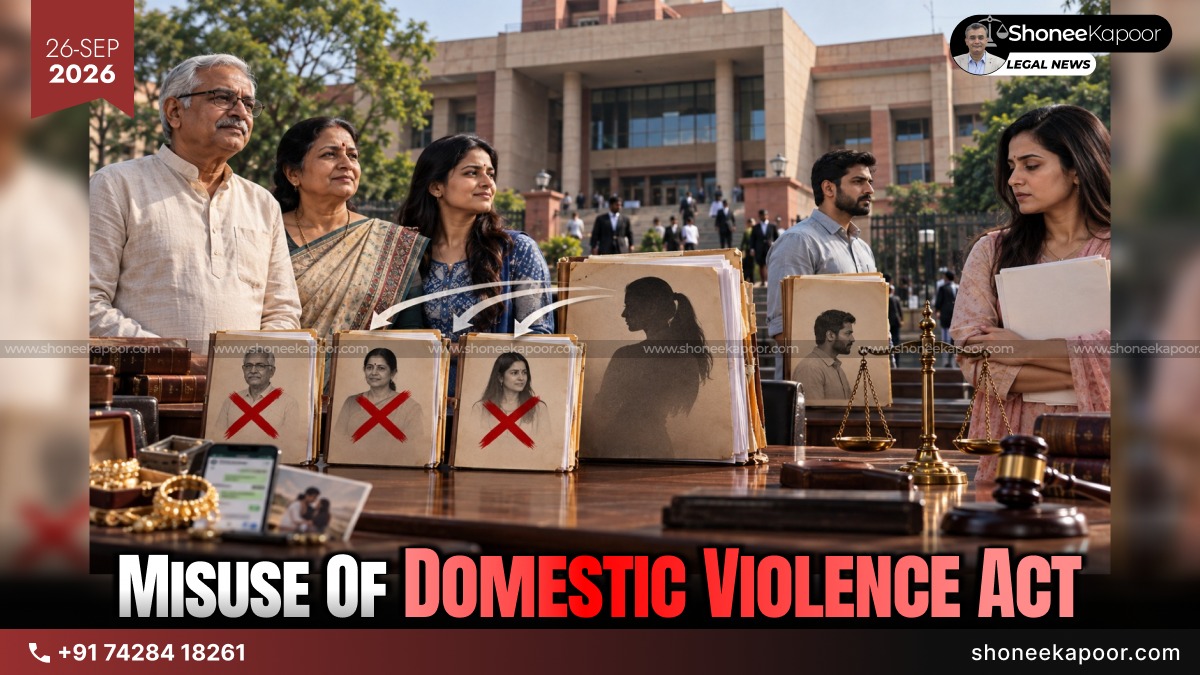
False Domestic Violence Case? Faridabad Court Discharges Husband’s Family, Says Vague & Omnibus Allegations Not Enough to Proceed

Curated by NEWS DESK
Editorial DeskHARYANA: A Faridabad court has ordered the deletion of the husband’s father, mother and sister from a Domestic Violence Act case, holding that relatives cannot be made to face years of litigation merely because they are related to the husband.
Judicial Magistrate First Class Anil Kumar passed the order on September 21, 2026. The father-in-law, mother-in-law and sister-in-law had sought deletion of their names from the case under Sections 25(2) read with 28 of the Protection of Women from Domestic Violence Act, 2005.
The wife had filed proceedings under Section 12 of the DV Act against her husband and his father, mother and sister. The in-laws argued that the husband and wife lived in Noida, while they lived separately in Delhi. They denied demanding dowry or subjecting the wife to physical or mental harassment.
In her reply, the wife alleged that “the respondents” lived with her in Noida and that “on the next day of marriage” harassment and additional dowry demands began. She accused the mother-in-law and sister-in-law of taunting her over istridhan and alleged that the mother-in-law acted “with the sole ulterior motive” and subjected her to mental and physical harassment. The remaining specific allegations largely concerned the husband.
The court examined whether any specific act of “domestic violence” under Section 3 had actually been attributed to each of the three in-laws. It noted that merely being a “relative of the husband” does not automatically justify continuing proceedings against that person.
The court made the principle clear:
“Inclusion in the array of respondents is not automatic upon the person being a relative of the husband.”
Referring to Supreme Court judgments including Preeti Gupta v. State of Jharkhand, Geeta Mehrotra v. State of U.P. and Kahkashan Kausar @ Sonam v. State of Bihar, the Magistrate noted the judicial concern over involving every relative of a husband through bald and omnibus allegations.
The court further observed:
“A person cannot be made to face proceedings on general allegations which do not spell out what that person did.”
Though those Supreme Court decisions concerned Section 498A IPC, the court held that this underlying principle was equally relevant to DV Act proceedings because orders passed against respondents can have serious legal consequences.
For the father-in-law, the court found no specific act, statement, demand or omission. The only allegation covering him was the collective assertion that “the respondents” demanded additional dowry. There were no particulars explaining what was demanded, who demanded it, when it happened or what the father-in-law personally said or did.
The court noted that:
“The father-in-law appears in the array of respondents only by reason of his relationship with the husband. That is not enough.”
Against the mother-in-law and sister-in-law, the allegations concerned taunts about stridhan and cooking, alleged mental and physical pressure, and custody of jewellery. However, the court found that the alleged taunts had no specific date, occasion or event attached to them.
While dealing with these allegations, the court observed that a remark about cooking or the wife’s family, though unpleasant, could amount to:
“the ordinary stuff of domestic friction in an unsettled matrimonial home.”
The allegation that the mother-in-law acted “mentally as well as physically” was also treated as a bare conclusion because no specific physical act, injury, medical examination or complaint was identified.
The court said:
“Such generalities are of the very kind which the Supreme Court has held insufficient to fasten a person with liability.”
The wife also alleged that the mother-in-law and sister-in-law “kept the entire gold jewellery in their custody”. However, the court noted that she did not specify what jewellery was involved, when or to whom it was entrusted, whether she demanded its return or whether access to it was refused.
On this allegation, the court held:
“Mere custody of jewellery by the elders of a household, without a demand and refusal or any averment of deprivation, does not amount to economic abuse.”
The court also considered WhatsApp communications produced by the in-laws. While it did not decide their admissibility or final evidentiary value, it noted that their authenticity had not been specifically denied. The material gave some support to the sister-in-law’s case that she showed no hostility towards the wife.
Importantly, the court observed that deleting the three in-laws would not take away the wife’s substantive remedies because reliefs under Sections 18 to 22 of the DV Act could still be pursued against the husband, against whom the complaint would continue.
At the same time, the court noted that the relatives, including the father-in-law, stated to be about 64 years old, could otherwise be forced to face litigation for years despite the absence of allegations explaining what each of them had actually done.
The court held that:
“Such a prospect, in the circumstances of this case, would amount to an abuse of process.”
Ultimately, the court found no specific act of domestic violence against the father-in-law and held that the allegations against the mother-in-law and sister-in-law were omnibus and unparticularised.
The court therefore ordered the deletion of their names, and all three stood discharged from the DV proceedings.
However, the DV case against the husband will continue independently and will be decided on its own merits. The court also clarified that if evidence during trial later shows that any deleted relative committed or abetted an act of domestic violence, the wife can seek their impleadment again.
EXPLANATORY TABLE OF LAWS AND SECTIONS
| Law / Section | What It Means | Relevance To This Case |
|---|---|---|
| Section 2(a), DV Act | Defines an “aggrieved person”. | Relevant to who can seek relief under the Act. |
| Section 2(f), DV Act | Defines “domestic relationship”. | Court examined whether the relationship requirement applied to the in-laws. |
| Section 2(q), DV Act | Defines “respondent”; after Hiral P. Harsora, proceedings are not restricted to adult male respondents. | Relatives can be respondents, but relationship alone does not establish a cause of action. |
| Section 2(s), DV Act | Defines shared household. | Applicants relied on their separate residence while opposing their inclusion. |
| Section 3, DV Act | Defines domestic violence, including physical, verbal, emotional and economic abuse. | The court examined whether the pleadings alleged specific acts satisfying this definition against each in-law. |
| Section 12, DV Act | Enables an aggrieved person to approach the Magistrate for relief. | Wife's main DV proceedings were filed under this provision. |
| Sections 18–22, DV Act | Provide protection, residence, monetary, custody and compensation remedies. | Court said these remedies could still be pursued against the husband. |
| Section 25(2), DV Act | Permits alteration, modification or revocation of an order after a change in circumstances. | Applicants invoked it, but the court did not base its jurisdiction on this section alone. |
| Section 28(1), DV Act | Applies criminal procedure to specified DV proceedings. | Forms part of the procedural framework considered by the court. |
| Section 28(2), DV Act | Allows the court to lay down its own procedure for disposal of a Section 12 application. | Court treated the deletion application substantively under this provision. |
| Section 31, DV Act | Provides criminal consequences for breach of a protection order. | Cited while explaining why unsupported proceedings against a respondent can have serious consequences. |
| Section 498A IPC | Penal provision concerning cruelty by husband or his relatives. | The Court relied on Supreme Court precedents on vague and omnibus allegations under this provision to articulate the broader principle. |
| Article 14, Constitution of India | Guarantees equality before law and equal protection of laws. | Mentioned through Hiral P. Harsora, which struck down the words “adult male” from Section 2(q). |
CASE DETAILS
| Particular | Details |
|---|---|
| Case Title | PB v. SS & Ors. |
| Court | Judicial Magistrate First Class, Faridabad |
|
Counsels for Respondents
|
Tripaksha Litigation Through Vaibhav Nijhawan, Advocate and Ishita Ahuja, Advocate
|
KEY TAKEAWAYS
- Being the husband’s relative is not enough to drag someone through years of a DV case. Specific allegations against each person matter.
- Father-in-law discharged: The court found no specific act, demand or statement against him. A collective allegation against “the respondents” was insufficient.
- Vague allegations cannot become lifelong litigation: The court found the accusations against the mother-in-law and sister-in-law omnibus and unparticularised.
- Every matrimonial dispute is not domestic violence: The court distinguished ordinary domestic friction from legally actionable domestic violence.
- The process itself can become punishment: Making family members face years of proceedings without allegations showing what they personally did can amount to an “abuse of process.”
Share Your Thoughts
Comments are moderated before publication.