
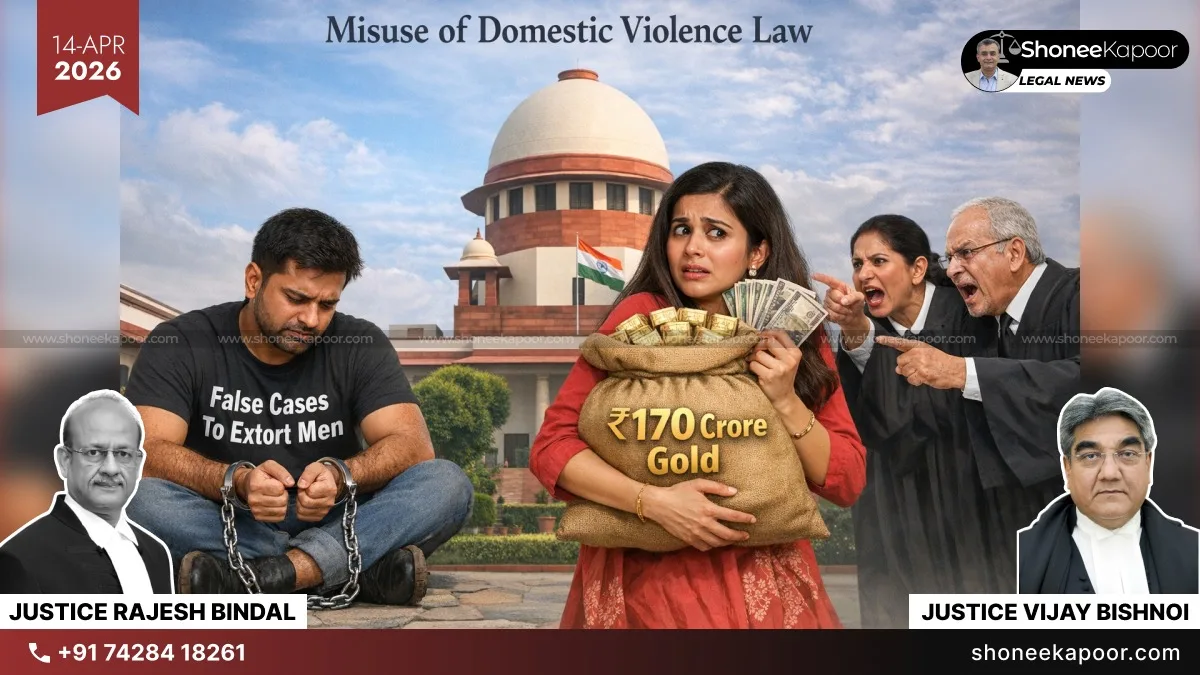
Was ₹170 crore gold really promised—or was it added later to build pressure? Why did the Supreme Court say such cases must be stopped at the very start?
NEW DELHI: The Supreme Court has dismissed a woman’s claim of ₹170 crore worth of gold against her estranged husband and his family, and quashed the domestic violence case filed by her. The court made it clear that cases without clear and specific allegations cannot be allowed to continue.
The matter came before a bench of Justices Rajesh Bindal and Vijay Bishnoi, where the husband had challenged a Delhi High Court order that allowed the domestic violence case to proceed despite an earlier settlement between both parties.
The Supreme Court clearly held:
“A criminal complaint regarding domestic violence, with mere reference to the names of the family members or the husband without any specific allegation that points towards their active involvement in commission of such an act of violence, shall be nipped in the bud.”
The court found the domestic violence case to be an “afterthought”.
It observed:
“While we are conscious of the fact that the parties to a long standing marital dispute are often fuelled by emotions, we cannot allow such emotions to take a drastic turn in as much as allowing the bursts of emotions to form the basis of criminal prosecution. Such criminal prosecution, if allowed, would lead to an abuse of law and cause harassment.”
A major issue in the case was the woman’s claim that she was promised ₹120 crore worth of jewellery and ₹50 crore in gold biscuits as part of a settlement. However, the Supreme Court found this claim to be completely unsupported by evidence.
The alleged ₹170 crore promise was not mentioned in the written settlement agreement, nor in any prior communication. Even documents submitted earlier by the woman did not include such a claim. The court noted that this demand appeared only later in the domestic violence complaint.
The explanation given—that such terms were kept out of the agreement to avoid tax issues—was strongly criticised by the court as “egregious”.
The court also noted that the woman was legally represented, and therefore could not later rely on unwritten and unverified claims of such huge amounts to back out of a formal settlement.
On examining the domestic violence complaint, the court found no detailed or specific allegations. There were no clear incidents of violence described, and the claims were general in nature.
Importantly, the court observed that during the long marriage, no such allegations were raised. The complaint was filed only after partial execution of the settlement and after the woman refused to proceed with the second motion of divorce.
This delay and timing led the court to conclude that the case was “premeditated” and filed later to continue litigation pressure. The court also noted that many allegations appeared to be “trivial disagreements exaggerated” to invoke criminal law.
The marriage, which began on February 19, 2000, had broken down over time, with both parties living separately since around 2022-23. The husband had filed for divorce in 2023 on grounds of cruelty and adultery.
The matter went to mediation, and both parties entered into a settlement on May 16, 2024. Under this, a total financial settlement of ₹1.5 crore and other asset transfers were agreed upon.
The husband had already paid substantial amounts, including ₹75 lakh, ₹14 lakh for a car, and returned jewellery. The wife had also transferred over ₹2.52 crore as part of financial adjustments.
However, the dispute escalated when the woman withdrew from the settlement and filed the domestic violence case in October 2025 against the husband and his mother.
The Supreme Court emphasized that emotional disputes in marriage cannot be converted into criminal cases without solid evidence. It warned that allowing such cases would lead to harassment and misuse of legal provisions meant for genuine protection.
The judgment also reinforced that once a settlement is voluntarily entered into and acted upon, it cannot be casually withdrawn unless there is clear proof of fraud, coercion, or breach.
Finding no such grounds, the court held the withdrawal from settlement to be unjustified.
Finally, using its powers under Article 142 of the Constitution, the Supreme Court dissolved the marriage, observing that the relationship had become “emotionally dead” and the “sacrosanct thread” of marriage had broken completely.
To bring full closure, the court directed the husband to pay the remaining ₹70.22 lakh within two weeks, complete all property transfers, and ordered that ₹89 lakh deposited by the wife be returned with interest. All ongoing civil and criminal cases between the parties were closed.
This judgment once again highlights that criminal law cannot be used as a pressure tool in matrimonial disputes, especially when claims are vague, delayed, and unsupported by evidence.
Explanatory Table – Laws & Legal Principles Involved
| Law / Section | Provision | What It Means in Law | How Supreme Court Applied It |
| Protection of Women from Domestic Violence Act, 2005 | Civil + quasi-criminal remedy for protection against domestic abuse | Requires specific, factual allegations of violence | Court held vague and general allegations without details are not maintainable |
| Criminal Jurisprudence Principle | Abuse of process of law | Courts must prevent misuse of legal process for harassment | Court said such complaints must be “nipped in the bud” if baseless |
| Evidence Law (General Principle) | Burden of proof | Person making a claim must prove it with evidence | ₹170 crore gold claim rejected as completely unsubstantiated |
| Settlement Agreement (Contract Law Principles) | Binding nature of settlement | Parties cannot back out without valid grounds (fraud, coercion etc.) | Court held withdrawal from settlement unjustified |
| Article 142 of the Constitution of India | Complete justice power of Supreme Court | SC can pass any order to do complete justice | Marriage dissolved despite procedural hurdles |
| Family Law (Mutual Consent Divorce – HMA Sec 13B) | Divorce through consent of both parties | Requires two motions and continued consent | Wife withdrawing consent after partial execution seen negatively |
| Criminal Law Safeguard | Protection against false implication | Criminal law cannot be used as pressure tactic | Court flagged “premeditated” litigation strategy |
Case Details
| Particular | Details |
| Case Title | Wife vs Husband |
| Nature of Case | Criminal Appeal before Supreme Court |
| Bench | Justices Rajesh Bindal and Vijay Bishnoi |
| Date of Judgment | April 13 |
| Court | Supreme Court of India |
| Originating Order Challenged | Delhi High Court order allowing DV proceedings |
| Key Issue | Validity of domestic violence complaint and ₹170 crore gold claim |
| Final Outcome | DV case quashed, marriage dissolved under Article 142 |
Key Takeaways
- Vague domestic violence allegations without specific incidents are legally unsustainable and must be dismissed at the threshold.
- Inflated and unverified financial claims are increasingly being used as pressure tactics in matrimonial disputes against men.
- Filing criminal cases after backing out of settlements reflects a clear pattern of litigation misuse to prolong harassment.
- Courts have now acknowledged that emotional disputes are being converted into criminal prosecution without evidence.
- This judgment is a strong signal that the legal system will not tolerate the weaponisation of protective laws to target husbands and their families.
This Could Change Your Case-Get FREE Legal Advice-Click Here!
Disclaimer: The views and opinions expressed in this article are those of the Indian courts and do not necessarily reflect the official policy or position of “ShoneeKapoor.com” or its affiliates. This article is intended for informational and educational purposes only. The content provided is not legal advice, and viewers should not act upon this information without seeking professional counsel. Viewer discretion is advised.
