
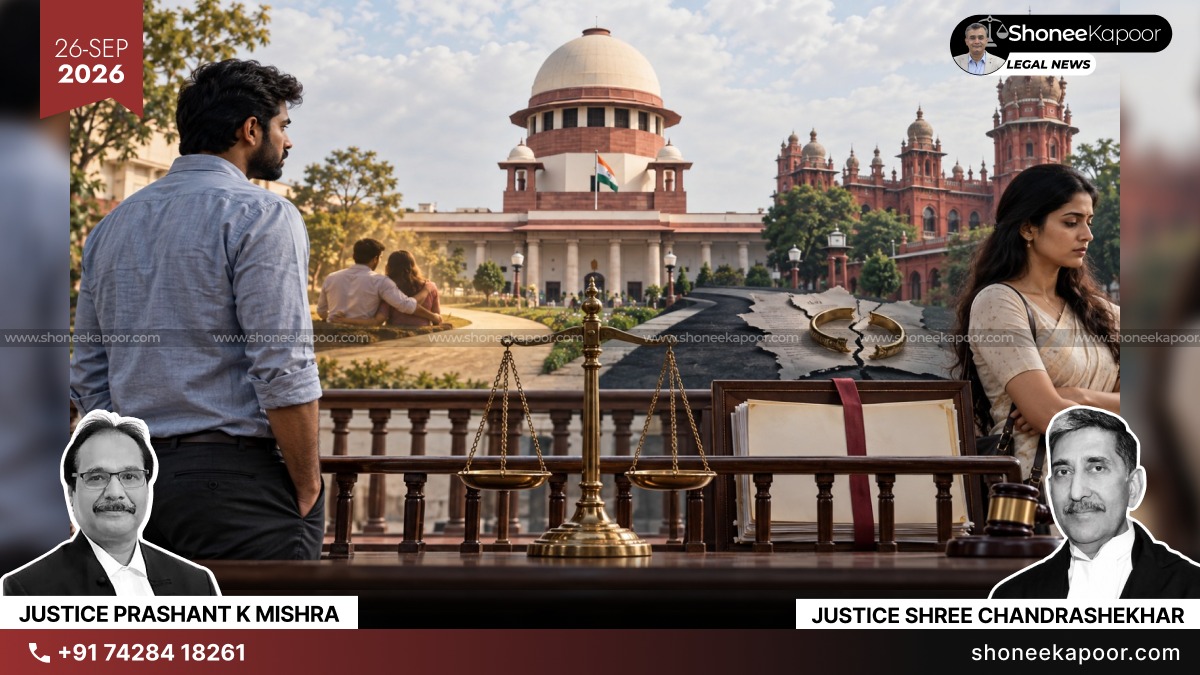
Failed Consensual Relationship Turned Into Rape Case? Supreme Court Stays Proceedings Against Man

Curated by NEWS DESK
Editorial DeskNEW DELHI: The Supreme Court of India has issued notice and stayed further Trial Court proceedings in a criminal case against a man involving allegations under Section 376 IPC arising from a relationship where the woman alleged that sexual relations took place on a promise of marriage.
The Court passed the order on 18 September 2026. The petition challenges the Madras High Court’s judgment dated 1 June 2026 in Crl. O.P.(MD) No.1760/2025, by which the High Court refused to quash the criminal proceedings.
According to the case background before the Madras High Court, the petitioner and the de facto complainant had been in a relationship. The prosecution alleged that the petitioner had sexual relations with her after assuring her that he would marry her. The petitioner, however, maintained that the relationship between two adults was consensual and disputed the allegation that consent had been obtained through a false promise of marriage.
The FIR was initially registered for offences under Sections 294(b), 417 and 506(i) IPC. During investigation, Section 376 IPC was subsequently added. The final report alleged offences under Sections 294(b), 376, 417 and 506(i) IPC, along with Section 4 of the Tamil Nadu Prohibition of Harassment of Women Act, 2002.
A significant part of the petitioner’s case was that the complainant’s versions at different stages allegedly did not support the later accusation of rape. He also relied upon the nature and duration of the relationship and other surrounding circumstances to argue that a consensual relationship was subsequently given a criminal colour after the relationship failed.
The petitioner further argued before the High Court that there is an important legal distinction between a breach of a promise to marry and a false promise made from the very beginning to obtain sexual consent. He argued that the material did not establish that he made a false promise of marriage at the inception of the relationship.
The complainant opposed quashing and maintained that her consent had been obtained on the assurance of marriage. The Madras High Court held that questions concerning the petitioner’s intention, the nature of consent, and the parties’ conduct involved disputed facts that should ordinarily be tested at trial.
The High Court therefore declined to terminate the prosecution while exercising its inherent jurisdiction under Section 528 BNSS. It dismissed the petitioner’s quashing petition on 1 June 2026.
The man thereafter approached the Supreme Court through Special Leave Petition (Criminal) No.15444/2026. The matter came before a Bench comprising Justice Prashant Kumar Mishra and Justice Shree Chandrashekhar on 18 September 2026.
The Supreme Court has therefore not quashed the rape case at this stage. It has issued notice in the man’s challenge and protected him from further Trial Court proceedings until further orders.
The Supreme Court will now examine the matter further after hearing the respondents.
EXPLANATORY TABLE OF LAWS AND SECTIONS
| Law / Section | What It Means | Relevance To This Case |
|---|---|---|
| Section 376 IPC | Punishment for rape under the IPC applicable to the alleged offence. | Added during investigation. The prosecution alleges sexual relations based on a promise of marriage; the petitioner disputes the rape allegation and relies on the consensual nature of the relationship. |
| Section 417 IPC | Punishment for cheating. | The allegation concerns alleged inducement connected with the promise of marriage. |
| Section 294(b) IPC | Covers obscene words/acts in or near a public place, subject to statutory ingredients. | The FIR was initially registered including this provision. |
| Section 506(i) IPC | Punishment for criminal intimidation falling within the first part of Section 506. | Part of the original FIR and subsequent final report. |
| Section 4, Tamil Nadu Prohibition of Harassment of Women Act, 2002 | Penal provision dealing with harassment of women under the State enactment. | Added to the offences alleged in the final report. |
| Section 528 BNSS, 2023 | Preserves the High Court’s inherent powers to make orders necessary to give effect to the BNSS, prevent abuse of court process, or secure the ends of justice. | The petitioner invoked this provision before the Madras High Court seeking quashing of the criminal proceedings. |
| Article 136, Constitution of India | Gives the Supreme Court discretionary jurisdiction to grant special leave to appeal. | The petitioner approached the Supreme Court through an SLP against the Madras High Court judgment. |
CASE DETAILS
| Particular | Details |
|---|---|
| Case Title | A v. State of Tamil Nadu & Anr. |
| Court | Supreme Court of India |
| Case No. | SLP (Crl.) No.15444/2026 |
| Impugned Case | Crl.O.P.(MD) No.1760/2025 |
| Impugned Judgment | Madras High Court, Madurai Bench, dated 01.06.2026 |
| Supreme Court Order Date | 18.09.2026 |
| Bench | Justice Prashant Kumar Mishra and Justice Shree Chandrashekhar |
| Petitioner Counsel | Tripaksha Litigation Through Mr R D Singh, Adv.; Ms Divya Tripathi, Adv.; Mr Siddhant Sehgal, Adv.; Mr Ashish Choudhury, AOR; Ms Prachi Grover, Adv.; Mr Anand Kamal, Adv.; Mr Abhishek Arora, Adv. |
KEY TAKEAWAYS
- Consensual relationship, then a rape case- the man maintained the relationship was consensual. After it ended, he faced a case that later included Section 376 IPC.
- Rape charge was added later- the original FIR did not contain Section 376 IPC. It was added during investigation.
- Changing versions can cost a man dearly- The petitioner relied on alleged inconsistencies in the woman’s statements while challenging the case.
- A failed relationship is not automatically rape- The key question is whether consent was obtained through a false promise to marry made from the beginning.
- Supreme Court stayed the trial- The Supreme Court issued notice and stayed further proceedings in the Trial Court. The case remains pending.
Share Your Thoughts
Comments are moderated before publication.