
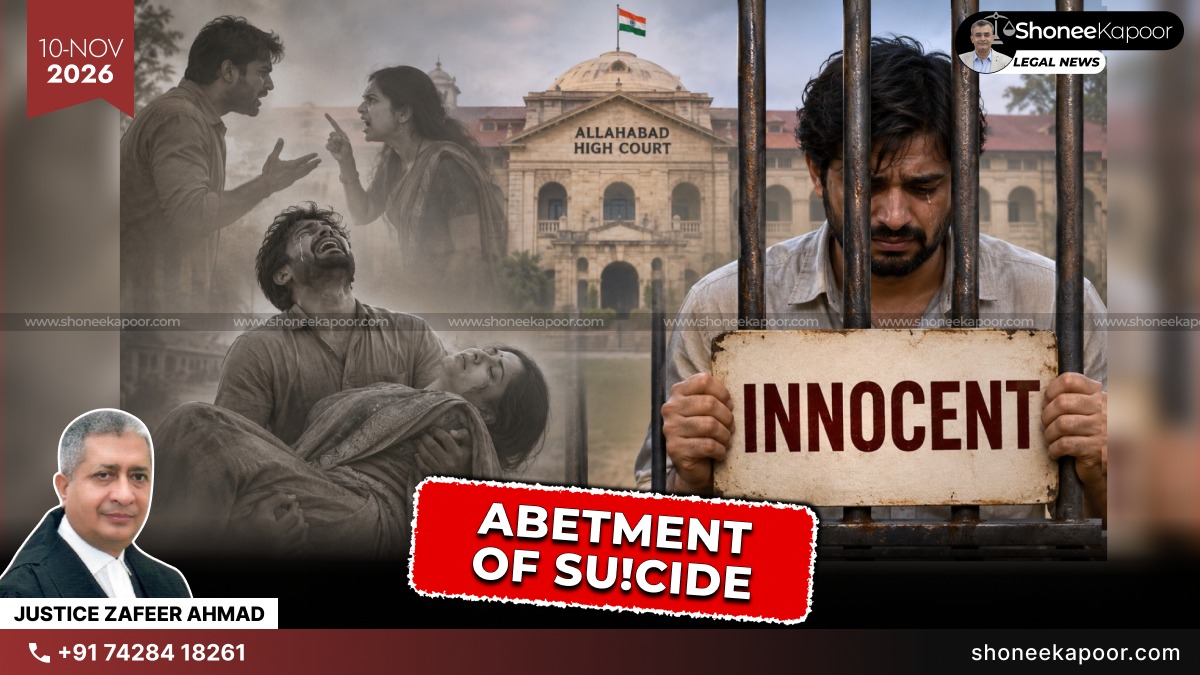
Husband Telling Wife To 'Go And Die' Is Not Abetment Of Suicide: Allahabad High Court Acquits Man After 7-Year Jail Sentence

Written and analysed by Vaibhav Ojha
Head Of Legal CommunicationsPRAYAGRAJ: The Allahabad High Court has ruled that telling someone to "die" or "go and die" does not automatically amount to abetment of suicide under Section 306 of the Indian Penal Code (IPC). The Court clarified that angry words, marital disputes or allegations of harassment cannot alone establish criminal liability unless the prosecution proves the essential ingredients of abetment.
Justice Zafeer Ahmad delivered the judgment while allowing an appeal filed by Shiv Ram, who had been sentenced to seven years of rigorous imprisonment following his wife's suicide. The High Court found serious contradictions in the prosecution evidence and held that the trial court had failed to identify any specific act showing that the husband intentionally instigated or aided the suicide.
The Court observed:
“An expression such as “die” or “go and die”, even if proved to have been uttered, cannot invariably be treated as an act of instigation. The Court must examine the surrounding circumstances, the manner in which the words were uttered, the occasion, the conduct preceding and following the utterance, its proximity to the suicide, and whether the utterance, viewed objectively, was intended to provoke or encourage the deceased to take her own life. Criminal law makes it clear that the law does not treat every angry, abusive or emotionally charged utterance as instigation within Section 107 IPC.”
The case arose from the death of Ramdasa, who had been married to Shiv Ram for approximately 20 years. The couple had no children.
On September 15, 2023, the deceased woman's brother, Lallu, lodged a police complaint alleging that Shiv Ram regularly harassed his wife over her childlessness and physical disability. He claimed that the husband repeatedly asked her to hang herself or jump into a river.
Ramdasa had died by hanging during the intervening night of September 9 and 10, 2023.
Based on the complaint, Police Station Asandra in Barabanki registered FIR No. 414 of 2023 under Section 306 IPC.
Following the investigation and trial, the Sessions Judge, Barabanki, convicted Shiv Ram on March 9, 2025, sentencing him to seven years of rigorous imprisonment and imposing a fine of ₹20,000.
Challenging the conviction before the Allahabad High Court, the husband argued that the prosecution had failed to prove any intentional act of instigation or assistance in the suicide.
His counsel submitted that the allegations were mainly based on statements from the deceased woman's relatives, whose evidence contained important contradictions and omissions.
The defence also questioned the delay in registering the FIR and the absence of independent evidence supporting the allegations of continuous harassment.
During his examination under Section 313 CrPC, Shiv Ram denied the accusations. He stated that his wife had suffered from tuberculosis for a long time and that he had arranged medical treatment for her. According to his explanation, her prolonged illness and resulting depression had contributed to her suicide.
The State opposed the appeal, arguing that the statements of the deceased woman's relatives established repeated harassment and humiliation over her childlessness and physical condition.
However, after examining the evidence, the High Court found that the prosecution had failed to establish the alleged harassment beyond reasonable doubt.
The Court noted that despite allegations of harassment throughout a marriage lasting nearly two decades, there was no contemporaneous complaint, letter, medical record or other independent material supporting the claim of continuous cruelty.
It also examined the statement of the deceased woman's brother, who claimed that she had telephoned him on September 8, 2023, complaining that her husband had beaten her and told her to commit suicide.
During cross-examination, however, he admitted that he had not disclosed this important conversation to the police during the investigation.
He had also failed to mention that Shiv Ram himself had contacted him to report that his wife was missing.
The High Court considered these omissions significant because the alleged telephone conversation was presented as an important incident immediately preceding the suicide.
The Court observed:
“General allegations of taunting or discord, without reliable evidence of the nature, continuity and proximity of the alleged conduct, cannot be elevated into proof of criminal harassment merely because the deceased subsequently committed suicide.”
Another important fact was that Shiv Ram himself had first informed the police about his wife's death.
The Investigating Officer confirmed that none of the villagers present during the inquest had attributed the suicide to harassment by the husband, even though members of both families were present.
The medical evidence also raised questions about the prosecution's allegations of repeated physical assault.
The post-mortem examination confirmed death due to hanging but found no injury apart from the ligature mark around the neck.
The Court clarified that medical injuries are not always necessary to establish cruelty. However, where repeated physical assault is specifically alleged, the absence of supporting injuries becomes relevant while assessing the evidence.
The High Court also considered the testimony of a prosecution witness who stated that the deceased had been ill and that her husband was arranging treatment for her. Other witnesses claimed they were unaware of her illness or treatment.
These inconsistencies, along with the unexplained delay of five days in lodging the FIR, created reasonable doubt about the prosecution's version.
Examining the legal requirements of abetment, the Court explained that Section 306 IPC must be read together with Section 107 IPC.
Section 107 recognises three forms of abetment: instigating a person to commit an act, participating in a conspiracy followed by an act or illegal omission, and intentionally aiding the commission of an act.
The Court referred to Supreme Court decisions, including Prakash v. State of Maharashtra, Arnab Manoranjan Goswami v. State of Maharashtra, Ramesh Kumar v. State of Chhattisgarh, S.S. Chheena v. Vijay Kumar Mahajan and State of West Bengal v. Orilal Jaiswal.
These judgments explain that abetment requires legally established participation, the necessary criminal intention and a sufficiently close connection between the accused's conduct and the suicide.
The High Court emphasised that matrimonial disagreements, unpleasant conduct or even allegations of harassment do not automatically satisfy these legal requirements.
It found that the trial court had relied on the fact of suicide and the allegations against the husband without identifying the specific conduct that legally constituted abetment.
The Court observed:
“The omission is particularly material here because suicide is not synonymous with abetment of suicide. The former establishes the occurrence, the latter requires proof of the accused's legally culpable participation in bringing about that occurrence.”
The High Court held that the trial court had committed a fundamental legal error by failing to examine whether Shiv Ram had intentionally instigated, conspired in or aided his wife's suicide.
It further found that the prosecution had not established the necessary criminal intention or a direct and sufficiently close connection between the husband's alleged conduct and the death.
The Court concluded that the contradictions, missing evidence, unexplained FIR delay and failure to prove the statutory ingredients of abetment entitled the accused to the benefit of reasonable doubt.
Accordingly, the Allahabad High Court allowed Shiv Ram's appeal, set aside his conviction and seven-year prison sentence, and acquitted him of the charges.
The Court directed his immediate release, provided he was not required in any other case, subject to furnishing bonds under Section 437-A CrPC.
LAWS AND SECTIONS EXPLAINED
| LAW / SECTION | LEGAL PROVISION | RELEVANCE TO JUDGMENT |
|---|---|---|
| Section 306 IPC | Abetment of suicide | Husband was convicted under this section; conviction overturned because abetment was not proved. |
| Section 107 IPC | Definition of abetment | Requires instigation, conspiracy involving an act or illegal omission, or intentional aid. |
| Section 313 CrPC | Examination of accused | Husband denied allegations and explained his wife's illness and treatment. |
| Section 374(2) CrPC | Appeal against conviction | Former procedural provision corresponding to Section 415(2) BNSS, noted by the Court. |
| Section 415(2) BNSS, 2023 | Appeal against conviction | Provision under which the criminal appeal was filed. |
| Section 437-A CrPC | Bail bonds for appearance before higher court | Husband directed to furnish bonds before release. |
SUPREME COURT JUDGMENTS RELIED UPON OR DISCUSSED
| JUDGMENT | LEGAL PRINCIPLE |
|---|---|
| Prakash v. State of Maharashtra, AIR 2024 SC (Supp) 2300 | Suicide and legally established abetment are separate requirements; intention and proximity matter. |
| Arnab Manoranjan Goswami v. State of Maharashtra, (2021) 2 SCC 427 | Cited by defence on the requirement of legally sufficient evidence of abetment. |
| Ramesh Kumar v. State of Chhattisgarh, (2001) 9 SCC 618 | Angry or emotional words do not automatically constitute instigation. |
| S.S. Chheena v. Vijay Kumar Mahajan, (2010) 12 SCC 190 | Abetment requires criminal intention and an active act of instigation or intentional aid. |
| State of W.B. v. Orilal Jaiswal, (1994) 1 SCC 73 | Ordinary matrimonial disputes cannot alone establish abetment of suicide. |
CASE DETAILS
| PARTICULARS | DETAILS |
|---|---|
| Case Title | Shiv Ram v. State of U.P. Through Principal Secretary, Department of Home, Lucknow |
| Court | Allahabad High Court, Lucknow Bench |
| Case Number | Criminal Appeal No. 779 of 2026 |
| Bench | Justice Zafeer Ahmad (Single Judge) |
| Reserved On | 20 August 2026 |
| Delivered On | 29 September 2026 |
| Counsel for Appellant | Nisha Srivastava, Preeti Devi |
| Counsel for Respondent | Government Advocate (G.A.); A.G.A. appeared for State |
| FIR Number | 414 of 2023 |
| Police Station | Asandra, District Barabanki, Uttar Pradesh |
| Trial Case | Sessions Trial No. 143 of 2024 |
| Trial Court | Sessions Judge, Barabanki |
| Trial Court Order | 9 March 2025 |
| Original Punishment | 7 years' rigorous imprisonment and ₹20,000 fine |
| High Court Decision | Appeal allowed; conviction and sentence set aside; husband acquitted |
KEY TAKEAWAYS
- Husband Acquitted: Allahabad HC overturned his 7-year prison sentence in wife's suicide case.
- "Go And Die" Is Not Automatically Abetment: Angry words alone cannot establish criminal guilt.
- Allegations Are Not Evidence: Contradictions and lack of reliable proof weakened the prosecution case.
- Delayed FIR Raised Serious Doubts: Five-day delay and missing crucial details undermined the allegations.
- Suicide Does Not Prove Husband's Guilt: Criminal intention and actual abetment must be proved beyond reasonable doubt.
Share Your Thoughts
Comments are moderated before publication.