
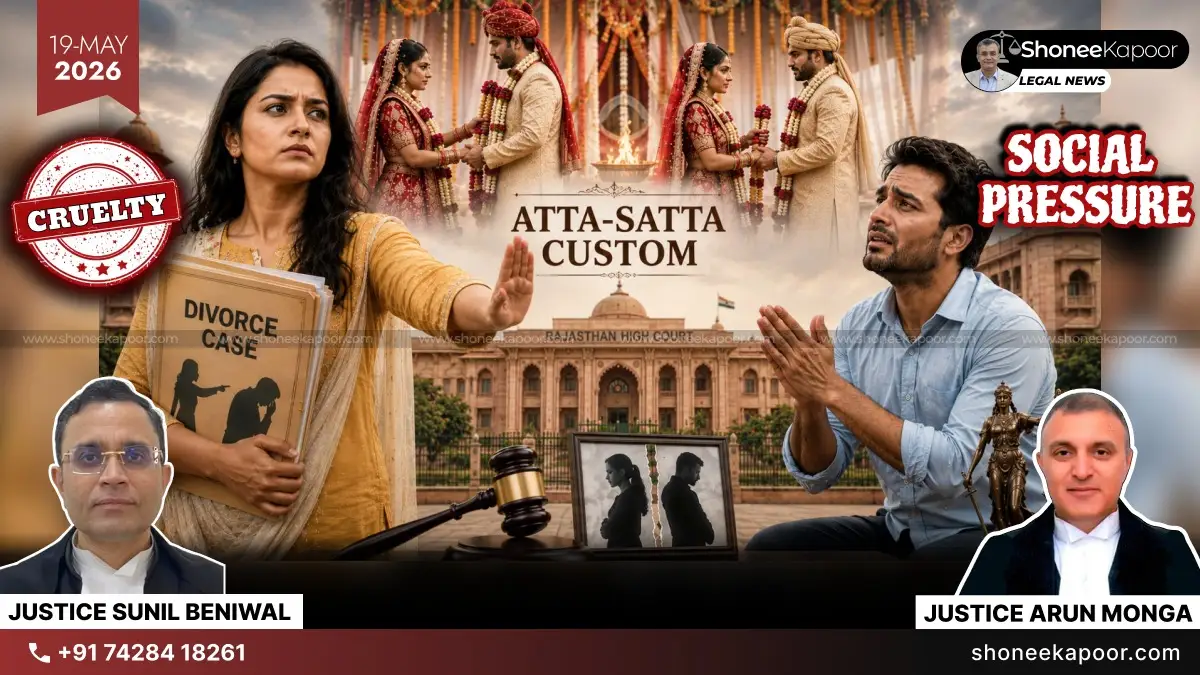
Can Living Together For Years Still Amount To Mental Cruelty In Marriage? Rajasthan High Court Gives Important Observation
JODHPUR: The Rajasthan High Court at Jodhpur, comprising Justice Arun Monga and Justice Sunil Beniwal, allowed a wife’s divorce appeal and set aside a Family Court judgment which had earlier refused to dissolve the marriage.
The case arose from an “atta-satta” marriage arrangement, a custom where two families exchange daughters in marriage.
The parties got married in 2016. On the same day, the husband’s minor sister was also married to the wife’s brother under the same reciprocal arrangement. Problems started later when the husband’s sister refused to continue that marriage after becoming major. According to the husband, this dispute created pressure from the wife’s family and eventually damaged his own marriage as well.
The wife later filed a divorce case alleging cruelty, dowry harassment and physical assault. She also lodged an FIR under Sections 498-A, 406, 323 and 34 IPC against the husband and his family members. However, the Family Court dismissed her divorce petition and accepted the husband’s argument that the real reason behind the marital breakdown was the collapse of the connected atta-satta marriage involving his sister.
While hearing the appeal, the High Court observed that the Family Court became too influenced by the family dispute linked to atta-satta instead of independently examining the matrimonial relationship between the parties. At the same time, the Court also recognised the harsh reality that such reciprocal marriage systems naturally place both families on a “collision path” when one marriage faces trouble.
The Court observed that:
“In an ‘atta-satta’ framework, families often treat both marriages as interconnected.”
The High Court held that merely staying together under one roof does not automatically mean the marriage was peaceful or free from cruelty. The judges noted that many spouses continue living together because of social pressure, financial dependency or lack of support.
The Court further observed:
“Mere shared physical residence does not always equate to harmonious cohabitation.”
During the hearing, the wife gave up all claims of past, present and future maintenance and permanent alimony in order to end the dispute permanently and “buy peace for posterity.”
The Court recorded this statement and clarified that no future financial claims could be made against the husband after the divorce decree.
The judgment also contained strong observations against the atta-satta custom, especially where minors are involved. The Court said no custom or social practice can override statutory law or individual consent.
The judges remarked:
“What is presented as a community custom is, in substance, an exchange transaction in human lives.”
The Court further said:
“Such a structure is fundamentally unjust because it denies individuality and turns marriage into mutual hostage-taking between families.”
In the end, the Rajasthan High Court dissolved the marriage under Section 13 of the Hindu Marriage Act and reversed the Family Court judgment. The Court clarified that its observations were only for deciding the divorce case and would not affect the pending criminal or custody proceedings between the parties.
Explanatory Table: Laws And Sections Involved
| Law / Section | Purpose | How Applied In This Case |
| Section 13, Hindu Marriage Act, 1955 | Provides grounds for divorce including cruelty. | High Court granted divorce under this provision. |
| Section 125 CrPC | Provides maintenance to dependent wife, children or parents. | Wife had filed maintenance proceedings during the dispute. |
| Section 498-A IPC | Punishes cruelty by husband or in-laws. | FIR was registered alleging cruelty and dowry harassment. |
| Section 406 IPC | Deals with criminal breach of trust. | Invoked over alleged non-return of stridhan articles. |
| Section 323 IPC | Punishes voluntarily causing hurt. | Applied due to allegations of physical assault. |
| Section 34 IPC | Covers acts done with common intention by multiple persons. | Applied against husband and family members together. |
| Sections 107 & 116(3) CrPC | Preventive action to maintain peace. | Proceedings were initiated during family disputes over atta-satta marriage. |
| Prohibition of Child Marriage Act, 2006 | Prohibits child marriages. | Court criticised atta-satta involving a minor girl. |
Case Details
- Case Title: Wife v. Husband
- Court: High Court of Judicature for Rajasthan at Jodhpur
- Case Number: D.B. Civil Miscellaneous Appeal No. 3506/2025
- Neutral Citation: 2026:RJ-JD:16834-DB
- Date of Judgment: 10/04/2026
- Bench: Hon’ble Mr. Justice Arun Monga | Hon’ble Mr. Justice Sunil Beniwal
- Counsels:
- For Appellant: Mr. DK Gaur
- For Respondent: Mr. Nitesh Mathur
Key Takeaways
- When marriages are treated like family barter deals, one failed relationship often destroys multiple lives together.
- Men trapped in reciprocal marriage systems are frequently pressured, emotionally blackmailed and blamed for disputes they never personally created.
- Living together for years does not automatically mean a marriage was peaceful, but false assumptions in matrimonial cases can deeply damage husbands as well.
- Criminal cases, family pressure and social customs often become weapons in marital conflicts instead of genuine attempts to resolve disputes.
- No tradition should be allowed to turn marriages into “mutual hostage-taking” where one family’s personal decision triggers retaliation against another couple.
This Could Change Your Case-Get FREE Legal Advice-Click Here!
Disclaimer: The views and opinions expressed in this article are those of the Indian courts and do not necessarily reflect the official policy or position of “ShoneeKapoor.com” or its affiliates. This article is intended for informational and educational purposes only. The content provided is not legal advice, and viewers should not act upon this information without seeking professional counsel. Viewer discretion is advised.
