
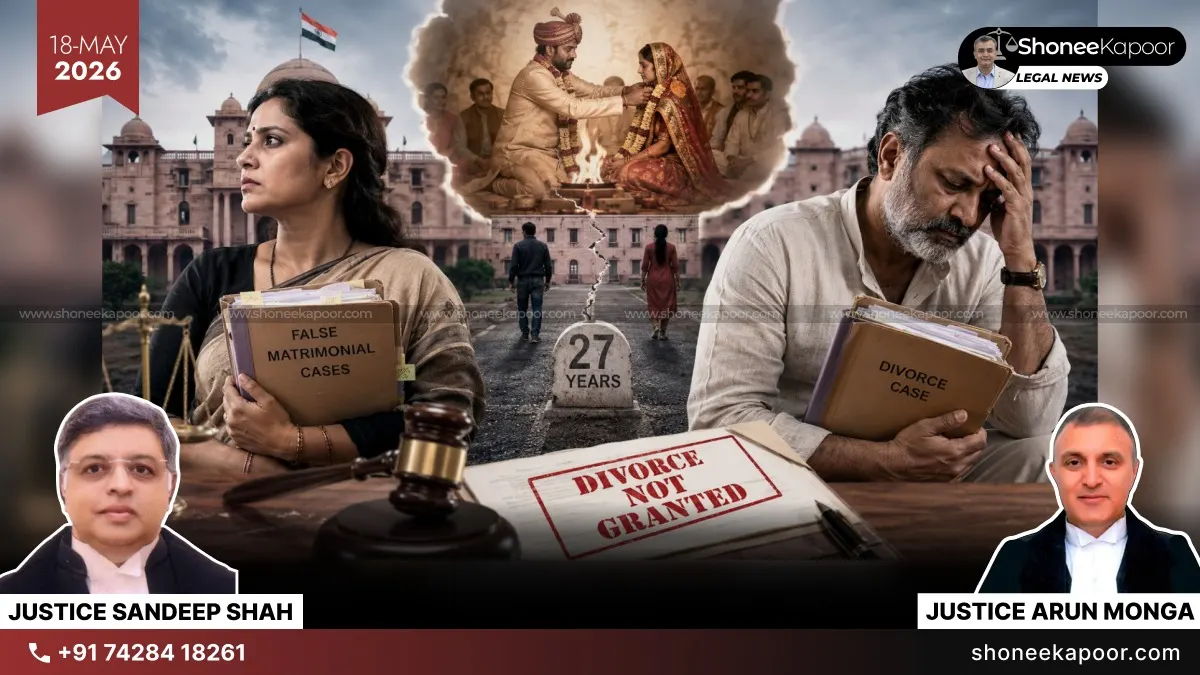
Can decades of separation, failed mediation, and allegations of false cases still not be enough for a husband to get divorce?
Rajasthan High Court held that even decades of separation and closure of criminal allegations are not enough if his “Nata marriage” is treated as the root cause, despite his claim of wife’s consent.
JAIPUR: The Rajasthan High Court recently passed a strongly worded judgment while refusing divorce to a husband who had been living separately from his wife for nearly 27 years.
The Division Bench of Justice Arun Monga and Justice Sandeep Shah held that a husband who himself enters into a second relationship during marriage cannot later accuse the wife of cruelty and desertion to seek divorce.
The parties got married in 1992 according to Hindu customs. Two sons were born from the marriage. According to the husband, disputes started because the wife wanted to live separately from his family. He also claimed that she refused to continue matrimonial life despite repeated efforts by him and his relatives.
However, the matter became complicated after the husband admitted before the Court that he entered into a “nata marriage” with another woman in 1997 while his first marriage was still legally valid.
The husband argued that the wife later filed criminal complaints against him and his family members, including cases under Sections 498A, 406, 494 and 323 IPC. He further argued that the police investigation found the allegations false and therefore the wife had treated him with mental cruelty.
The husband also argued that the parties had already been living separately for more than 27 years and therefore the marriage had completely broken down.
The High Court, however, refused to accept these arguments. The Court agreed with the Family Court that the husband himself was responsible for the collapse of the marriage.
While dismissing the appeal, the Court made extremely strong observations against the husband’s conduct.
The Court stated:
“He who comes into equity must come with clean hands”.
The Court further observed:
“He cannot be permitted to light a fire and then seek compensation for the burns.”
The Bench noted that the husband openly admitted his second relationship and even recorded the second woman’s name in his Aadhaar card as wife. The Court said this clearly showed that the husband himself abandoned his legally wedded wife.
The judgment further stated:
“A Court of law is not an instrument available to a wrongdoer to consecrate his wrong.”
The Court rejected the husband’s argument that the wife had consented to the second marriage. It held that even if such consent existed, it had no legal value because Hindu Marriage Act prohibits second marriage during subsistence of first marriage.
The Court observed:
“No consent of the existing spouse can validate such a marriage, because the prohibition is a matter of public policy and statutory mandate, not merely a private right capable of waiver.”
The High Court said that living separately due to government job postings cannot automatically be called desertion, especially when both husband and wife were government teachers posted at different places.
The Court also refused to treat the wife’s criminal complaints as cruelty merely because police later filed a final report.
While discussing the “Nata marriage” custom, the Court strongly criticised the practice and held that custom cannot override the Hindu Marriage Act. The Bench observed:
“Custom must walk hand in hand with conscience, and tradition must bow to justice.”
The Court warned that such practices leave both women vulnerable and finally concluded that-
“Nata, as a form of customary marriage, must therefore be unequivocally disapproved of by society, condemned and thrown out altogether from the bounds of acceptable practice.”
Accordingly, the Rajasthan High Court dismissed the husband’s appeal and refused divorce.
Explanatory Table: Laws & Sections Involved
| Law / Section | Purpose | How It Was Used In This Case |
| Section 13, Hindu Marriage Act, 1955 | Provides legal grounds for divorce | Husband filed divorce petition under this section |
| Section 13(1)(ia), Hindu Marriage Act | Divorce can be granted if spouse causes cruelty | Husband alleged mental cruelty by wife |
| Desertion under Hindu Marriage Act | Leaving spouse without reasonable cause | Court held wife had valid reason to live separately |
| Section 5(i), Hindu Marriage Act | Second marriage is prohibited during subsistence of first marriage | Court held husband’s “Nata marriage” violated this provision |
| Section 11, Hindu Marriage Act | Second marriage becomes void if first marriage still exists | Court said second marriage had no legal validity |
| Section 29(2), Hindu Marriage Act | Protects limited customs relating to divorce | Court clarified this section cannot legalise “Nata marriage” |
| Section 498A IPC | Cruelty by husband or in-laws | Wife filed criminal complaint under this section |
| Section 406 IPC | Criminal breach of trust | Included in wife’s FIR against husband |
| Section 494 IPC | Bigamy or second marriage during lifetime of spouse | Related to allegations regarding second marriage |
| Section 323 IPC | Punishment for causing hurt | Included in criminal complaint filed by wife |
| Article 14, Constitution of India | Equality before law | Court discussed dignity and equality of women |
| Article 15, Constitution of India | Protection against discrimination | Court referred to gender justice principles |
| Article 39, Constitution of India | Equal rights for men and women | Court referred to constitutional protection for women |
Case Details
- Case Title: Husband Vs Wife
- Court: High Court of Judicature for Rajasthan at Jodhpur
- Case Number: D.B. Civil Miscellaneous Appeal No. 1211/2023
- Neutral Citation: 2026:RJ-JD:22646-DB
- Date of Judgment:12 May 2026
- Bench:
- Hon’ble Mr. Justice Arun Monga
- Hon’ble Mr. Justice Sandeep Shah
- Counsels:
- For Appellant: Mr. Vikram Sharma
- For Respondent: Mr. Manish Patel
Key Takeaways
- A man’s entire marital history can get ignored once he enters a second relationship without legally ending the first marriage.
- Long separation alone does not guarantee divorce if the husband is seen as the one who triggered the breakdown.
- Filing criminal complaints later may still not help a husband prove mental cruelty, even if police close the case.
- In matrimonial disputes, reactions of a hurt spouse are often treated as “reasonable response” rather than cruelty.
- Personal relationships, social customs and emotional arrangements mean nothing once they conflict with statutory marriage laws.
This Could Change Your Case-Get FREE Legal Advice-Click Here!
Disclaimer: The views and opinions expressed in this article are those of the Indian courts and do not necessarily reflect the official policy or position of “ShoneeKapoor.com” or its affiliates. This article is intended for informational and educational purposes only. The content provided is not legal advice, and viewers should not act upon this information without seeking professional counsel. Viewer discretion is advised.
