
When spouses stop emotionally functioning as a family, does the law still force continuation of marriage?
The Supreme Court upheld divorce after marital breakdown, but removed cruelty and desertion findings against the wife.
NEW DELHI: The Supreme Court of India, in judgment delivered by Justice Sandeep Mehta and Justice Vikram Nath, strongly criticised the approach taken by the Family Court and Gujarat High Court for treating a wife’s professional ambitions and independent decisions as acts of cruelty against her husband.
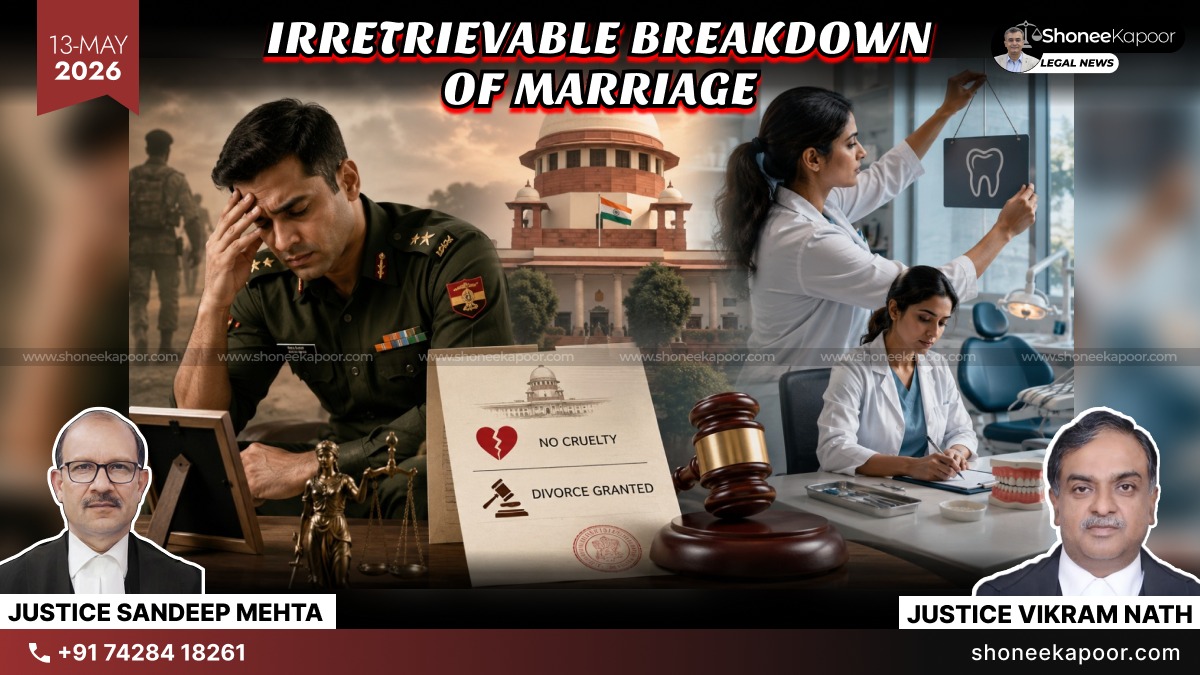
The case involved a qualified dentist married to an Army officer posted in difficult locations including Kargil. After marriage, the wife started her own dental clinic. Later, she shifted with her husband to Kargil during pregnancy but eventually returned to Ahmedabad because of limited medical facilities and later health complications suffered by their daughter. The child reportedly required specialised treatment and medical care.
The husband later sought divorce by alleging cruelty and desertion. The Family Court accepted several allegations against the wife and treated her decision to continue her dental practice, stay separately for certain periods, and prioritise her professional career as acts of cruelty.
The Supreme Court strongly disapproved this reasoning and observed:
“We are constrained to observe that the approach adopted by the learned Family Court, as affirmed by the High Court, is not only legally unsustainable but also deeply disquieting.”
According to the Supreme Court, marriage does not erase a woman’s individuality or professional identity. The Bench stated:
“Marriage does not eclipse her individuality, nor does it subjugate her identity under that of her spouse.”
The judges also clarified that the wife’s actions were wrongly portrayed by the lower courts. The Court observed:
“What is portrayed as defiance in the impugned judgments is, in truth, an assertion of independence.”
During the proceedings, the Family Court had even treated the inauguration of the wife’s dental clinic without informing her husband or in-laws as an act of cruelty. The lower court had further observed that a wife is expected to stay wherever her husband resides.
The Supreme Court called this approach “pedantic and regressive.”
The Bench further remarked:
“To brandish the effort of the wife to pursue her own career goals as acts of cruelty, as the same may have hurt the sentiments of the husband or the in-laws, is highly objectionable and deplorable.”
The husband had also sought criminal prosecution of the wife for alleged false statements and perjury. However, the Supreme Court rejected the request and held that the allegations appeared to be driven by “personal vendetta and spiteful approach.”
Finally, the Supreme Court removed all findings of cruelty and desertion against the wife from the judicial record. However, since both parties no longer wished to continue the marriage and the husband had reportedly remarried, the Court decided not to interfere with the divorce decree already granted by the lower courts. The Bench clarified that the divorce would now be treated as granted on the ground of “irretrievable breakdown of marriage” instead of cruelty or desertion.
Explanatory Table: Laws And Provisions Involved
| Law / Provision | Purpose | How Applied In This Case |
| Section 195 CrPC | Restricts courts from taking cognizance of certain offences like false evidence unless proper procedure is followed | Husband invoked this section seeking criminal action against wife for alleged false statements |
| Section 340 CrPC | Procedure for courts to initiate prosecution for perjury or false evidence | Husband filed application seeking prosecution of wife for alleged perjury |
| Special Marriage Act, 1954 | Governs interfaith and civil marriages in India | Court noted parties had a love marriage registered under the Special Marriage Act |
| Maintenance Proceedings under Army Rules | Army regulations allowing maintenance to dependents of serving officers | Army authorities directed husband to pay part of salary to wife and child |
| Cruelty under Hindu Matrimonial Jurisprudence | Ground for divorce where spouse causes mental or physical cruelty | Lower courts wrongly treated wife’s career decisions as cruelty |
| Desertion under Matrimonial Law | Ground for divorce when spouse abandons matrimonial relationship without reasonable cause | Supreme Court held wife’s separate residence for child’s welfare and career could not be treated as desertion |
| Irretrievable Breakdown of Marriage | Legal principle recognising complete collapse of marriage beyond repair | Supreme Court finally sustained divorce on this ground only |
Case Details
- Case Title: Ann Saurabh Dutt v. Lieutenant Colonel Saurabh Iqbal Bahadur Dutt
- Court: Supreme Court of India
- Case Numbers:
Civil Appeal arising out of SLP(Civil) No. 25076 of 2024
Connected with SLP(Civil) No. 28451 of 2024 - Bench: Justice Vikram Nath | Justice Sandeep Mehta
- Neutral Citation: 2026 INSC 475
- Date of Judgment: 12 May 2026
Key Takeaways
- A husband’s emotional pain, loneliness, and struggle to hold a marriage together should not be ignored simply because the dispute is labelled as “modern independence.”
- Living separately for years can deeply affect a husband mentally, emotionally, and financially, even when legal cruelty may not be established.
- Marriage cannot survive when one partner feels emotionally abandoned while silently carrying the burden of broken family life.
- Endless matrimonial litigation, allegations, and ego-driven battles often destroy the mental peace and dignity of husbands long before divorce is granted.
- When relationships completely collapse, honest separation is better than stretching accusations that leave both spouses emotionally exhausted and the husband socially isolated.
This Could Change Your Case-Get FREE Legal Advice-Click Here!
Disclaimer: The views and opinions expressed in this article are those of the Indian courts and do not necessarily reflect the official policy or position of “ShoneeKapoor.com” or its affiliates. This article is intended for informational and educational purposes only. The content provided is not legal advice, and viewers should not act upon this information without seeking professional counsel. Viewer discretion is advised.
