
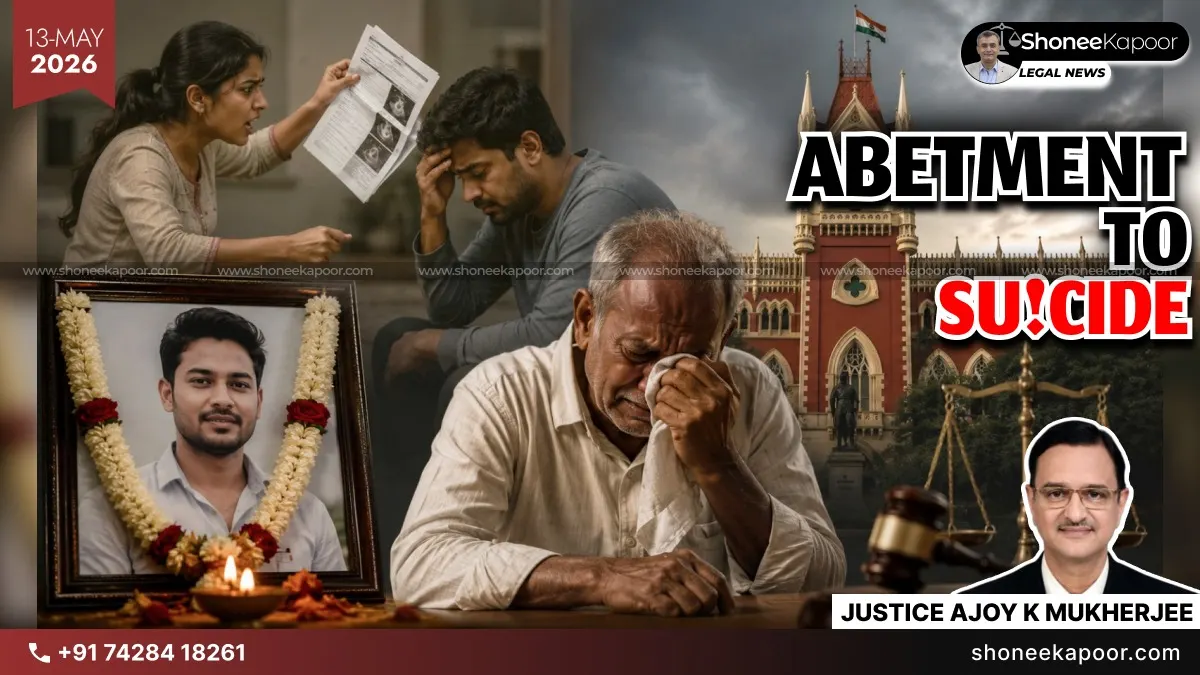
Can merely naming a wife in a husband’s suicide note become enough to prosecute her for abetment of suicide?
The Calcutta High Court held that a suicide note alone is not sufficient unless there is clear evidence of direct instigation, intentional provocation, or active involvement leading to the suicide.
KOLKATA: The Calcutta High Court has quashed criminal proceedings against a woman and her father in a husband suicide case, observing that ordinary matrimonial disputes, emotional hurt, or marital discord cannot automatically become a case of abetment to suicide without clear evidence of intentional provocation. The judgment was delivered by Justice Dr. Ajoy Kumar Mukherjee.
The case involved the suicide of Arijit Samaddar, who died on 19 September 2022. After his death, his father lodged an FIR alleging that the wife and her family members were responsible for the suicide. It was claimed that the deceased had named them in a suicide note.
The marriage had taken place in December 2021, but disputes soon arose between the couple. The wife allegedly discovered certain medical issues relating to the husband and repeatedly asked him to seek treatment. Due to differences between them, she left the matrimonial home in February 2022.
The Court noted that the wife returned only once on 2 July 2022 to collect her belongings, and there was no contact between the couple after that. Nearly two and a half months later, the husband died by suicide.
The husband’s family alleged that he suffered immense emotional pain, humiliation, and mental stress due to the marital dispute. It was also alleged that pictures relating to his private medical condition were circulated, which deeply affected him emotionally.
While examining the case, the Calcutta High Court observed that for an offence under Section 306 IPC, there must be clear evidence of instigation, intentional aid, or active conduct pushing a person towards suicide. The Court noted that mere emotional pain, marital discord, or humiliation cannot automatically amount to abetment unless there is a direct and intentional act linked to the suicide.
Referring to Ramesh Kumar vs State of Chhattisgarh, the Court reiterated:
“Instigation is to goad, urge forward, provoke, incite or encourage to do “an act”.”
The judgment further quoted:
“A word uttered in the fit of anger or emotion without intending the consequences to actually follow cannot be said to be instigation.”
The Court also relied upon State of West Bengal vs Orilal Jaiswal, where the Supreme Court had cautioned that ordinary matrimonial discord and emotional sensitivity alone are not sufficient to hold someone guilty of abetment to suicide.
The High Court observed that the deceased husband appeared emotionally shattered because of the breakdown of his marriage and the humiliation he allegedly faced. However, the Court found that after July 2022 there was no direct contact between the husband and the accused persons, and no material showing any immediate provocation before the suicide.
The judgment specifically recorded:
“There is no allegation against any of the petitioners of a nature that the deceased was left with no alternative but to commit the unfortunate act of committing suicide.”
The Court further observed:
“There needs to be a positive act that creates an environment where the deceased is pushed to an edge, in order to sustain the charge levelled against the petitioners.”
Holding that the alleged acts were too remote and did not satisfy the legal ingredients of Sections 306 and 506 IPC, the High Court ultimately quashed the criminal proceedings pending before the Sessions Court at Barasat.
Explanatory Table: Laws And Provisions Involved
| Law / Provision | Purpose | How Applied In This Case |
| Section 306 IPC | Punishment for abetment of suicide | Husband’s family alleged that the wife and her relatives mentally harassed him and pushed him to suicide |
| Section 107 IPC | Defines “abetment” including instigation, conspiracy, or intentional aid | Court examined whether there was any direct instigation or intentional act leading to suicide |
| Section 506 IPC | Criminal intimidation or threats | Allegation was made that the accused threatened the deceased, but Court found no evidence |
| Section 482 CrPC | Inherent powers of High Court to quash criminal proceedings | Petitioners approached the High Court seeking quashing of the criminal case |
| Mens Rea Principle | Criminal intention or guilty mind required for conviction | Court held that criminal intention cannot be presumed without evidence |
| Abetment Principle | Requires active provocation or conduct pushing a person towards suicide | Court found no direct act close to the suicide incident |
Case Details
- Case Title: Shreya Basak & Anr. Vs. The State of West Bengal and Anr.
- Court: Calcutta High Court
- Case Number: CRR 4048 of 2024
- Bench: Justice Dr. Ajoy Kumar Mukherjee
- Neutral Citation: 2026:CHC-AS:699
- Date of Judgment: 11.05.2026
- Counsels:
- For Petitioners: Mr. Sandipan Ganguly, Sr. Adv.; Mr. Sourav Chatterjee, Sr. Adv.; Mr. Aditya Tiwari
- For Opposite Party No. 2: Mr. Kallok Kumar Basu; Md. Jannat Ul Firdous; Mr. Rajsekhar Hota
- For State: Mrs. Rituparna De Ghosh; Mr. Abhinaba Mukherjee
Key Takeaways
- A husband silently suffering humiliation, rejection, and emotional collapse can become mentally shattered long before anyone notices his pain.
- Not every failed marriage or emotional breakdown of a man should automatically turn into criminal liability against the other side without clear legal evidence.
- Men facing public embarrassment, isolation, and matrimonial distress often suffer silently while their mental health remains ignored.
- A suicide note may reflect emotional pain and frustration, but criminal prosecution still requires proof of direct instigation and intentional conduct.
- Behind many matrimonial suicides is a vulnerable man struggling with emotional trauma, helplessness, and fear of social humiliation long before the final step.
This Could Change Your Case-Get FREE Legal Advice-Click Here!
Disclaimer: The views and opinions expressed in this article are those of the Indian courts and do not necessarily reflect the official policy or position of “ShoneeKapoor.com” or its affiliates. This article is intended for informational and educational purposes only. The content provided is not legal advice, and viewers should not act upon this information without seeking professional counsel. Viewer discretion is advised.
