
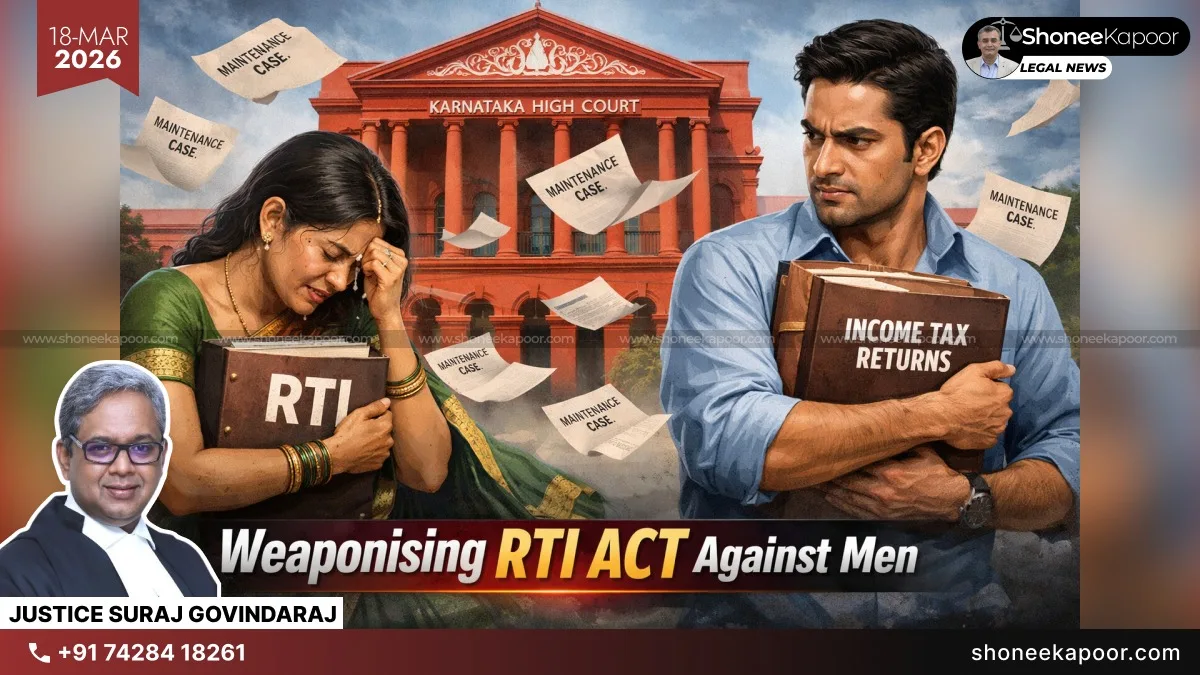
Can a wife demand husband’s income details through RTI for maintenance? Court says NO, but leaves one legal route open.
If income is disputed, how will courts verify the truth? The answer lies inside.
BENGALURU: The Karnataka High Court has clarified that a wife cannot access her husband’s Income Tax Returns (ITR) or financial records through the Right to Information (RTI) Act for the purpose of maintenance proceedings. The Court held that such financial details fall under “personal information” and are protected from disclosure under Section 8(1)(j) of the RTI Act, 2005.
The bench at Bengaluru relied on the Supreme Court judgment in Girish Ramchandra Deshpande v. CIC to reinforce that personal financial disclosures made in tax filings cannot be shared unless a clear and larger public interest is involved. The Court made it clear that disputes between husband and wife, including maintenance claims, remain private matters and do not qualify as public interest.
“…The details disclosed by a person in his income tax returns are personal information which stand exempted from disclosure under clause (j) of Section 8(1) of the RTI Act, unless a larger public interest is established…The expression ‘larger public interest’ postulates an interest that extends beyond the individual parties to the dispute and concerns the public at large or a significant section thereof. An individual maintenance dispute… remains primarily a private matter between the spouses”
At the same time, the Court ensured that the legal process remains balanced.
Justice Suraj Govindaraj clarified that while RTI cannot be used as a shortcut to access financial records, the appropriate forum for such disclosure is the court handling the maintenance case.
The Court emphasized that maintenance decisions should not rely only on statements made by either side without proper proof. It directed that courts must actively ensure that accurate financial data is placed on record when income is disputed.
“…The Court [maintenance courts] shall not determine maintenance based merely on oral assertions or unverified claims regarding income. Where the income of either party is disputed, the Court shall suo motu consider invoking its powers to summon documentary evidence, including income tax returns and related financial records…”
This means that while direct access through RTI is blocked, courts retain full authority to call for income records from the Income Tax Department under legal provisions like Section 138 of the Income Tax Act, 1961. This ensures that financial transparency is maintained within judicial oversight rather than through public disclosure mechanisms.
The High Court partly allowed the petition and gave liberty to the wife to approach the maintenance court for proper assessment of her husband’s financial capacity. It also issued guidelines for seeking production of financial documents during such proceedings.
Explanatory Table – Laws & Sections Involved
| Law / Section | What It Says (Simple Explanation) | Role in This Case |
| Right to Information Act, 2005 – Section 8(1)(j) | Protects personal information from disclosure unless there is a strong public interest | Court used this to deny access to husband’s ITR via RTI |
| Income Tax Act, 1961 – Section 138 | Allows sharing of income details only through proper legal authority (like courts) | Court said financial records can be summoned through court, not RTI |
| Articles 226 & 227 of Constitution of India | Gives High Courts power to review and correct decisions of lower authorities | Petition filed under these provisions to challenge CIC order |
| RTI Act – “Larger Public Interest” Test | Information can be disclosed only if it benefits public at large, not private disputes | Court ruled maintenance dispute is private, not public interest |
| Criminal / Maintenance Proceedings (General Law) | Courts decide maintenance based on financial capacity of parties | Court directed that proper evidence must be brought through court process |
Case Details
- Case Title: Income Tax Officer and CPIO v. Smt. Gulsanober Bano Zafar Ali Ansari and Another
- Court: High Court of Karnataka at Bengaluru
- Date of Judgment: 21st February 2026
- Case Number: Writ Petition No. 34625 of 2019 (GM-RES)
- Neutral Citation: NC: 2026:KHC:11056
- Bench: Hon’ble Mr. Justice Suraj Govindaraj
- Coram: Single Bench – Justice Suraj Govindaraj
Parties
- Petitioner: Income Tax Officer and CPIO, Income Tax Department
- Respondents: Smt. Gulsanober Bano Zafar Ali Ansari & Central Information Commission
Counsels
- For Petitioner: Sri M. Dilip & Sri Y.V. Raviraj
- For Respondent No.1: Sri Kemparaju
- For Respondent No.2 (CIC): Sri Shanthi Bhushan, DSGI
Key Takeaways
- RTI cannot be misused as a pressure tool to extract a man’s private financial data in matrimonial disputes.
- The court clearly recognizes that income details are personal and deserve protection from fishing enquiries.
- Maintenance cannot be decided on allegations—proof is mandatory, which curbs inflated or exaggerated claims.
- Only courts—not the spouse—control access to financial records, restoring procedural balance.
- The ruling reinforces that legal process must prevail over harassment tactics disguised as “rights”.
This Could Change Your Case-Get FREE Legal Advice-Click Here!
Disclaimer: The views and opinions expressed in this article are those of the Indian courts and do not necessarily reflect the official policy or position of “ShoneeKapoor.com” or its affiliates. This article is intended for informational and educational purposes only. The content provided is not legal advice, and viewers should not act upon this information without seeking professional counsel. Viewer discretion is advised.
