
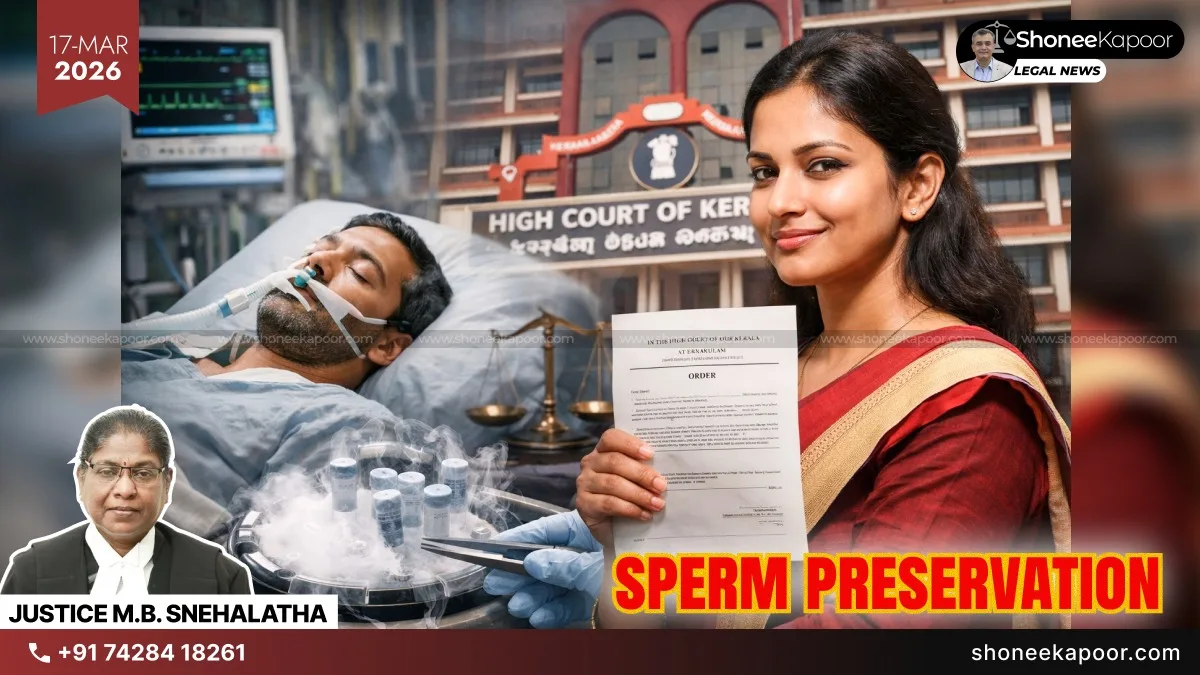
Kerala High Court allowed preservation of a brain-dead husband’s sperm without consent due to urgency— raising concerns over men’s reproductive autonomy
ERNAKULAM: In a significant and sensitive case, the Kerala High Court, led by Justice M.B. Snehalatha, passed an interim order allowing a wife to extract and preserve the gametes of her brain-dead husband, even though he could not give consent due to his medical condition. The Court admitted the writ petition and proceeded to grant urgent relief, considering the critical situation of the husband.
The wife approached the Court stating that her husband was undergoing treatment and had suffered severe brain damage, leaving him in a brain-dead condition and dependent on ventilator support. She informed the Court that doctors had confirmed there was no possibility of recovery and that he was unable to provide consent as required under the law.
The petition clearly stated that she wanted to preserve his reproductive material for future use under assisted reproductive technology.
The Court recorded that:
“Her husband suffers from extensive cerebral venous thrombosis post 2 weeks of chicken pox, which has now resulted in his brain death, and he is currently kept alive with ventilator support.”
It was further noted that:
“She is desirous of extracting and cryopreserving gametes of her husband, who is unable to grant consent to the same as contemplated under Section 22 of the Assisted Reproductive Technology (“ART”) Act due to his present medical condition.”
The petitioner argued that the delay in such cases could permanently destroy her chance of having a biological child. The Court acknowledged this urgency and recorded that:
“There is no possibility of obtaining written informed consent from him, and if the matter is delayed any further, irreparable hardship may be caused in view of his health condition and the impending chance of paternity.”
Taking these facts into account, the Court granted interim relief and directed the hospital to proceed with the extraction and preservation process. The order clearly states:
“Interim relief is granted directing the 5th respondent-hospital to allow the extraction and cryopreservation of the gametes… by allowing the services of the 6th respondent or other recognized ART clinics.”
At the same time, the Court placed an important restriction, clarifying that:
“Other than the extraction and preservation of the gametes, no further procedure under the Assisted Reproductive Technology (Regulation) Act shall be carried out without the permission of this Court.”
The Court has effectively allowed the use of a man’s reproductive material without his explicit consent due to medical incapacity. The larger legal question remains—if the situation were reversed, would a husband be granted similar permission to extract and preserve his wife’s reproductive material without her consent? The answer to that question will define the true balance of reproductive and bodily autonomy laws in India.
Explanatory Table: Laws & Sections Involved
| Law / Section | Explanation (Simple Indian English) | Relevance in This Case |
| Article 226, Constitution of India | Gives High Courts power to issue directions/orders (writs) to protect rights | Wife filed writ to get court permission when law did not allow hospital to act without consent |
| Writ of Mandamus | Court order directing authority to perform duty | Used to direct hospital to allow extraction of gametes |
| Section 22, Assisted Reproductive Technology (Regulation) Act, 2021 | Requires written informed consent before using reproductive material | Husband could not give consent due to brain death, creating legal barrier |
| Assisted Reproductive Technology (Regulation) Act, 2021 | Regulates IVF, sperm/egg use, and fertility procedures in India | Entire dispute revolves around whether procedure can happen without consent |
| Principle of Informed Consent | A person must voluntarily agree before any medical procedure | Central issue—husband’s consent was absent |
| Judicial Discretion (Equitable Relief) | Court can grant relief in exceptional urgent situations | Court used this to allow preservation despite legal restriction |
Case Details
- Case Title: XXXX v. Union of India & Ors.
- Court: Kerala High Court
- Case Number: WP(C) No. 9271 of 2026 (H)
- Bench: Justice M.B. Snehalatha
- Date of Order: 09 March 2026
- Counsels:
- For Petitioner: M/s. Sukarnan, Nesmel Divan, Akhil Vinayan & Saurav Shaji, Advocates
- For Respondents 1 & 2: Deputy Solicitor General of India (DSGI)
- For Respondents 3 & 4: Government Pleader
Key Takeaways
- Court allowed use of a man’s reproductive material without his explicit consent, setting a concerning precedent on male bodily autonomy.
- Legal safeguard of “informed consent” under ART Act was effectively diluted in favour of emotional and situational considerations.
- Relief was granted only for extraction and preservation, showing courts can bypass statutory restrictions in urgent cases.
- Decision highlights a gender imbalance—men’s reproductive rights are not equally protected in incapacitated conditions.
- This order opens the door for future misuse where a man’s biological rights can be exercised without his knowledge or approval, demanding urgent legal clarity and safeguards.
This Could Change Your Case-Get FREE Legal Advice-Click Here!
Disclaimer: The views and opinions expressed in this article are those of the Indian courts and do not necessarily reflect the official policy or position of “ShoneeKapoor.com” or its affiliates. This article is intended for informational and educational purposes only. The content provided is not legal advice, and viewers should not act upon this information without seeking professional counsel. Viewer discretion is advised.
