
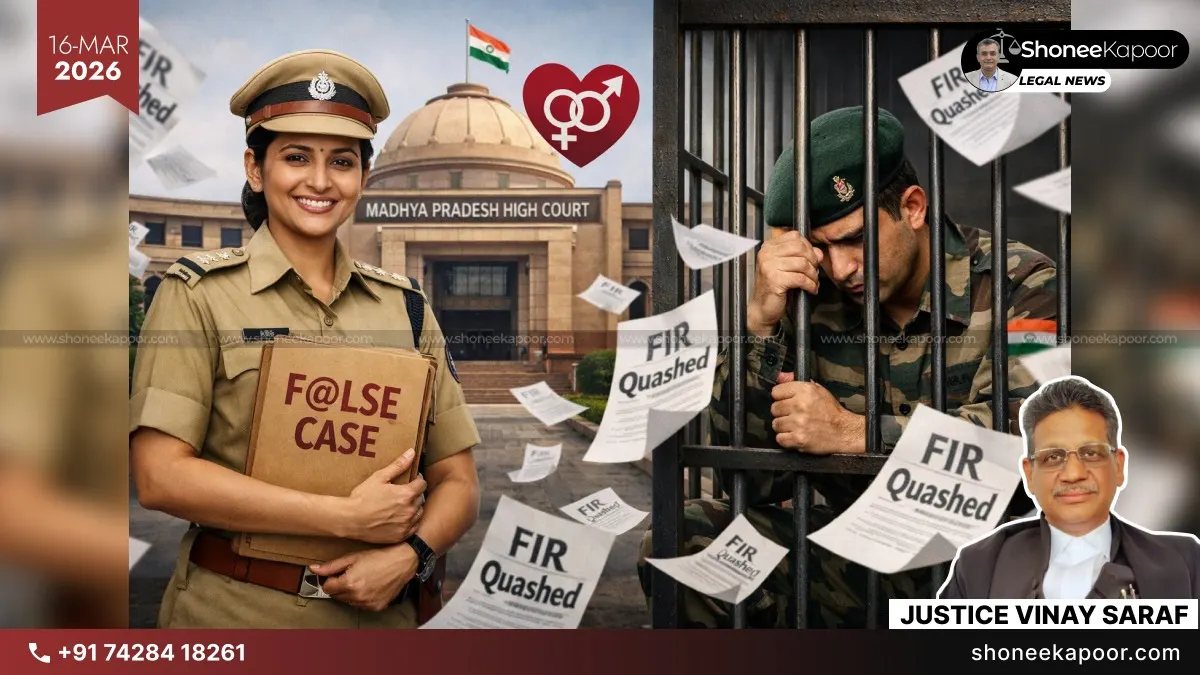
Can a 13-year relationship later be called deception after both adults knew the facts? Madhya Pradesh High Court quashed the FIR against an Army officer, raising important observations on consent and long-term relationships.
NEW DELHI: The Madhya Pradesh High Court quashed an FIR filed against an Army officer who had been accused of engaging in sexual intercourse by deceitful means. The court observed that the complainant, a highly educated woman working in the Police Department, could not have continued a relationship for more than a decade without her voluntary consent.
The order was passed on March 11 by Justice Vinay Saraf. The case involved allegations that the Army officer had misrepresented his marital status and developed a physical relationship with the complainant. However, the court carefully examined the facts and circumstances of the case before deciding to set aside the criminal proceedings.
While deciding the matter, the High Court observed:
“It is not convincible that the complainant or any woman who is working in a Police Department would continue to meet the petitioner or maintained a prolonged physical relationship with him in the absence of voluntary consent on her part.
The petitioner and the complainant both are highly educated and working in uniformed services therefore and it cannot be believed that on the pretext of false marriage the complainant developed the physical relationship with the petitioner and continued the same without any demur or objection even after knowing the fact that the petitioner is already married”.
The Army officer had approached the High Court seeking quashing of the FIR registered against him under Section 351(2) of the Bharatiya Nyaya Sanhita for criminal intimidation and Section 69 for sexual intercourse by deceitful means.
According to the FIR, the complainant and the petitioner first met on December 23, 2012, at an Army Canteen in Bhopal. After the meeting, they allegedly started communicating and eventually developed a physical relationship. The complainant claimed that the petitioner had presented himself as a bachelor at the beginning of the relationship.
However, the complainant later discovered in 2013 that the officer was already married. When she questioned him, the petitioner reportedly stated that his wife had a bad character and that he was living separately from her. He also allegedly told the complainant that he would divorce his wife and later marry her.
Despite knowing about the marriage, the relationship between the two reportedly continued for several years. According to the complaint, the relationship lasted until 2025. On February 25, 2025, the complainant allegedly discovered that the petitioner was also in contact with other women and had made similar assurances to them.
Following this, she filed a complaint which resulted in the registration of an FIR against the Army officer.
During the hearing, the counsel for the petitioner argued that the relationship between the two was completely consensual. It was also highlighted that the complainant was a mature and educated woman working as a Police Constable in the Special Police Establishment under the Lokayukt Organisation in Bhopal.
The petitioner’s counsel further submitted that there was never any promise of marriage made by the officer and that the complainant had continued the relationship even after knowing that he was already married.
On the other hand, the counsel for the State argued that the relationship initially developed because the petitioner falsely claimed to be unmarried.
While examining the case, the High Court noted that the relationship began in 2012 and continued for around 12 to 13 years. The court also took into account that both individuals were educated and serving in disciplined uniformed services — the complainant as a police constable and the petitioner as an Army officer.
The court also referred to the legal principles regarding consent under Section 375 of the Indian Penal Code. It observed that consent must be a conscious and reasoned decision made by a person before engaging in a physical relationship.
The bench further clarified the legal test that courts apply in cases where allegations are made on the basis of a false promise of marriage.
The court stated:
“To establish whether the “consent” was vitiated by a “misconception of fact” arising out of a promise to marry, two propositions must be established. The promise of marriage must have been a false promise, given in bad faith and with no intention of being adhered to at the time it was given. The false promise itself must be of immediate relevance, or bear a direct nexus to the woman’s decision to engage in the sexual act”.
After examining the timeline of the relationship and the conduct of both parties, the High Court observed that it was difficult to accept that the complainant had continued such a long relationship without voluntary consent.
The court also noted that both parties were highly educated and working in uniformed services, making it unlikely that the complainant had entered into and continued the relationship solely based on a false promise of marriage.
In view of these findings, the High Court concluded that the criminal case could not be sustained and therefore quashed the FIR filed against the Army officer.
The petition was accordingly allowed.
Laws and Sections Discussed In The Case
| Law / Section | Law Name | Explanation | Role In This Case |
| Section 528 BNSS, 2023 | Bharatiya Nagarik Suraksha Sanhita | Gives High Courts power to quash criminal proceedings to prevent abuse of process of law | Petition filed under this provision to quash FIR |
| Section 69 BNS, 2023 | Bharatiya Nyaya Sanhita | Criminalizes sexual intercourse obtained through deceitful means such as false promise of marriage | Alleged offence against the Army officer |
| Section 351(2) BNS, 2023 | Bharatiya Nyaya Sanhita | Criminal intimidation causing fear or threat | Alleged threat by petitioner |
| Section 375 IPC | Indian Penal Code | Defines rape and explains concept of consent | Court analysed consent principles |
| Section 90 IPC | Indian Penal Code | Consent given under misconception of fact is not valid consent | Used to assess false promise of marriage claims |
| Section 376 IPC | Indian Penal Code | Punishment for rape | Discussed in legal precedents cited |
| Section 415 IPC | Indian Penal Code | Defines cheating and dishonest inducement | Court examined whether deception existed |
| Section 506 IPC | Indian Penal Code | Punishment for criminal intimidation | Discussed through precedents |
| Section 164 CrPC | Criminal Procedure Code | Statement before magistrate during investigation | Referenced in precedent judgments |
| Section 183 BNSS | Bharatiya Nagarik Suraksha Sanhita | Recording of statements during investigation | Used for complainant’s statement |
Case Details Extracted From Judgment
| Particular | Details |
| Case Title | VPS vs The State of Madhya Pradesh and Others |
| Court | High Court of Madhya Pradesh |
| Bench | Hon’ble Justice Vinay Saraf |
| Date of Decision | 11 March 2026 |
| Case Number | Misc. Criminal Case No. 35779 of 2025 |
| Neutral Citation | 2026:MPHC-JBP:19601 |
| Respondents | State of Madhya Pradesh & Others |
| FIR Number | FIR No. 95/2025 |
| Police Station | Mahila Thana, Bhopal |
| District | Bhopal |
| Key Issue | Alleged sexual relationship by deceitful means and criminal intimidation |
| Result | FIR and criminal proceedings quashed |
Bench
| Judge | Court |
| Hon’ble Shri Justice Vinay Saraf | High Court of Madhya Pradesh, Jabalpur Bench |
Counsels Appearing In The Case
| Party | Counsel |
| Petitioner | Senior Advocate Kailash Chandra Ghildiyal |
| Petitioner Advocate | Awadhesh Kumar Ahirwar |
| State | Nalini Gurung (Panel Lawyer) |
| Complainant | Dinesh Tripathi |
FIR Details
| Particular | Information |
| FIR Date | 27 March 2025 |
| FIR Number | 95/2025 |
| Police Station | Mahila Thana, Bhopal |
| Charges | Section 351(2) BNS and Section 69 BNS |
| Allegation | Sexual intercourse by deceitful means and criminal intimidation |
Key Takeaways
- A long-term consensual relationship cannot suddenly be turned into a criminal allegation after it breaks down.
- The High Court recognised that an educated adult woman working in the police department cannot claim lack of consent after continuing a relationship for over a decade.
- Courts are increasingly acknowledging that many such cases emerge after relationships turn sour, turning personal disputes into criminal prosecutions.
- The judgment reinforces that a failed relationship or broken promise cannot automatically become a rape allegation.
- This case again shows how easily men can face years of criminal litigation, stigma, and career damage even when the allegations do not meet the legal threshold of an offence.
This Could Change Your Case-Get FREE Legal Advice-Click Here!
Disclaimer: The views and opinions expressed in this article are those of the Indian courts and do not necessarily reflect the official policy or position of “ShoneeKapoor.com” or its affiliates. This article is intended for informational and educational purposes only. The content provided is not legal advice, and viewers should not act upon this information without seeking professional counsel. Viewer discretion is advised.
