
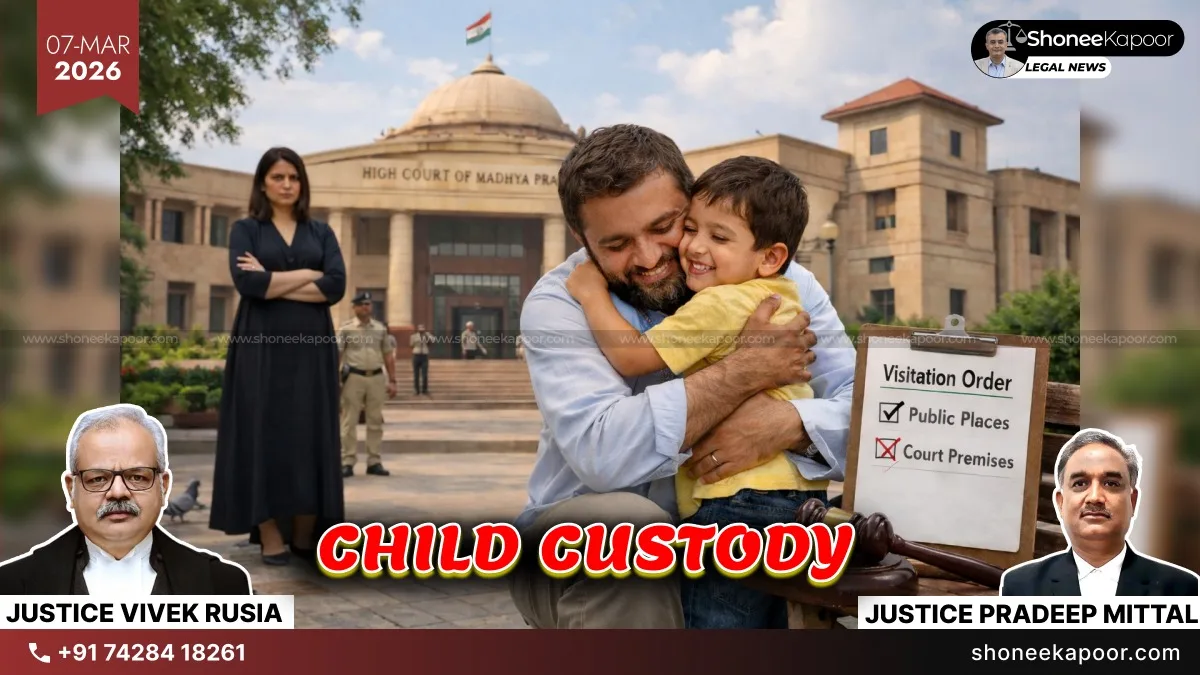
A father challenged an order that allowed him to meet his child only inside the Family Court premises.
The MP High Court stepped in, calling courts emotionally intimidating for children and permitting meetings in public places instead.
Courts Can Scar Children: In an order dated 24 February 2026, the Madhya Pradesh High Court at Jabalpur, comprising Justice Vivek Rusia and Justice Pradeep Mittal, decided a case involving a father’s right to meet his minor son.
The appeal was filed after the Family Court refused to change an earlier order related to the father’s visitation rights.
Earlier, the Family Court had allowed the father to meet his son only inside the court premises on the second and fourth Saturdays from 3:00 PM to 5:00 PM, and the meeting had to take place in the presence of the mother.
However, during some of these meetings, arguments and unpleasant incidents reportedly took place between the parents. Because of this situation, the High Court reconsidered whether the court premises was the right place for a child to meet a parent.
The High Court observed that forcing children to come to court repeatedly is not healthy for them. The judges clearly stated that:
“Courts should be the last resort for a child to visit because courts are often seen as intimidating, sterile, and stressful environments that can ‘scar’ a child emotionally.”
The Court further explained that visitation should happen in a “child-friendly” environment, suggesting places such as “Malls, parks, or reputable play zones.”
The Court also referred to the Supreme Court decision in Vivek Kumar Chaturvedi & Anr Vs. State of U.P. & Ors (2025 INSC 159) and highlighted that:
“For older children (e.g., 7th standard), the court must elicit the child’s attitude in a comfortable setting rather than forcing the child’s presence in a hostile environment.”
Taking these factors into consideration, the High Court modified the visitation arrangement. The father is now allowed to meet his son on the second and fourth Sunday of every month from 11:00 AM to 5:00 PM in public places instead of the court premises. The father must inform the mother in advance about the meeting’s date, time, and location.
The Court also allowed the father to give his son clothes, sweets, gifts, chocolates, and toys during these meetings. In addition, the Court granted a special permission for the upcoming Eid festival, allowing the father to take the child to his house for three hours so that the child can meet his grandfather and other relatives.
With these directions, the High Court disposed of the appeal and emphasized that the child’s emotional comfort and welfare must always remain the priority in visitation matters.
Explanatory Table: Laws And Provisions Involved
| Law / Provision | Purpose | How Applied in This Case |
| Guardians and Wards Act, 1890 – Section 7 | Court can regulate guardianship and access of minors. | Basis for court’s power over custody and visitation. |
| Guardians and Wards Act, 1890 – Section 17 | Welfare of the child is the main consideration. | Court focused on child’s emotional comfort. |
| Guardians and Wards Act, 1890 – Section 25 | Court can regulate custody and access of a minor. | Used to modify the father’s visitation rights. |
| Family Courts Act, 1984 – Section 7 | Gives Family Courts jurisdiction over custody matters. | Family Court originally passed the visitation order. |
| Family Courts Act, 1984 – Section 9 | Encourages settlement in family disputes. | Court aimed for a workable and less hostile arrangement. |
| Article 227 of the Constitution of India | High Court supervises subordinate courts. | High Court reviewed the Family Court’s order. |
| Child Welfare Principle | Child’s best interest is paramount. | Visitation moved to child-friendly places. |
| Vivek Kumar Chaturvedi & Anr vs State of U.P. & Ors (2025 INSC 159) | Child’s views should be taken in a comfortable environment. | Court relied on this principle to avoid court meetings. |
Case Details
- Case Title: Abdul Rahim Ansari vs Hiba Khan and Others
- Court: High Court of Madhya Pradesh at Jabalpur
- Case Number: Misc. Appeal No. 3879 of 2025
- Bench: Justice Vivek Rusia and Justice Pradeep Mittal
- Date of Order: 24 February 2026
- Counsels:
- For Appellant: Shri Shariq Khan and Shri Achyut Govindam Tiwari
- For Respondent: Shri Pranjal Tiwari
Key Takeaways
- A father’s right to meet his child cannot be reduced to brief, controlled meetings inside a courtroom when both parents live in the same city.
- The High Court recognised that forcing a child to visit courts for parental meetings can harm the child emotionally and is not in the child’s best interest.
- Courts must prioritise the child’s welfare over rigid procedures and ensure that parental access happens in a natural, child-friendly environment.
- The order reinforces that fathers remain important in a child’s life and meaningful visitation should allow proper bonding time, not token access.
- Family courts must balance parental conflict with the child’s emotional needs and ensure that fathers are not pushed to the margins of their child’s life.
This Could Change Your Case-Get FREE Legal Advice-Click Here!
Disclaimer: The views and opinions expressed in this article are those of the Indian courts and do not necessarily reflect the official policy or position of “ShoneeKapoor.com” or its affiliates. This article is intended for informational and educational purposes only. The content provided is not legal advice, and viewers should not act upon this information without seeking professional counsel. Viewer discretion is advised.
