
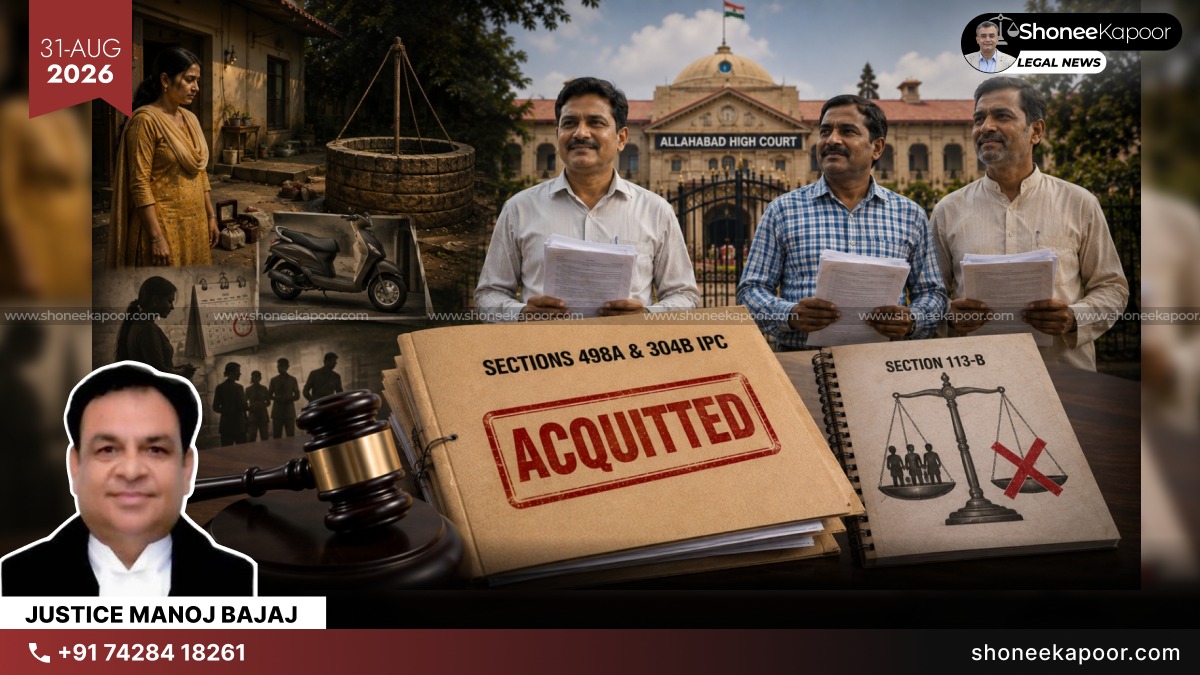
35 Years Later, Husband & Relatives Acquitted In Dowry Death Case | Prosecution Failed To Prove Harassment “Soon Before” Death: Allahabad High Court

Curated by NEWS DESK
Editorial DeskCan a dowry death conviction survive for decades when the prosecution fails to prove harassment “soon before” the woman’s death? The Allahabad High Court found serious gaps in the evidence and finally acquitted the husband and his relatives 35 years after the case began.
UTTAR PRADESH: The Allahabad High Court has acquitted Shiv Narain @ Surya Narain, Jai Narayan and Pateshwar in a decades-old dowry death case, holding that the prosecution failed to prove that the deceased woman was subjected to dowry-related cruelty or harassment soon before her death.
The case arose from the death of Urmila, who had married Shiv Narain on May 12, 1987. She went missing on the intervening night of September 19-20, 1991, and her body was recovered from a well near her matrimonial home on September 21. Her father later alleged that she had been harassed for dowry and that the accused had murdered her and thrown her body into the well.
Police registered the FIR on October 2, 1991. The accused were prosecuted under Sections 498-A, 304-B, 201 and 120-B IPC. In 1996, the trial court convicted them and imposed, among other sentences, seven years' rigorous imprisonment under Section 304-B IPC. The appeals then remained pending for years, and the appeals of some other convicts abated after their deaths.
While examining the evidence, the High Court noticed an important inconsistency. Urmila's parents claimed during trial that a scooter had been demanded as dowry, but this specific scooter demand was not mentioned in the FIR or in the statements recorded during investigation. According to the Court, the specific allegation was introduced only when the parents gave evidence before the trial court.
The Court also noted that the alleged scooter demand related to around November 1987, whereas Urmila died in September 1991. Her father admitted that he had visited her matrimonial home about one month before her death, but his evidence did not show that the husband or his relatives demanded dowry from him during that visit.
Significantly, the Court found no complaint made by Urmila during her lifetime alleging dowry harassment. Several close relatives who could have supported the prosecution's allegation were also not examined as witnesses.
The High Court observed:
“Consequently, in the light of the sequence of events of stay of Urmila and absence of any complaint whatsoever during her lifetime, much less in respect of dowry demand, this Court finds that the evidence adduced by prosecution does not prove beyond doubt that the complainant’s daughter was harassed for demand of dowry soon before her death.”
The Court further examined the statutory presumption relating to dowry death under Section 113-B of the Indian Evidence Act, 1872. Referring to the Supreme Court's decision in Karan Singh v. State of Haryana, 2025 INSC 133, it held that the prosecution must first establish the foundational requirement of cruelty or harassment connected with a dowry demand soon before the woman's death.
The Court said:
“In other words, the prosecution has to prove cruelty in order to attract Section 113-B of the Indian Evidence Act, and in the absence of any such evidence, the presumption would not be available.”
The High Court also found serious problems with the allegation that Urmila had been murdered and her body thrown into the well. The post-mortem showed a solitary ante-mortem head injury, and the doctor stated that such an injury could have resulted if she had fallen into the well and struck her head against the tubewell pipe.
The Court noted that the prosecution had not established the manner or place of the alleged murder. There was also no medical evidence showing a post-mortem injury supporting the allegation that her body had been thrown into the well after murder.
Importantly, no charge under Section 302 IPC for murder had been framed, nor had the prosecution filed a charge sheet for that offence. Yet, the trial court proceeded on the finding that the accused had committed murder. The High Court termed this approach “apparently erroneous in law and perverse.”
The Court also held that the Section 201 IPC conviction for causing disappearance of evidence could not survive when the underlying allegation of murder itself was unsupported by evidence.
As regards Pateshwar, the Court found no allegation that he had harassed Urmila for dowry. He was residing separately in another village. Similarly, the Court found the conviction of Pateshwar and Jai Narayan on the basis of an alleged criminal conspiracy for dowry death unsustainable on the evidence available.
After examining the prosecution evidence, the High Court concluded that it contained material discrepancies and inconsistencies and created serious doubt about the case. The charges had not been proved beyond the required standard.
Accordingly, the High Court set aside the 1996 conviction and sentence and acquitted Shiv Narain @ Surya Narain, Jai Narayan and Pateshwar of all charges.
EXPLANATORY TABLE OF LAWS AND SECTIONS
| Law / Section | What It Means | Relevance In This Case |
|---|---|---|
| Section 304-B IPC | Deals with dowry death where a woman dies unnaturally within seven years of marriage and was subjected to dowry-related cruelty or harassment “soon before” her death. | The High Court found that the prosecution failed to prove dowry harassment “soon before” Urmila’s death, so the essential ingredients of dowry death were not established. |
| Section 498-A IPC | Punishes cruelty by a husband or his relatives against a married woman. | The appellants had been convicted under this section, but the High Court found serious gaps in the prosecution evidence and ultimately acquitted them of all charges. |
| Section 201 IPC | Punishes causing disappearance of evidence or giving false information to screen an offender. | The prosecution alleged that Urmila’s body was thrown into a well after murder. The High Court held that when murder itself was not proved, the Section 201 conviction could not survive. |
| Section 120-B IPC | Punishes criminal conspiracy between two or more persons to commit an illegal act. | Jai Narayan and Pateshwar were linked through an alleged conspiracy, but the High Court found their conviction unsustainable when the underlying dowry-death allegations were not proved. |
| Section 302 IPC | Punishes murder. | No charge under Section 302 IPC was framed, yet the Trial Court treated Urmila’s death as murder. The High Court called this approach erroneous in law and perverse. |
| Section 299 IPC | Defines culpable homicide, where death is caused with the required intention or knowledge. | The High Court discussed this provision to distinguish culpable homicide from dowry death, noting that the two offences have different legal ingredients. |
| Section 113-B, Indian Evidence Act, 1872 | Creates a presumption of dowry death once it is first shown that the woman faced dowry-related cruelty or harassment “soon before” her death. | The Court held that this presumption could not operate because the prosecution had failed to first prove the required dowry-related cruelty or harassment. |
| Section 173(2) CrPC | Requires the investigating agency to submit its final police report or charge sheet after investigation. | The charge sheet was filed under Sections 498-A, 304-B, 201 and 120-B IPC, but not under Section 302 IPC for murder. |
| Section 313 CrPC | Gives an accused an opportunity to personally explain the circumstances appearing against him in prosecution evidence. | The accused denied the prosecution allegations and stated that they had been falsely implicated. |
| Section 2, Dowry Prohibition Act, 1961 | Defines the term “dowry” | Section 304-B IPC adopts this definition while determining whether a death qualifies as a dowry death. |
CASE DETAILS
| Particular | Details |
|---|---|
| Case Title | Shiv Narain @ Surya Narain v. State of U.P |
| Main Appeal | Criminal Appeal No. 205 of 1996 |
| Connected Appeals | Criminal Appeal Nos. 177 of 1996 and 178 of 1996 |
| Court | High Court of Judicature at Allahabad, Lucknow |
| Bench | Hon'ble Justice Manoj Bajaj |
| Counsel for Appellants | Anil Srivastava, Amit Srivastava |
| Counsel for State | Government Advocate; Ms Shikha Sinha, A.G.A., argued for the State |
KEY TAKEAWAYS
- The prosecution could not prove dowry harassment “soon before” death, yet the husband and relatives carried the case for decades.
- The alleged scooter demand was missing from the FIR and investigation statements and surfaced only during trial.
- The High Court noted there was no complaint by the woman during her lifetime alleging dowry harassment.
- No Section 302 IPC murder charge was framed, yet the trial court treated it as murder. The High Court called the approach erroneous and perverse.
- Acquitted after decades. The court can clear a man’s name, but it cannot return the years, money, peace and reputation lost in the process.
Share Your Thoughts
Comments are moderated before publication.