
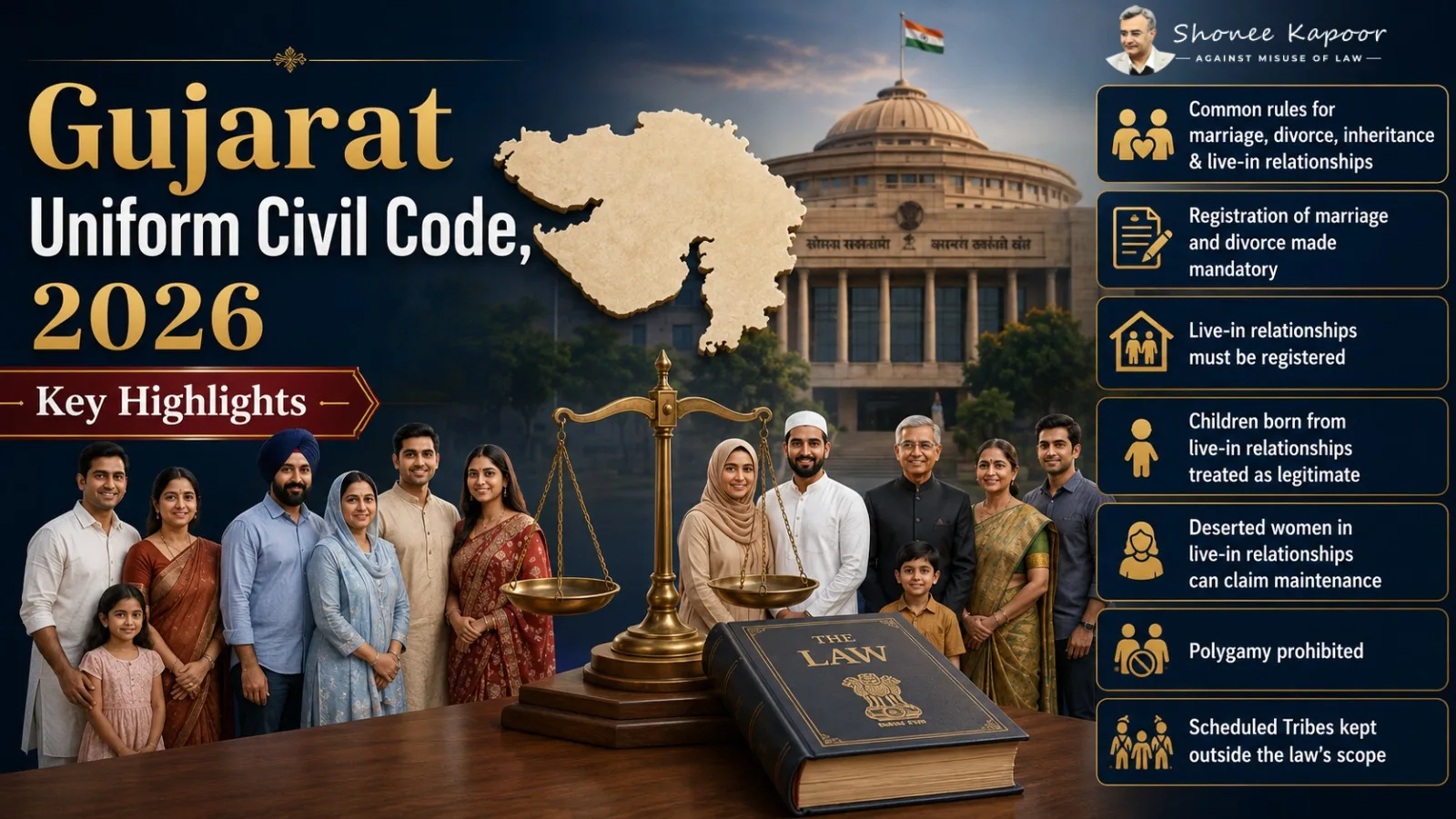
Gujarat Uniform Civil Code, 2026

Written and analysed by Shonee Kapoor
Legal Consultant, Author & Men's Rights ActivistUnderstanding Divorce, Mutual Consent, Maintenance, Child Custody, and Legal Rights Under the Gujarat Uniform Civil Code, 2026
The Gujarat Uniform Civil Code (UCC), 2026 has introduced a common legal framework governing marriage, divorce, maintenance, succession, and live-in relationships across communities in Gujarat. The objective is to provide uniform civil laws irrespective of religion while ensuring equality before law. The Code contains a dedicated framework for divorce, replacing different personal law procedures with one common legal process for those covered by the Code.
This guide explains everything about Gujarat UCC Divorce, including the grounds for divorce, mutual consent divorce, maintenance, child custody, judicial separation, and the legal procedure.
What is Gujarat UCC?
The Gujarat Uniform Civil Code provides a single legal framework for matters relating to:
- Marriage
- Divorce
- Judicial Separation
- Nullity of Marriage
- Maintenance
- Child Custody
- Succession
- Live-in Relationships
Instead of different personal laws governing different religious communities, the Code establishes common civil rules applicable to those covered under the legislation, subject to the exemptions provided by law.
Divorce Under Gujarat UCC
One of the most significant features of the Gujarat UCC is the introduction of uniform divorce laws.
The Code lays down common procedures and grounds for dissolution of marriage, ensuring that divorce proceedings are handled through civil courts under a standardized legal framework. It also includes provisions relating to judicial separation, nullity of marriage, mutual consent divorce, maintenance, child custody, and appeals.
Grounds for Divorce Under Gujarat UCC
Depending upon the facts of each case, divorce may generally be sought on legally recognized grounds provided under the Code.
These may include:
- Cruelty
- Desertion
- Adultery (where applicable under the Code)
- Mental disorder in legally recognized circumstances
- Conversion or other statutory grounds where applicable
- Irretrievable breakdown where recognized
- Other grounds specifically provided by the Gujarat UCC
Each case depends on its own facts and supporting evidence.
Mutual Consent Divorce Under Gujarat UCC
The Gujarat UCC provides for divorce by mutual consent, allowing spouses who mutually agree that the marriage has broken down to jointly seek dissolution before the competent court.
Generally, the process involves:
- Joint petition
- Settlement regarding maintenance
- Settlement regarding child custody (if applicable)
- Property settlement
- Court satisfaction regarding voluntary consent
- Final decree of divorce
Mutual consent divorce is generally faster than contested divorce where both parties are in agreement.
Contested Divorce Under Gujarat UCC
If one spouse does not agree to divorce, the other spouse may file a contested divorce petition before the competent court.
The court examines:
- Evidence
- Witnesses
- Documents
- Conduct of parties
- Legal grounds under the Code
The court grants divorce only if statutory requirements are satisfied.
Judicial Separation
Before dissolution of marriage, spouses may also seek judicial separation.
Judicial separation allows parties to live separately without immediately dissolving the marriage. During this period, reconciliation remains legally possible.
Maintenance Under Gujarat UCC
The Gujarat Uniform Civil Code also contains provisions relating to maintenance.
The court may consider factors such as:
- Income of both spouses
- Standard of living
- Financial dependence
- Responsibilities towards children
- Assets and liabilities
The objective is to ensure fairness while deciding maintenance claims.
Child Custody
Whenever children are involved, the welfare of the child remains the paramount consideration.
The court may determine:
- Physical custody
- Visitation rights
- Educational responsibilities
- Financial support
- Welfare of the minor child
Every custody decision depends upon the best interests of the child.
Registration of Divorce
The Gujarat UCC also provides for registration of divorce decrees after they attain finality, creating an official civil record of the dissolution of marriage.
Benefits of Gujarat UCC Divorce Laws
Some key advantages include:
- Uniform procedure across communities
- Greater legal certainty
- Standardized divorce process
- Better record keeping
- Common rules regarding maintenance
- Uniform child custody principles
- Transparent judicial process
Important Legal Considerations
Every divorce case is unique.
Factors such as:
- Domestic violence allegations
- Property disputes
- Maintenance claims
- Child custody
- Criminal proceedings
- Settlement negotiations
may significantly affect the outcome.
Professional legal advice should always be obtained before initiating divorce proceedings.
The Gujarat UCC Divorce framework represents a significant shift toward a uniform civil law governing matrimonial disputes. By introducing common rules for divorce, judicial separation, maintenance, custody, and registration, the Gujarat Uniform Civil Code aims to create a more consistent legal process while leaving the ultimate decision to the competent civil courts based on the facts of each case.
FAQs
Yes. The Code includes provisions for divorce by mutual consent before the competent court.
Yes. The Code contains a dedicated framework governing marriage and divorce for persons covered by the legislation.
Yes. The Code includes provisions relating to maintenance and permanent alimony, subject to judicial determination.
The Code provides for registration of final divorce decrees under the prescribed procedure.





Share Your Thoughts
Comments are moderated before publication.