
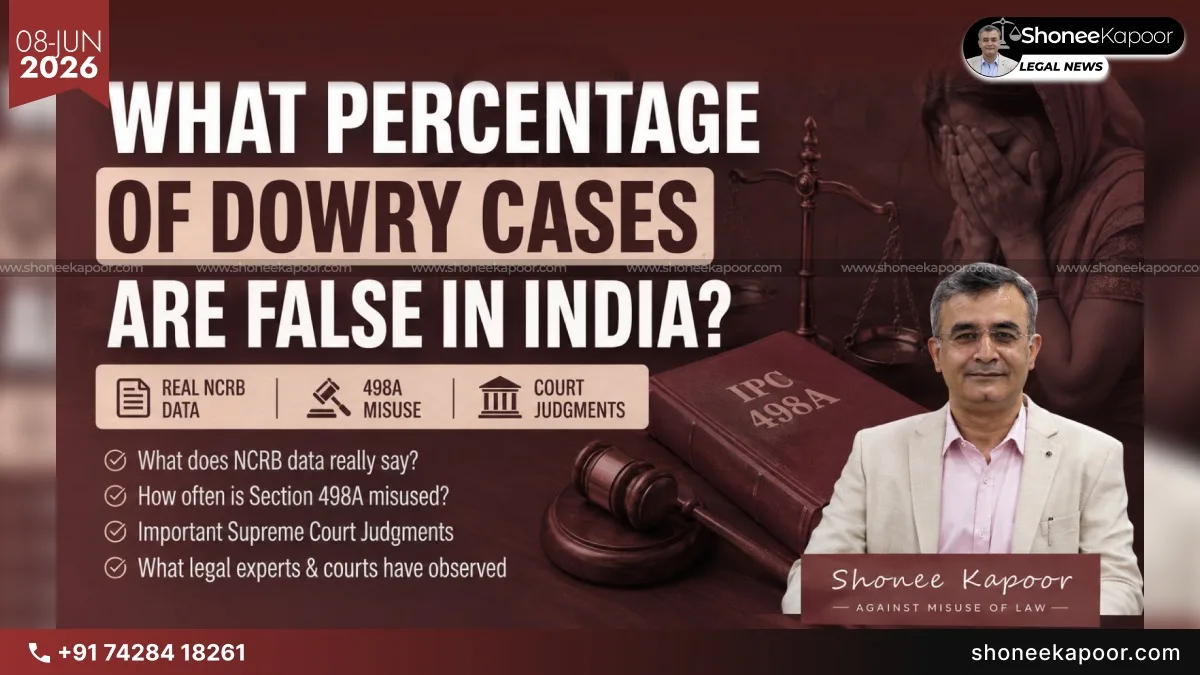
What Percentage Of Dowry Cases Are False In India? Real NCRB Data, 498A Misuse & Court Judgments

Written and analysed by Shonee Kapoor
Legal Consultant, Author & Men's Rights ActivistWhat percentage of dowry cases are actually false? Examine RTI data, Supreme Court observations, conviction rates, and the legal reality behind Section 498A cases in India.
NEW DELHI: One of the most common questions I am asked is:
“What percentage of dowry cases are false?”
The honest answer is simple.
Nobody in India knows the exact percentage.
Not the police.
Not the courts.
Not the NCRB.
That is because Indian crime statistics do not classify every acquittal, discharge, quashing, compromise, or closure as a “false case.”
However, what we do know is far more revealing.
Court records, RTI data, and repeated observations by the Supreme Court show that a very large number of dowry-cruelty cases under Section 498A IPC (now Section 85 of the Bharatiya Nyaya Sanhita) ultimately fail to result in conviction.
And that should concern every citizen who believes in justice.
THE DATA NOBODY WANTS TO DISCUSS
For years, the public has been told that low conviction rates do not necessarily mean false cases.
That is true.
But low conviction rates do mean one thing:
A large number of accused persons are being dragged through the criminal justice system without the prosecution being able to prove guilt beyond reasonable doubt.
That is not a small issue.
It is a constitutional issue.
In Delhi, RTI data obtained from district courts revealed that out of thousands of Section 498A prosecutions, only a tiny fraction resulted in conviction, while a significant number were quashed or ended unsuccessfully. Reports based on this RTI data indicated conviction rates as low as 0.2% in the courts examined.
Even if one refuses to call all such cases “false,” it becomes impossible to ignore the scale of failed prosecutions.
WHAT DOES THE SUPREME COURT SAY?
The Supreme Court has repeatedly acknowledged concerns regarding misuse of Section 498A.
In Rajesh Sharma v. State of U.P. (2017), the Court observed that complaints under Section 498A were often being used as a weapon rather than a shield and expressed concern over the harassment of innocent relatives.
Although some directions in that judgment were later modified in Social Action Forum v. Union of India, the Supreme Court did not deny the existence of misuse. It merely held that safeguards must remain within the framework of criminal law.
In recent years, multiple benches of the Supreme Court have again warned against vague allegations, indiscriminate implication of relatives, and criminal proceedings based on generalized accusations.
WHY CONVICTION RATES MATTER
Imagine being arrested.
Imagine your elderly parents being named in an FIR.
Imagine your siblings living abroad being summoned.
Imagine spending five to ten years fighting a criminal trial.
And then imagine being acquitted because the allegations could not be proved.
That acquittal does not automatically establish malicious prosecution.
But it certainly means the criminal justice system imposed a massive burden on people who were never ultimately found guilty.
For the accused family, the punishment often begins long before any judgment is delivered.
CAN WE SAY ALL ACQUITTALS ARE FALSE CASES?
No.
And any honest legal commentator should say so clearly.
An acquittal can happen for many reasons:
- Insufficient evidence
- Contradictory testimony
- Witnesses turning hostile
- Procedural defects
- Failure of prosecution to prove guilt beyond reasonable doubt
Therefore, claiming that every acquittal equals a false case would be legally incorrect.
But claiming that misuse does not exist would be equally incorrect.
The Supreme Court itself has repeatedly acknowledged misuse concerns while simultaneously upholding the need for strong protection for genuine victims.
A 26-YEAR CASE THAT ENDED IN ACQUITTAL
In 2025, the Supreme Court acquitted a husband after a legal battle that lasted approximately 26 years.
The Court found the allegations vague and unsupported by credible evidence and expressed concern regarding misuse of Section 498A.
Whether one labels that case “false” or “unproven,” the question remains:
Can any justice system justify a quarter-century criminal prosecution that ends without proof of guilt?
THE REAL QUESTION INDIA SHOULD BE ASKING
Instead of asking:
“What percentage of dowry cases are false?”
We should ask:
“How many innocent people are forced to undergo criminal prosecution before courts determine that allegations could not be proved?”
That is the question policymakers should answer.
Because justice is not only about protecting genuine victims.
Justice is also about protecting innocent citizens from wrongful prosecution.
A civilized legal system must do both.
CONCLUSION
There is no official government figure stating what percentage of dowry cases are false.
However, court records, RTI disclosures, acquittal rates, quashing rates, and repeated Supreme Court observations demonstrate that misuse concerns are real and cannot be dismissed.
The solution is neither weakening protection for genuine victims nor ignoring wrongful prosecutions.
The solution is better investigation, evidence-based prosecutions, accountability for malicious complaints, and equal concern for every innocent person caught in the system.
Justice must protect victims.
But justice must also protect the falsely accused.
FAQs
India does not maintain an official statistic declaring a fixed percentage of dowry cases as false.
No. An acquittal only means guilt was not proved beyond reasonable doubt.
Yes. The Supreme Court has repeatedly expressed concern regarding misuse and over-implication of relatives.
Yes. The Supreme Court has upheld its constitutionality while acknowledging misuse concerns.
Long criminal trials, low conviction rates, and the impact of unproven allegations on entire families.
Related Articles

What Legal Remedies Are Available For Men In India? 498A, Divorce, Maintenance, Custody & False Cases
Know the legal remedies available for men in India against false 498A, maintenance, domestic violence, custody battle...
How To Remove Name From 498A FIR: An Innocent Husband’s Legal Guide
A false 498A FIR can destroy a man’s reputation, career, and family before trial even begins. This legal guide explai...
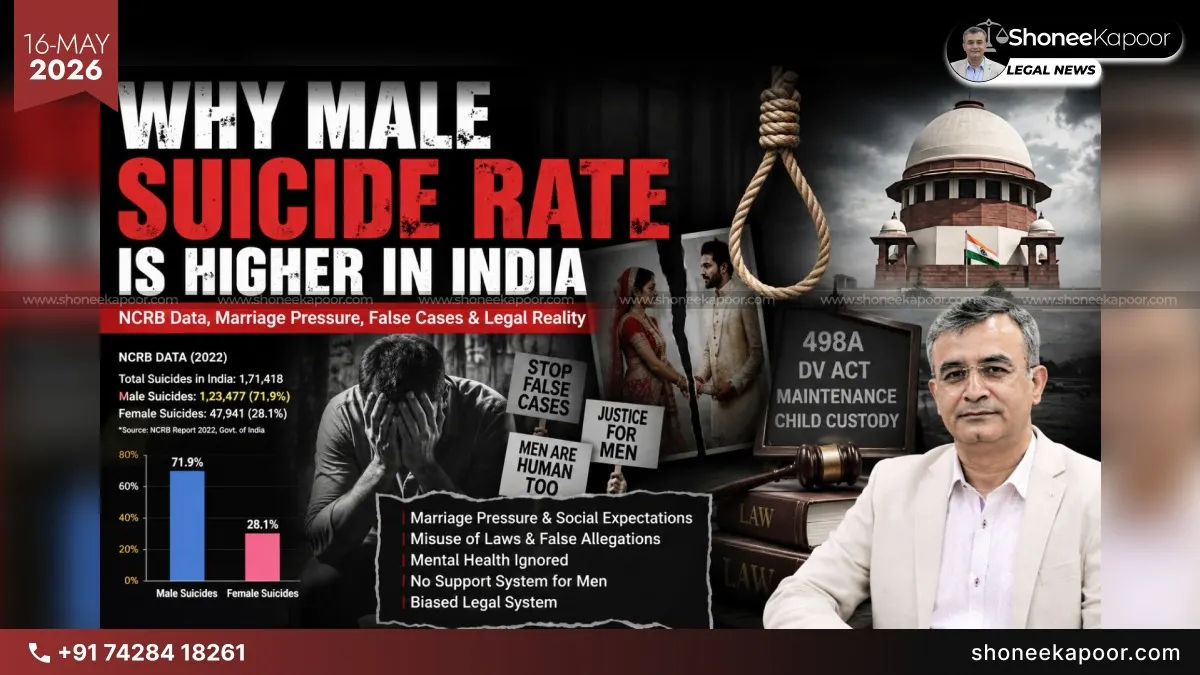
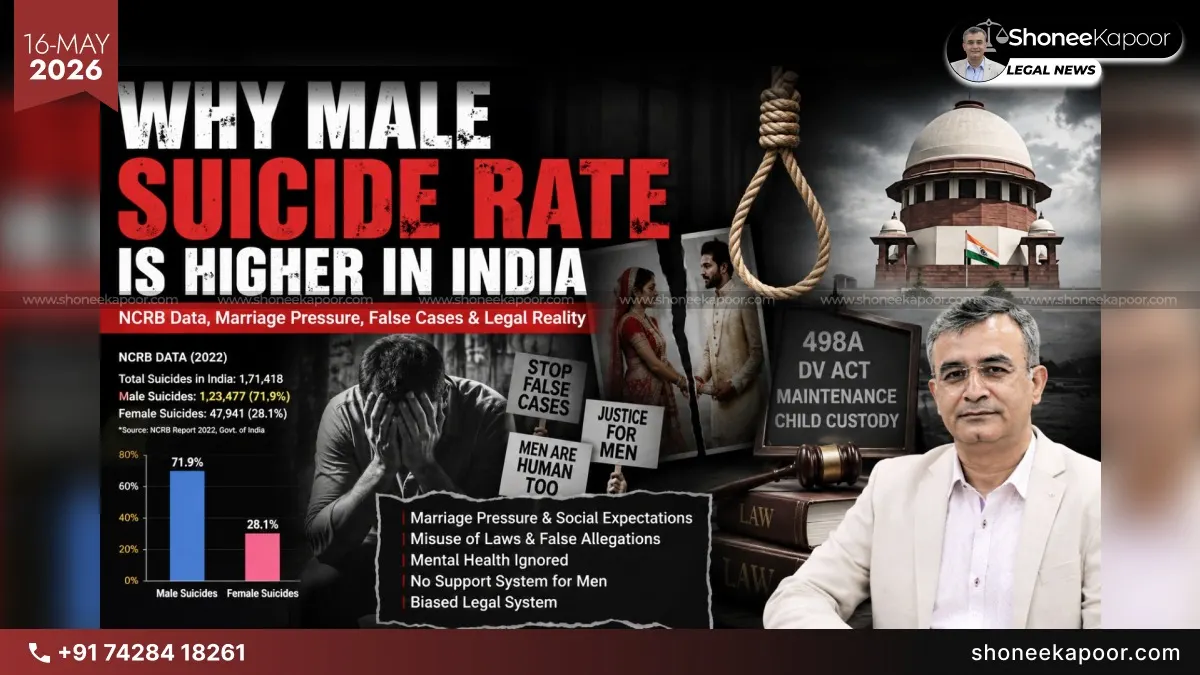
Why Male Suicide Rate Is Higher In India: NCRB Data, Marriage Pressure, False Cases & Legal Reality
NCRB data shows men form nearly three-fourths of suicide deaths in India. Here is the legal, social and family-court ...






Share Your Thoughts
Comments are moderated before publication.