
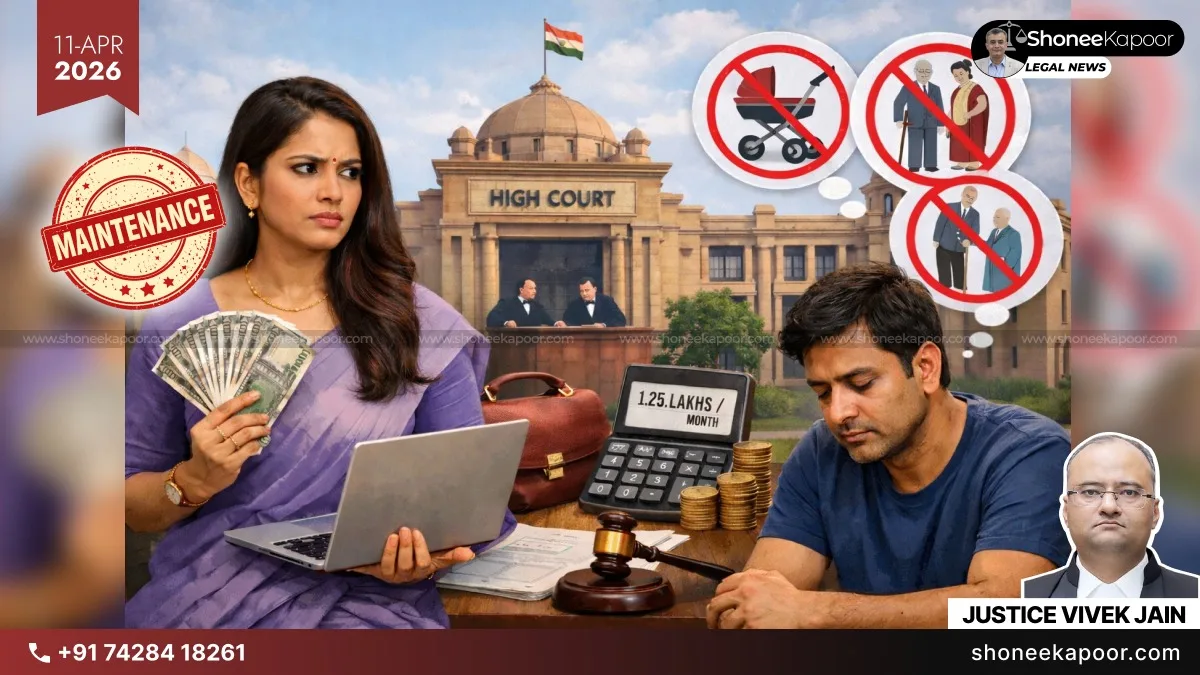
Finding no income disparity or dependency, the Madhya Pradesh High Court dismissed the earning wife’s maintenance plea.
Are men being compelled to fight unnecessary litigation despite clear financial independence on the other side?
JABALPUR: In a recent judgment, Justice Vivek Jain of the Madhya Pradesh High Court dismissed a petition filed by the wife seeking interim maintenance under Section 24 of the Hindu Marriage Act, 1955. The case arose from a matrimonial dispute where the husband had already filed for divorce, and both parties had been living separately since June 2023.
The wife approached the Family Court seeking maintenance and litigation expenses. However, she herself admitted that she was earning around ₹20 lakh per year. Later, she tried to change her statement and claimed her income had reduced to ₹14.81 lakh annually. Despite this, the Court noted that even the reduced income translated to a monthly earning of approximately ₹1.25 lakh.
The Family Court had earlier rejected her application, observing that she had no other financial responsibilities and was capable of maintaining herself. When the matter reached the High Court, the Court carefully examined whether there was any legal error in that decision.
The High Court found that there was no major difference in the financial status of both parties. Unlike other cases where maintenance is granted due to a large income gap, here both husband and wife were earning at comparable levels. Additionally, there was no child involved or any dependent responsibility on the wife.
The wife relied on a judgment of the Delhi High Court in Smt. Shikha Badhani vs. Shri Hemant Badhani, where maintenance was granted despite the wife earning ₹1.25 lakh per month. However, the Court clarified that the facts of that case were entirely different, as the husband in that matter was earning around ₹1.35 crore annually and there was also a child to maintain.
Rejecting the wife’s argument, the Court made a strong observation, stating that the present petition was
“Nothing, but an attempt to extract a pound of flesh from the husband, which cannot be permitted.”
Based on these findings, the Court upheld the Family Court’s decision and dismissed the wife’s petition, clearly reinforcing that maintenance is not a right for financially independent spouses where no real need is established.
Explanatory Table: Laws And Provisions Involved
| Law / Provision | Purpose | How Applied in This Case |
| Section 24, Hindu Marriage Act, 1955 | Provides interim maintenance during ongoing matrimonial cases | Denied due to wife’s sufficient income |
| Section 25, Hindu Marriage Act, 1955 | Provides permanent alimony after final judgment | Not applied; no financial need shown |
| Hindu Marriage Act, 1955 | Governs marriage, divorce, and maintenance rights | Used to assess need-based entitlement |
| Code of Civil Procedure, 1908 | Lays down civil procedure and judicial review | No legal error found in lower court |
| Article 227 of the Constitution of India | Gives High Court supervisory powers | No interference warranted |
Case Details
- Case Title: Smt. Neha Adlak vs. Rahul Kawadkar
- Court: Madhya Pradesh High Court, Jabalpur Bench
- Case Number: Misc. Petition No. 1928 of 2026
- Bench: Justice Vivek Jain
- Date of Judgment: 31 March 2026
- Neutral Citation 2026:MPHC-JBP:25498
- Counsel:
- For Petitioner (Wife): Shri Rajesh Kumar Patel, Advocate
Key Takeaways
- Maintenance is not automatic; a financially independent spouse cannot claim it without proving real need.
- Courts are increasingly recognizing misuse of maintenance provisions as a pressure tactic in matrimonial disputes.
- Comparable income between spouses weakens any claim for interim financial support.
- Absence of children or dependents significantly reduces the justification for seeking maintenance.
- Legal provisions meant for support cannot be used as tools for financial extraction during litigation.
This Could Change Your Case-Get FREE Legal Advice-Click Here!
Disclaimer: The views and opinions expressed in this article are those of the Indian courts and do not necessarily reflect the official policy or position of “ShoneeKapoor.com” or its affiliates. This article is intended for informational and educational purposes only. The content provided is not legal advice, and viewers should not act upon this information without seeking professional counsel. Viewer discretion is advised.
