
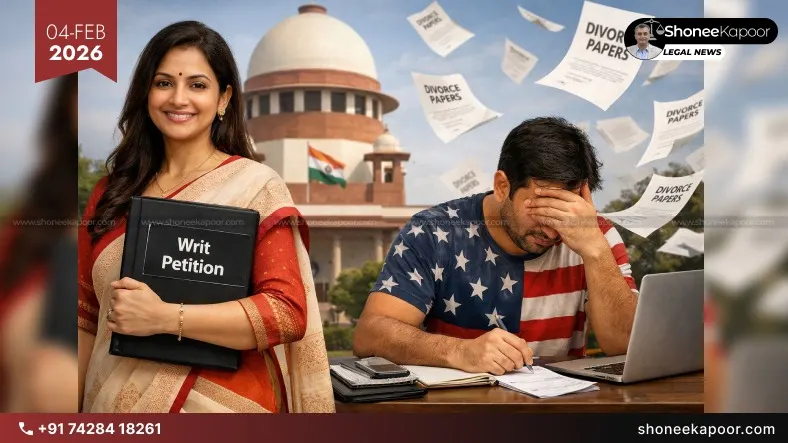
An Indian woman has approached the Supreme Court seeking to block divorce proceedings started by her husband in the United States. She claims the foreign case is illegal, lacks jurisdiction, and violates her fundamental rights under Indian law.
NEW DELHI: An Indian woman has filed a writ petition before the Supreme Court of India under Article 32 of the Constitution, challenging divorce proceedings initiated by her husband before a Family Court in the State of Rhode Island, United States.
She has alleged that the foreign divorce case is illegal, beyond jurisdiction, and violates her fundamental rights guaranteed under Articles 14 and 21 of the Constitution of India.
In her petition, the woman has stated that the divorce proceedings initiated abroad are not only unlawful but are also being misused as a pressure tactic.
The plea states:
“The foreign divorce proceedings are ex facie without jurisdiction, oppressive, and constitutionally impermissible. They are being employed as an instrument of coercion, extortion, and-economic abuse, directly violating the law laid down by this Honble Court in Y. Narasimha Rao v. Y. Venkata Lakshmi, (1991) 3 SCC 451, which mandates that matrimonial disputes must be adjudicated by courts of competent jurisdiction in accordance with the governing personal law and domicile of the parties”.
The writ petition has been filed by a resident of Kanniyakumari district in Tamil Nadu through Advocate-on-Record Subhasish Bhowmick. The respondents named in the case include the Union of India, her husband, and the Embassy of the United States of America in India.
The petitioner has argued that normal remedies available before Indian civil or family courts are not sufficient to stop an ongoing foreign legal process. She has claimed that approaching the Supreme Court directly under Article 32 is the only effective remedy available to prevent serious and irreversible harm to her constitutional rights.
She has further requested the Supreme Court to declare that any divorce decree passed by the foreign court should be treated as null, void, and unenforceable in India. Along with this, she has sought directions to the Union of India to take suitable diplomatic and protective steps to safeguard her legal and constitutional rights.
According to the petition, the marriage between the parties was solemnised on January 06, 2023, at Devakottai in Tamil Nadu, following Indian Christian religious rites. The marriage was officially registered on January 09, 2023, under the Tamil Nadu Registration of Marriages Act, 2009. The petitioner has clearly stated that the marriage is governed exclusively by the Indian Divorce Act, 1869, and that she continues to be permanently domiciled in India.
The woman has alleged that after she was taken to the United States on a dependent visa, she was subjected to physical violence, emotional abuse, and financial exploitation. She has claimed that she was forced to give up her Indian property, stridhan, gold jewellery, important documents, and articles kept in a joint locker.
She has further stated that after her dependent visa expired on July 18, 2024, she was left without lawful immigration status in the United States. During this period, she was allegedly subjected to further pressure and coercion. Even after returning to India in March 2024, she claims that demands continued to be made for the transfer of her Indian property.
The petition alleges that in September 2025, her husband brought her back to India, abandoned her, and returned alone to the United States. She has stated that on October 28, 2025, he completely blocked all communication with her. The plea further claims that in December 2025, the husband and his father approached her with assurances of reconciliation and settlement, which persuaded her not to initiate legal proceedings in India at that stage.
Despite these assurances, the petition alleges that the husband secretly filed divorce proceedings on October 30, 2025, before the Family Court in the State of Rhode Island, without her consent and without her submitting to the jurisdiction of that court.
The petitioner has reiterated that the foreign divorce proceedings are illegal, oppressive, and constitutionally impermissible. She has relied upon the Supreme Court judgment in Y. Narasimha Rao v. Y. Venkata Lakshmi (1991) 3 SCC 451, which lays down that a foreign matrimonial judgment is not binding in India unless the foreign court has jurisdiction as per the personal law governing the parties and unless both parties voluntarily submit to that jurisdiction.
In this context, the plea states:
“In the present case, the marriage is governed exclusively by the Indian Divorce Act, 1869, the Petitioner never voluntarily submitted to the jurisdiction of the Rhode Island Family Court, and the foreign proceedings are founded on grounds alien to Indian Christian matrimonial law. Hence, the proceedings are ex facie without jurisdiction and void in India”.
The petitioner has also relied on several judicial precedents to argue that Indian courts have the authority to restrain foreign legal proceedings when such proceedings are oppressive, vexatious, or initiated in bad faith.
Explanatory Table: Laws & Legal Provisions Involved In The Case
| Law / Provision | Section / Article | Simple Explanation | Relevance to This Case |
| Constitution of India | Article 32 | Gives citizens the right to directly approach the Supreme Court for protection of fundamental rights | The wife invoked Article 32 stating that no other remedy can stop the foreign divorce proceedings |
| Constitution of India | Article 14 | Guarantees equality before law | Alleged violation due to arbitrary and unequal treatment through foreign proceedings |
| Constitution of India | Article 21 | Protects life and personal liberty, including dignity | Claimed violation due to coercive and oppressive divorce proceedings abroad |
| Indian Divorce Act, 1869 | Entire Act | Governs divorce and matrimonial disputes for Christians in India | Marriage is governed exclusively by this Act, not foreign law |
| Tamil Nadu Registration of Marriages Act, 2009 | Registration provisions | Mandates registration of marriages solemnised in Tamil Nadu | Marriage was validly registered under this Act |
| Code of Civil Procedure, 1908 | Section 13 | Lays down when foreign judgments are not conclusive in India | Used to argue that foreign divorce decree is unenforceable |
| Supreme Court Judgment | Y. Narasimha Rao v. Y. Venkata Lakshmi (1991) 3 SCC 451 | Holds that foreign divorce decrees are invalid unless jurisdiction and consent conditions are met | Core precedent relied upon to challenge US divorce proceedings |
Case Details
- Case Title: Writ Petition under Article 32 of the Constitution of India challenging foreign divorce proceedings initiated in the State of Rhode Island, USA
- Court: Supreme Court of India
- Jurisdiction Invoked: Article 32 of the Constitution of India
- Petitioner: Indian wife, resident of Kanniyakumari District, Tamil Nadu
- Respondents:
- Union of India
- Husband
- Embassy of the United States of America in India
- Counsel for Petitioner: Advocate-on-Record Subhasish Bhowmick
- Foreign Court Involved: Family Court, State of Rhode Island, United States of America
Key Takeaways
- Foreign courts are increasingly being invoked to drag Indian husbands into costly, one-sided legal battles without their consent or lawful jurisdiction.
- Filing divorce abroad while the marriage is governed by Indian personal law amounts to forum shopping and creates severe legal and financial pressure on the husband.
- Such foreign proceedings expose husbands to double jeopardy, forcing them to defend themselves simultaneously in India and overseas.
- Supreme Court jurisprudence clearly protects Indian spouses from being bound by foreign matrimonial decrees obtained through unfair or coercive means.
- Cross-border misuse of divorce laws often shifts the burden entirely onto husbands, turning matrimonial litigation into a tool of harassment rather than justice.
This Could Change Your Case-Get FREE Legal Advice-Click Here!
Disclaimer: The views and opinions expressed in this article are those of the Indian courts and do not necessarily reflect the official policy or position of “ShoneeKapoor.com” or its affiliates. This article is intended for informational and educational purposes only. The content provided is not legal advice, and viewers should not act upon this information without seeking professional counsel. Viewer discretion is advised.
