
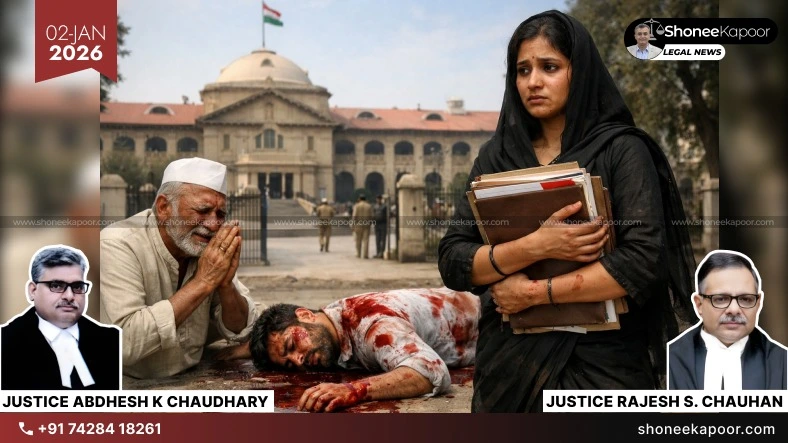
When the wife of a murdered man chooses not to pursue criminal proceedings, an uncle cannot claim “victim” status. The Allahabad High Court held that the closest legal heir’s decision brings legal finality and bars third-party intervention.
PRAYAGRAJ: The Allahabad High Court clarified who can legally speak for a deceased victim in criminal proceedings. The Court held that under Section 2(wa) of the Code of Criminal Procedure, the wife of a deceased person clearly outshines an uncle in what the Court described as the “closest legal heir test”.
Section 2(wa) of CrPC defines a “victim” as a person who has suffered loss or injury due to the offence, and the term also includes the guardian or legal heir of such person. The dispute before the Court arose when the uncle of a deceased man sought transfer of investigation to the CBI, claiming influence over the police machinery.
While examining the maintainability of such petitions, the Bench of Justice Rajesh Singh Chauhan and Justice Abdhesh Kumar Chaudhary made it clear that emotional closeness or personal concern cannot override legal hierarchy.
The Court categorically held:
“The present petitioner, who is uncle of the deceased, may not come within the purview of victim or legal heir of the deceased, as the wife outshines the uncle in the ‘closest legal heir test’ to be considered as legal heir in view of Section 2 (wa) of Cr.P.C.”
The Bench noted that although the term “closest legal heir” is not expressly defined in any statute, courts cannot allow confusion over who is entitled to pursue criminal remedies. Criminal law, the Court observed, is fundamentally an offence against society, and the State has the primary duty to prosecute. Private intervention must therefore be limited and legally justified.
Explaining the principle further, the Court observed:
“According to the ‘closest legal heir test’, the closest or the proximate legal heir of the victim must outshine the next closer legal heir because the administration of justice does not warrant any dispute even on determining as to who would be the ‘legal heir’ to pursue the grievance of a victim, in pursuing a criminal case, which is fundamentally construed to be an offence against the society and therefore, it is the primary duty of the State to protect the right and interest of the victim.”
The case arose from the murder of one Ajeet Singh in 2021. FIRs were registered against multiple accused persons, and another FIR was lodged against a senior journalist and a political figure for allegedly possessing confidential documents. The deceased’s uncle approached the High Court seeking CBI investigation, alleging that influential persons were manipulating the Special Task Force.
However, the Court noted that the wife of the deceased had already filed similar petitions earlier, which were dismissed. She later approached the Supreme Court, after which the matter was remanded back to the High Court, and eventually all her petitions were withdrawn. Even the uncle’s attempt to get impleaded in the wife’s petitions was rejected.
Despite this history, the uncle filed fresh writ petitions with identical prayers, without challenging the charge sheets already filed. The Court found this conduct legally untenable.
Analysing the scheme of the CrPC, the Court referred to the meaning of “near relative” under Section 394 CrPC and “legal representative” under Section 320(4)(b) CrPC read with Section 2(11) of the Civil Procedure Code. It also examined the Hindu Succession Act hierarchy and found that an uncle does not fall within the immediate or proximate category of heirs.
The Court recorded:
“This Court finds that as per Section 2 (11) of the Civil Procedure Code, defines ‘legal representative’ to be a person who in law represents the estate of a deceased person, which brings the schedule incorporated as per Section 8 of the Hindu Succession Act, 1956 appended to the said Act relating to ‘Class-I’ and ‘Class-II’ heir into limelight. Interestingly, in both the cases, this Court finds that Uncle is a far away and/or distant relative and in a way does not find any place both under the meaning of the word ‘near relative’ or ‘legal representative’ mentioned in the Code of Criminal Procedure.”
Applying these principles, the Court concluded that the wife is the closest legal heir. Since she had withdrawn all her petitions and did not authorise the uncle, the writ petitions filed by him could not be entertained.
On the issue of transfer of investigation, the Court further clarified that such an extraordinary power can be exercised only when strong and fresh material is shown. Mere suspicion or apprehension is not enough.
The Bench observed:
“The order of transfer of investigation could have been passed when the Court finds that there is new material or evidence of sterling nature, which has been ignored by the investigating agency but in the present case, no such material or evidence has been shown to the Court and only apprehension has been shown to the effect that the main mastermind and allegedly the person to be instrumental in the said crime, who allegedly planned the murder of late Ajeet Singh is having close association with STF, the investigating agency, therefore, such investigation is not proper.”
The Court also emphasised that once investigation is complete, charge sheets are filed, and trial has commenced, interference by a third party would amount to disturbing an ongoing criminal process. It reiterated settled law that strangers have extremely limited locus in criminal proceedings.
Ultimately, the High Court held that the uncle was not a “victim” under Section 2(wa) CrPC, lacked locus standi, and that the prayers for CBI investigation were stale and legally unsustainable. Both writ petitions were disposed of without costs.
Explanatory Table: Laws & Sections Discussed In The Case
| Law / Section | What It Says | How the Court Used It |
| Section 2(wa) CrPC | Defines “victim” as a person who has suffered loss or injury due to the offence, and includes guardian or legal heir | The core provision. The Court held that only the closest legal heir can claim victim status. Wife qualifies; uncle does not |
| Section 394 CrPC (Explanation) | Defines “near relative” as parent, spouse, lineal descendant, brother or sister | Used to show that an uncle is not treated as a near relative in criminal law |
| Section 320(4)(b) CrPC | Talks about compounding of offences by a “legal representative” | Read with CPC to understand who can legally represent a deceased person |
| Section 2(11) CPC | Defines “legal representative” as a person who represents the estate of the deceased | Helped the Court link criminal procedure with civil law concepts |
| Section 8, Hindu Succession Act, 1956 | Lays down Class-I and Class-II heirs | Demonstrated that a wife is a Class-I heir, while an uncle is a distant relative |
| Section 216 CrPC | Power of trial court to alter or add charges | Court noted that even if issues arise, trial court can address them without third-party interference |
| Section 482 CrPC | Inherent powers of High Court | Highlighted that even this power cannot be misused by strangers without locus |
| Article 32, Constitution of India | Right to approach Supreme Court | Mentioned as part of procedural history when uncle approached the Apex Court |
| Official Secrets Act, 1923 (Section 5) | Deals with unauthorised possession of secret documents | Relevant to the second FIR where the petitioner had no connection or victim status |
Case Summary
- Court: Allahabad High Court, Lucknow Bench
- Case Title: Rajesh Singh vs State of Uttar Pradesh & Others
- Connected Matters
- Criminal Misc. Writ Petition No. 4791 of 2025
- Criminal Misc. Writ Petition No. 6047 of 2025
- Bench: Justice Rajesh Singh Chauhan and Justice Abdhesh Kumar Chaudhary
- Date of Judgment: 18 December 2025
- Nature of Petitions: Writ petitions seeking transfer of investigation from Police/STF to CBI
- Counsels for Petitioner
- Kapil Misra
- Ashish Kumar Singh
- Counsels for Respondents
- Government Advocate (U.P.)
- Anurag Kumar Singh
- Naved Ali
- Rao Narendra Singh
Key Takeaways
- The law allows a murder case to lose momentum if the wife chooses withdrawal, even when serious allegations remain.
- Moral responsibility and legal authority are not treated the same; intent to fight for justice becomes irrelevant.
- A man’s death can legally fade into silence if the closest heir disengages.
- Relatives who refuse to accept closure are branded as outsiders, no matter how genuine their concern.
- This exposes a hard truth: criminal justice can stop not because truth is found, but because interest is withdrawn.
This Could Change Your Case-Get FREE Legal Advice-Click Here!
Disclaimer: The views and opinions expressed in this article are those of the Indian courts and do not necessarily reflect the official policy or position of “ShoneeKapoor.com” or its affiliates. This article is intended for informational and educational purposes only. The content provided is not legal advice, and viewers should not act upon this information without seeking professional counsel. Viewer discretion is advised.
