
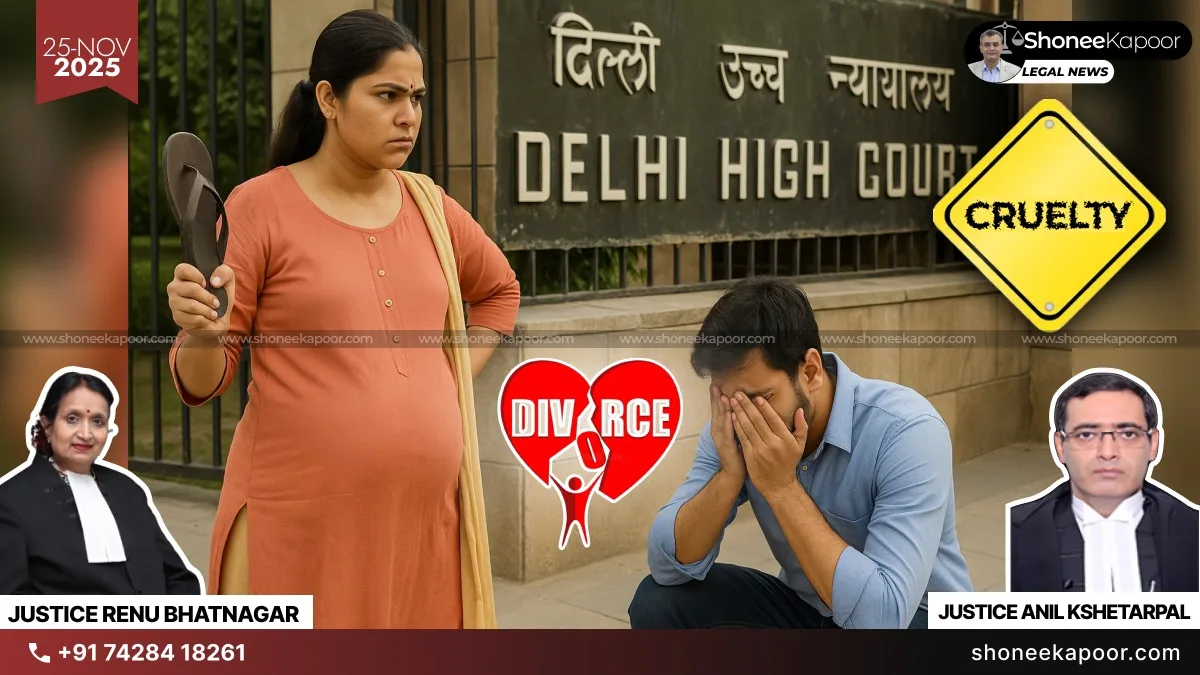
Wife’s Pregnancy Cannot Whitewash Or Erase Cruelty: Delhi High Court Grants Divorce To Husband

Curated by NEWS DESK
Editorial DeskThe Delhi High Court dissolved a 2016 marriage holding that a wife’s pregnancy or temporary reconciliation cannot wipe out past acts of cruelty. The Court found that repeated insults, threats, refusal to cohabit, and allegations of molestation against the husband’s father made the marriage irreparable.
NEW DELHI: The Delhi High Court ruled that when a spouse repeatedly behaves with cruelty, those actions cannot be excused or forgotten merely because the wife became pregnant or because the couple briefly lived together again.
The Court made it clear that the law requires judging cruelty based on the full pattern of behaviour, not on isolated moments where the relationship seemed normal.
As the Division Bench of Justice Anil Kshetarpal and Justice Renu Bhatnagar said:
“The occurrence of pregnancy or temporary reconciliation cannot erase antecedent acts of cruelty, particularly when the record demonstrates that the Respondent’s abusive conduct, threats, and denial of cohabitation persisted thereafter. Cruelty must be judged from the entirety of the circumstances and not from isolated episodes of reconciliation.”
The case involved a marriage solemnized in 2016. The husband approached the Family Court in 2021 seeking divorce on the ground of mental cruelty. He described several incidents where the wife allegedly abused him, refused to live with his parents, insulted his disabled mother, threatened suicide, denied physical relations, and finally left the matrimonial home in January 2020 with all her belongings and did not return.
The wife denied the allegations and instead claimed that she was harassed for dowry, pushed out of the home, and that the husband’s father even tried to molest her. She relied on bills, documents, and later criminal proceedings filed after the divorce petition.
The Family Court rejected the husband’s divorce plea because it felt the wife’s miscarriage in early 2019 showed that the couple had a harmonious relationship and because the husband did not “sufficiently rebut” her dowry-related claims. It also held that he approached the Court without clean hands.
The High Court completely disagreed with that reasoning. It held that simply because the wife conceived and suffered a miscarriage, it cannot be assumed that there was no cruelty. The Court explained that cruelty must be seen as a series of actions showing a sustained pattern of mental pain, stress, humiliation, or threats – not as one or two isolated events that appear normal.
To evaluate whether mental cruelty existed, the High Court relied on several Supreme Court judgments. It referred to V. Bhagat v. D. Bhagat (1994) 1 SCC 337, which held that mental cruelty includes conduct that causes deep mental pain making it impossible for the other spouse to live with the partner.
The Court also cited Samar Ghosh v. Jaya Ghosh (2007) 4 SCC 511, where the Supreme Court held that cruelty cannot be decided incident-by-incident but must be assessed cumulatively in the social, emotional, and personal context of the spouses.
The husband’s evidence was found consistent, detailed, and largely unshaken during cross-examination. The wife’s accusations, especially of molestation by the father-in-law, were found to be unsupported by any complaint or FIR before the divorce petition. Instead, all her legal actions began only after the matrimonial dispute escalated, which the Court said weakens her credibility.
The wife’s accusations of molestation by the father-in-law had no timely complaint, FIR, or supporting evidence, which the Court found significant. The Court applied the principle from A. Jayachandra v. Aneel Kaur (2005) 2 SCC 22, where the Supreme Court held that belated or exaggerated allegations made only after litigation starts may themselves amount to cruelty.
Further, the High Court referred to K. Srinivas Rao v. D.A. Deepa (2013) 5 SCC 226, in which the Supreme Court held that false allegations and threats of criminal cases against a spouse or their family amount to mental cruelty. The Court also noted the ruling in Naveen Kohli v. Neelu Kohli (2006) 4 SCC 558, which recognizes that marriages which have broken down beyond repair should not be forced to continue.
Regarding the Family Court’s finding that the husband lacked “clean hands”, the High Court observed that this principle was wrongly applied. For this, the Court referred to Savitri Pandey v. Prem Chandra Pandey (2002) 2 SCC 73, where the Supreme Court clarified that the “clean hands” rule applies only when the petitioner’s own wrongful conduct directly causes the breakdown of marriage. In the present case, the High Court found no evidence that the husband contributed to the breakdown.
After examining the full record, the High Court concluded that the marriage had broken down completely and there was no possibility that the couple could live together again. They had already been living separately since January 2020, and there was no child from the marriage.
Recognizing the emotional impact of such cases, the Court also made an important remark regarding the nature of matrimonial disputes.
The Bench observed:
“Matrimonial litigation often leaves behind deep emotional scars. The dissolution of marriage is not a triumph of one over the other, but a legal recognition that the relationship has reached a point of no return. Both parties are urged to maintain civility in all future interactions, particularly in the event of any pending or future proceedings concerning maintenance or other ancillary reliefs.”
With these findings, the Delhi High Court set aside the Family Court’s order and granted the husband a decree of divorce. The Court repeated that pregnancy or temporary reconciliation cannot cancel out past cruelty and that the sustained conduct of the wife – including repeated humiliation, threats of self-harm, refusal to cohabit, abusive behaviour, and serious allegations against the father-in-law – fulfilled the legal test for mental cruelty.
The judgment offers clarity for future cases: isolated phases of peace in a marriage do not automatically wipe out long-term cruelty, and belated criminal complaints filed only after litigation begins may not carry much weight.

Explanatory Table Of All Laws & Sections Mentioned
| Law / Section | What It Means (Simple Explanation) | How It Was Used in This Case |
| Section 13(1)(ia) – Hindu Marriage Act, 1955 | Allows divorce if one spouse has treated the other with “cruelty” (mental or physical). | Husband filed divorce on this ground. HC held he successfully proved mental cruelty. |
| Section 23(1)(a) – Hindu Marriage Act, 1955 | Court must ensure the person seeking divorce is not taking advantage of their own wrong (clean-hands principle). | Family Court wrongly used this to deny divorce. High Court said it was misapplied & not applicable here. |
| Section 5(ii)(a), (b), (c) – HMA (referenced indirectly) | Defines prohibited conditions for marriage (mental capacity, etc.). | Not directly applied; referenced in statutory context of Section 23. |
| Section 125 – CrPC, 1973 | Provision for maintenance to wife/child/parents. | Wife filed a maintenance case after the divorce petition was filed. HC noted it came later, reducing credibility. |
| Family Courts Act, 1984 – Section 19 (Appeal) | Allows appeals to High Court from Family Court judgments. | Husband filed this appeal under Section 19. |
| Indian Penal Code / Criminal Complaints (FIR) | Used for criminal allegations like dowry, molestation, harassment. | Wife filed FIR only after husband sought divorce, considered “reactive” by HC. |
| Case Laws Referenced | Interpretation standards for ‘mental cruelty’. | SC precedents used to evaluate cruelty. Listed separately below. |
Supreme Court Judgments Referenced
| Case Name | What Supreme Court Held | Relevance Here |
| V. Bhagat v. D. Bhagat (1994) 1 SCC 337 | Mental cruelty includes behaviour causing deep mental pain making it impossible to live together. | Applied to evaluate wife’s behaviour. |
| Samar Ghosh v. Jaya Ghosh (2007) 4 SCC 511 | Cruelty must be assessed cumulatively, not incident-wise. | HC relied on this to overturn Family Court’s error. |
| A. Jayachandra v. Aneel Kaur (2005) 2 SCC 22 | False/belated allegations can amount to mental cruelty. | Wife’s late FIR & accusations treated as cruelty. |
| K. Srinivas Rao v. D.A. Deepa (2013) 5 SCC 226 | Filing false criminal cases or threatening them is cruelty. | Wife’s allegations & threats considered cruelty. |
| Naveen Kohli v. Neelu Kohli (2006) 4 SCC 558 | Irretrievable breakdown can justify dissolution. | HC relied on this to hold marriage beyond repair. |
| Savitri Pandey v. Prem Chandra Pandey (2002) 2 SCC 73 | Section 23(1)(a) applies only when petitioner causes breakdown. | Used to reject Family Court’s “unclean hands” finding. |
Case Title: MAT.APP.(F.C.) 173/2025 – Appellant vs. Respondent
Bench (Judges)
- Hon’ble Mr. Justice Anil Kshetarpal
- Hon’ble Ms. Justice Renu Bhatnagar
Date of Judgment
- Reserved on: 10 November 2025
- Pronounced on: 20 November 2025
Counsels
- For Appellant (Husband):
- Mr. S.D. Dikshit, Advocate
- Ms. Anu Tyagi, Advocate
- Appellant present in person
- For Respondent (Wife):
- Mr. Advocate (name not provided)
- Respondent present in person
Key Case Facts
- Marriage on 01.03.2016 at Karawal Nagar, Delhi.
- Husband filed divorce on 24.03.2021 under Section 13(1)(ia) HMA – cruelty.
- Wife accused husband’s father of molestation, and alleged dowry harassment.
- Husband alleged:
- Wife wanted another man
- Abusive behaviour & insults (including calling mother “langdi”)
- Threats of suicide
- Refusal of physical relations
- Demand for a new house
- Desertion on 17.01.2020
- Family Court rejected divorce relying on wife’s miscarriage (2019) and “clean hands” doctrine.
- High Court reversed and granted divorce.
Key Takeaways
- Pregnancy or temporary reconciliation cannot erase past acts of cruelty.
- Cruelty must be assessed from the entire pattern of behaviour, not isolated peaceful moments.
- Wife’s miscarriage in 2019 does not prove a harmonious relationship.
- Wife’s allegations of molestation against father-in-law made reconciliation impossible.
- Belated criminal complaints filed only after divorce litigation weaken credibility.
- Repeated insults, threats of suicide, refusal of cohabitation, and desertion establish mental cruelty.
- Family Court wrongly applied the “clean hands” doctrine; husband had not committed any matrimonial wrong.
- High Court held that the marriage had irretrievably broken down.
- Decree of divorce granted under Section 13(1)(ia) HMA.
- Court emphasised that dissolution is not a victory for one spouse but recognition that the relationship has reached a point of no return.
This Could Change Your Case-Get FREE Legal Advice-Click Here!
Disclaimer: The views and opinions expressed in this article are those of the Indian courts and do not necessarily reflect the official policy or position of “ShoneeKapoor.com” or its affiliates. This article is intended for informational and educational purposes only. The content provided is not legal advice, and viewers should not act upon this information without seeking professional counsel. Viewer discretion is advised.
Related Articles
Karisma Kapoor – Sunjay Kapur Case Explained: Marriage, Divorce, 498A, Death & the Delhi High Court Property War
From a celebrity wedding to IPC 498A allegations, a Supreme Court-linked divorce settlement, and now a Delhi High Cou...
Share Your Thoughts
Comments are moderated before publication.