
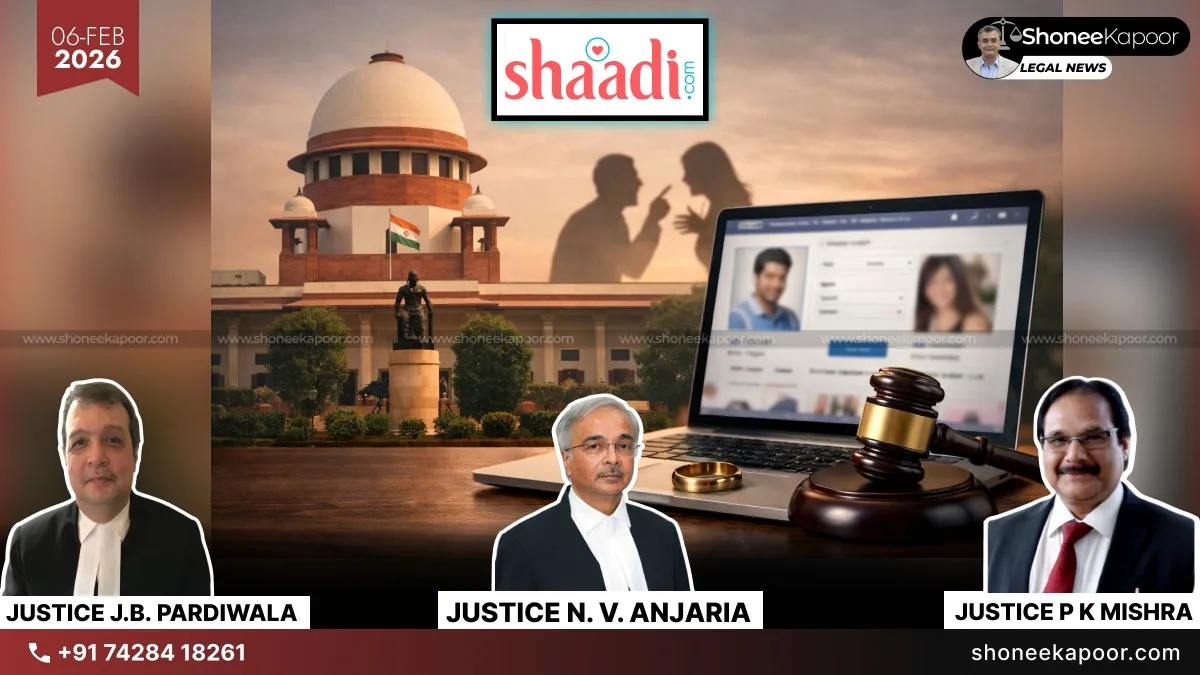
The Supreme Court expressed concern over Shaadi.com while hearing a matrimonial dispute, questioning the role and responsibility of online marriage platforms. The remark comes amid rising cases of failed marriages, fraud, and legal battles linked to matrimonial websites.
NEW DELHI: The Supreme Court, while hearing a matrimonial dispute, made a sharp observation that has once again brought online matrimonial platforms under legal and social scrutiny.
During the hearing, when the counsel informed the court that the estranged husband and wife had met through a matrimonial website, Justice JB Pardiwala reacted by asking:
“What do we do with this shaadi.com?”
The matter before the court involved a couple whose marriage had completely broken down. The counsel told the bench that mediation efforts had failed several times and that the husband had not met his wife for the last two years. On hearing this, Justice Pardiwala asked:
“Shaadi.com? You met on Shaadi.com?”
When the counsel confirmed that the couple had indeed met through the matrimonial platform, Justice Pardiwala repeated his concern and asked:
“What do we do with this shaadi.com?”
Despite the frustration expressed by the court, Justice Pardiwala ultimately directed the counsel to attempt mediation once again, highlighting how courts often push reconciliation even when relationships have clearly collapsed, sometimes prolonging legal and emotional hardship for one side.
This remark has gained significance as it comes just days after Anupam Mittal, the founder of Shaadi.com, was granted protection from coercive action by the Supreme Court in a separate matter involving alleged fraud between users of the platform.
On Tuesday (February 3), the Supreme Court granted Anupam Mittal, the founder and CEO of shaadi.com, eight weeks’ interim protection from coercive action in connection with a cheating case registered by a woman against a man she allegedly met through the website in Hyderabad.
In that case, the Supreme Court set aside an earlier order passed by the Telangana High Court, which had refused to quash the criminal proceedings against Mittal. A bench comprising Justices P K Mishra and NV Anjaria sent the matter back to the High Court and directed it to decide the case afresh on merits.
The fresh examination by the High Court will involve determining the extent of a matrimonial platform’s liability when its users defraud each other. This issue has become increasingly important as matrimonial platforms are now frequently dragged into criminal and matrimonial disputes, even though they are not direct parties to the interactions that follow.
During the hearing, Mittal submitted before the Supreme Court that shaadi.com merely acts as a matchmaking platform and cannot be held responsible for subsequent interactions between users, particularly where communications later shift to private platforms such as WhatsApp.
This argument raises a broader legal question: where does the responsibility of a platform end, and where does personal accountability begin?
The Supreme Court’s remark has also reignited debate about the growing number of disputes and criminal cases arising out of online matrimonial matches. Across major Indian cities, enforcement agencies have reported a sharp rise in cases involving people who met through matrimonial websites and later found themselves either locked in bitter marital litigation or trapped in financial frauds.
In Mumbai, a 42-year-old graphic designer alleged that a man she met on a matrimonial site posed as an NGO chairman and induced her to pay nearly Rs 18 lakh under false pretences. Mumbai Police have registered a case and are investigating the matter.
Regional cybercrime units have also issued advisories warning users about sophisticated scams being carried out on matrimonial platforms. These scams usually involve fake profiles claiming high-status jobs, government positions, or NRI backgrounds, which are used to quickly gain trust before pushing victims into large financial transactions.
Authorities have urged users to carefully verify profiles and avoid sharing personal or financial information at early stages. Any suspicious behaviour, they advise, should be reported to cybercrime helplines immediately.
Behind these developments lies a deeper issue that courts are increasingly encountering — marriages formed online often move very fast, but when they collapse, the legal consequences are slow, harsh, and usually one-sided. Matrimonial disputes today frequently turn into long criminal and civil battles, with allegations flying freely and years of litigation following, leaving many individuals financially and mentally exhausted.
The Supreme Court’s simple but pointed question reflects not just frustration with one platform, but a larger concern about how technology-driven marriages are colliding with outdated legal processes, creating serious consequences for individuals caught in the middle.
Explanatory Table: Laws & Legal Provisions Referred or Involved
| Law / Legal Area | Section / Provision | Explanation |
| Criminal Law (General) | Cheating (Section not specified) | The complaint involved allegations of cheating by a user met through a matrimonial platform. The specific IPC section was not mentioned in the reported order. |
| Criminal Procedure | Quashing of Proceedings | The issue before the court was whether criminal proceedings against the platform founder could be quashed at the threshold. |
| Platform Liability | Intermediary Responsibility | The court is examining how far a matrimonial website can be held responsible for acts committed by users after initial matchmaking. |
| Matrimonial Law | Mediation in marital disputes | The court again directed mediation, reflecting judicial preference for reconciliation even after prolonged separation. |
Case Details
| Particulars | Details |
| Court | Supreme Court of India |
| Case Nature | Matrimonial dispute involving failed mediation and long separation |
| Bench | Justice J.B. Pardiwala |
| Status | Counsel directed to attempt mediation once again |
Related Connected Matter (Shaadi.com Founder Case)
| Particulars | Details |
| Connected Party | Anupam Mittal, Founder & CEO, Shaadi.com |
| Court | Supreme Court of India |
| Bench | Justices P. K. Mishra and N. V. Anjaria |
| Relief Granted | Eight weeks’ interim protection from coercive action |
| Lower Court | Telangana High Court |
| Order | Earlier refusal to quash proceedings set aside |
| Current Direction | Matter remanded to High Court for fresh decision on merits |
| Core Legal Question | Extent of liability of matrimonial platforms for user fraud |
Key Takeaways
- The Supreme Court’s remark shows growing judicial discomfort with online matrimonial platforms becoming gateways to broken marriages and long legal battles.
- Courts continue to push mediation even after years of separation, often prolonging uncertainty and legal exposure for husbands.
- Matrimonial platforms distance themselves from responsibility, but users—mostly men—end up facing criminal cases, maintenance claims, and reputational damage.
- Fraud and misuse linked to online matches are rising, yet accountability is uneven and usually tested only after irreversible harm is done.
- The absence of clear legal boundaries on platform liability leaves individuals trapped between failed marriages and slow, adversarial court processes.
This Could Change Your Case-Get FREE Legal Advice-Click Here!
Disclaimer: The views and opinions expressed in this article are those of the Indian courts and do not necessarily reflect the official policy or position of “ShoneeKapoor.com” or its affiliates. This article is intended for informational and educational purposes only. The content provided is not legal advice, and viewers should not act upon this information without seeking professional counsel. Viewer discretion is advised.
