
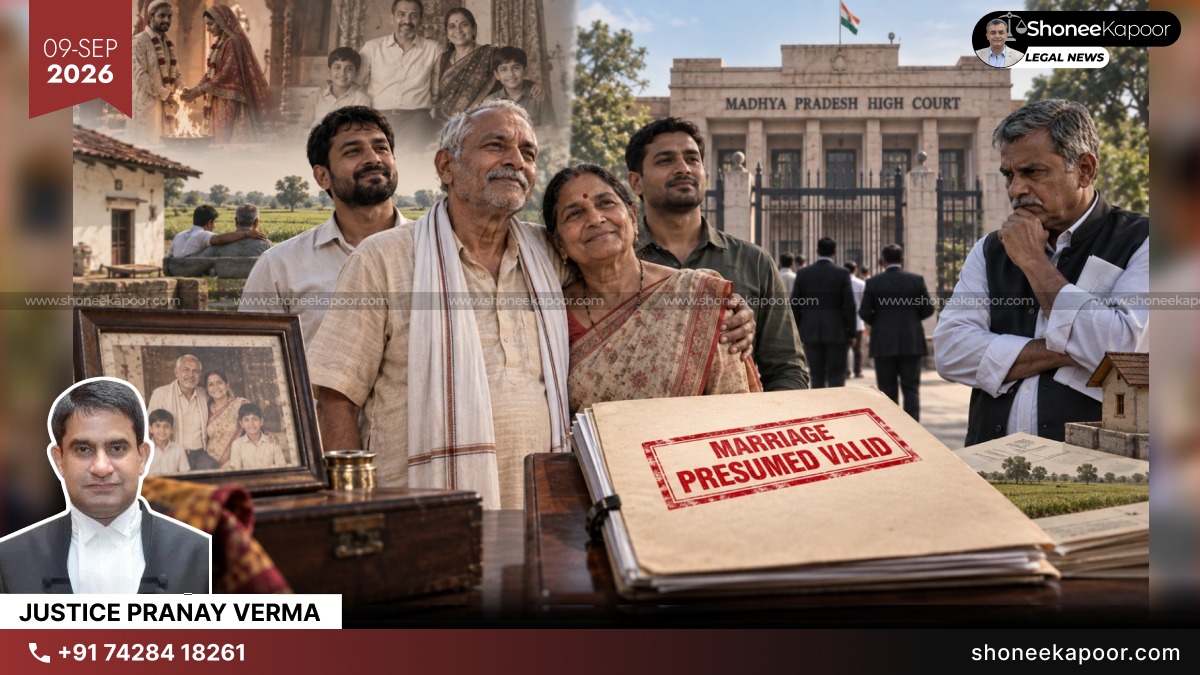
Marriage Validity Questioned After 26 Years? MP High Court Says Long Cohabitation Presumes Valid Marriage, Rebuttable Only By Strong Evidence

Curated by NEWS DESK
Editorial DeskCan a relationship be treated as invalid merely because the exact customary marriage ceremony could not be proved? The Madhya Pradesh High Court held that long cohabitation as husband and wife creates a strong presumption of a valid marriage.
MADHYA PRADESH: The Madhya Pradesh High Court has held that when a man and woman have lived together for a long period as husband and wife, the law strongly favours a presumption that their marriage is valid unless strong evidence proves otherwise.
Justice Pranay Verma dismissed a second appeal challenging Rajiyabai's marital status and her sons' property claims.
The dispute arose over Dhunna's family property. He was earlier married to Nimiya. After her death, according to the plaintiffs, Dhunna married Rajiyabai under the Kari system of marriage. They had two sons.
The sons approached the Civil Court seeking a share in Dhunna's property. However, defendant no.2 disputed their claim and argued that Rajiyabai was not Dhunna's legally wedded wife under the Kari system. On that basis, he also questioned the sons' legitimacy.
The Trial Court partly allowed the plaintiffs' claim. The First Appellate Court later held that they were entitled to a 2/5th share in the lands and house along with symbolic possession. Defendant no.2 then approached the High Court in a second appeal.
The appellant argued that the plaintiffs had failed to prove that Dhunna and Rajiyabai had actually married under the Kari form of marriage. Therefore, according to him, a valid marriage could not be presumed merely because the couple had lived together.
The respondents argued that even if the exact Kari marriage ceremony was not proved, the evidence clearly showed that Dhunna and Rajiyabai had lived together for a long period as husband and wife and were recognised by society as such.
The High Court found that Dhunna himself had stated that Rajiyabai had been living with him as his wife for 26 years. Other witnesses also stated that they had lived together for a long period as husband and wife. It was also admitted that the plaintiffs were born from their cohabitation.
The Court further noted that no evidence showed any legal impediment preventing Dhunna and Rajiyabai from marrying. Their relationship had also started after the death of Dhunna's first wife.
The High Court observed that except defendant no.2, no one in the village disputed their status as husband and wife. The Court said:
"The presumption would always be for legitimacy of the marriage rather than being for its illegitimacy."
The Court also noted that defendant no.2 had produced no evidence to prove that Rajiyabai was not Dhunna's wife.
Referring to the Supreme Court decision in Chowdamma (Dead) v. Venkatappa, 2025 SCC OnLine SC 1814, the High Court reiterated that when a couple has lived together for a long period as husband and wife, a strong presumption arises in favour of marriage.
The Supreme Court principle relied upon by the High Court states:
“A strong presumption arises in favour of wedlock where the partners have lived together for a long spell as husband and wife. Although the presumption is rebuttable, a heavy burden lies on him who seeks to deprive the relationship of legal origin.”
The High Court therefore held that the finding that Dhunna and Rajiyabai had lived as husband and wife could not be disturbed merely because the specific customary form of marriage had not been independently proved.
The Court also dealt with an earlier compromise concerning the property. Since the plaintiffs were not parties to that earlier suit, the High Court held that the compromise decree would not bind them.
The Court further noted that defendant no.2 had not established that the property was Joint Hindu Family property or that Dhunna had entered into the compromise as Karta of the family.
Accordingly, the High Court answered the substantial questions of law against the appellant, upheld the First Appellate Court's decree and dismissed the second appeal without costs.
EXPLANATORY TABLE OF LAWS AND SECTIONS
| Law / Section | What It Means | Relevance In This Case |
|---|---|---|
| Section 100, Code of Civil Procedure, 1908 | Governs second appeals before a High Court, generally requiring a substantial question of law. | Defendant no.2 approached the MP High Court through a second appeal against the First Appellate Court's decree. |
| Section 114, Indian Evidence Act, 1872 | Permits a court to presume the existence of certain facts based on the common course of natural events, human conduct and surrounding circumstances. | The principal issue was whether a valid marriage could be presumed from long cohabitation even though the Kari form of marriage was not independently proved. |
| Presumption From Long Cohabitation | Long and continuous cohabitation of a man and woman as husband and wife can create a rebuttable presumption of valid marriage. | Dhunna stated that Rajiyabai had lived with him as his wife for 26 years, and other witnesses recognised them as husband and wife. |
| Coparcenary / Karta Principle | A Karta may act for a Hindu joint family in legally recognised circumstances, but the joint family property must first be established. | The appellant argued that an earlier compromise by Dhunna bound the plaintiffs. The High Court rejected this argument on the facts and held that the earlier compromise did not bind the plaintiffs. |
CASE DETAILS
| Particular | Details |
|---|---|
| Case Title | Fulla v. Munna & Ors. |
| Court | High Court of Madhya Pradesh at Jabalpur |
| Case Number | Second Appeal No. 1018 of 1999 |
| Neutral Citation | 2026:MPHC-JBP:67685 |
| Bench | Justice Pranay Verma |
| Reserved On | August 6, 2026 |
| Pronounced On | September 3, 2026 |
| Counsel for Appellant | Shri Nitin Kumar Agrawal, Advocate |
| Counsel for Respondents 1 & 2 | Shri Sanjeev Tuli, Advocate |
| First Appellate Court | Second Additional District Judge, Sagar, Camp Khurai |
| First Appeal | Civil Appeal No. 34-A/1998 |
| Trial Court | Second Civil Judge Class II, Khurai |
| Original Suit | Civil Suit No. 110-A/1991 |
KEY TAKEAWAYS
- 26 years of cohabitation as husband and wife strongly supported the presumption of a valid marriage.
- Failure to prove the exact Kari marriage ceremony did not automatically make the relationship illegitimate.
- The Court made it clear that the person attacking such a marriage carries a heavy burden of proof.
- A man’s long-standing marital relationship cannot be casually stripped of legal recognition merely through allegations or technical objections.
- When family status and children’s property rights are at stake, suspicion cannot replace evidence.
Share Your Thoughts
Comments are moderated before publication.