
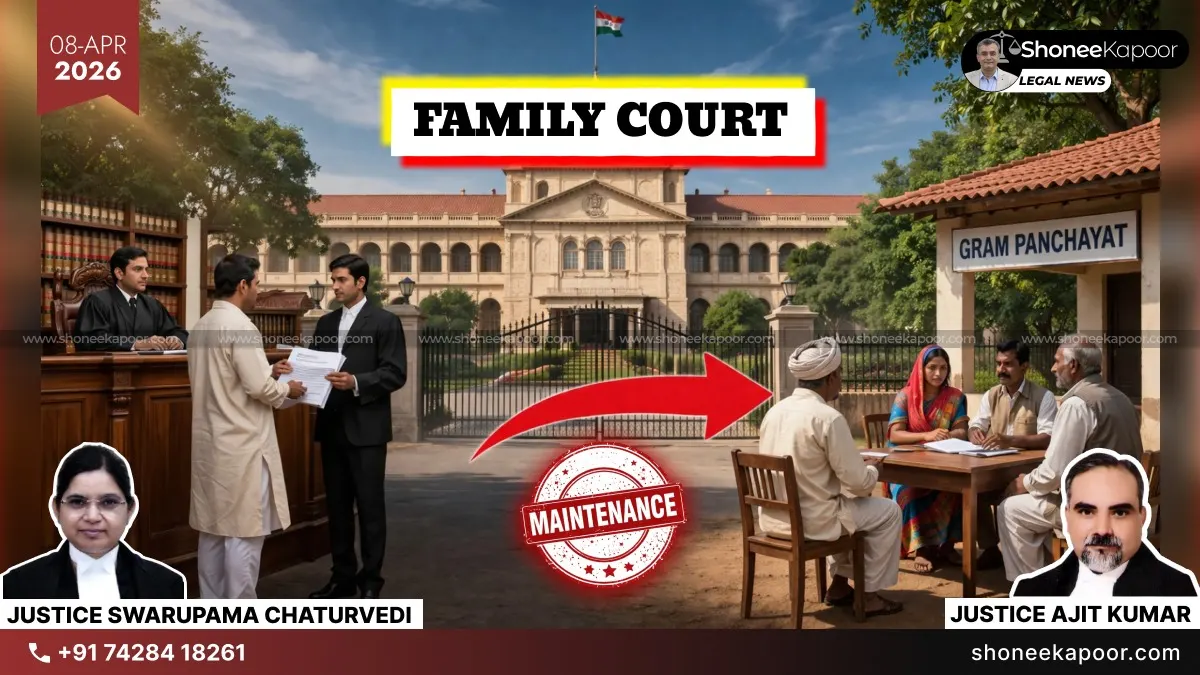
Can your maintenance case suddenly be moved from a Family Court to a village court without your consent? Allahabad High Court says yes—if you don’t challenge the law itself, the transfer stands.
PRAYAGRAJ: The Allahabad High Court, in a significant judgment delivered by Justice Ajit Kumar and Justice Swarupama Chaturvedi, has upheld the legality of transferring maintenance cases from Family Courts to Gram Nyayalayas. The case arose from petitions filed by Bar Associations challenging administrative orders that shifted such cases to village courts.
The Court examined the legal framework of both the Family Courts Act, 1984 and the Gram Nyayalayas Act, 2008. It noted that both are special laws created to provide easier and faster access to justice, but they operate in different areas. The Court emphasized that any overlap between the two must be resolved through a balanced interpretation so that both laws continue to function effectively.
While petitioners argued that Family Courts have exclusive jurisdiction and that transfer would affect the right to appeal directly to the High Court, the Court did not accept this argument. It clarified that Gram Nyayalayas are also legally empowered to handle maintenance matters under the statutory scheme.
The Court made it clear that administrative instructions or orders cannot override statutory provisions, but when such orders are passed strictly under the powers given by law, they remain valid. In this case, the transfer of cases was done under Section 16 of the Gram Nyayalayas Act, which specifically allows such transfers.
The judges also highlighted an important principle of law that when two special laws appear to conflict, courts should first try to harmonize them. However, if there is a clear inconsistency, the later law will prevail over the earlier one as it reflects the latest intention of the legislature.
The Court observed:
“The legislative intent behind both Statutes are for providing more litigant friendly and easily accessible judicial forums.”
It further clarified the principle of interpretation by stating:
“Wherever two enactments are irreconcilably inconsistent, the later enactment must prevail to the extent of such inconsistency.”
On the issue of challenge, the Court strongly noted, “the validity of the action taken thereunder cannot be assailed in isolation.”
This became the key reason for dismissal of the petitions. The Court held that since the petitioners did not challenge the validity of the Gram Nyayalayas Act itself, they cannot challenge the administrative orders passed under it.
The High Court dismissed both writ petitions and upheld that transfer of maintenance cases to Gram Nyayalayas is legally valid. The ruling reinforces that statutory provisions cannot be bypassed indirectly and that procedural challenges must go to the root of the law itself.
Explanatory Table: Laws & Sections Involved
| Law / Section | Purpose | How Applied in This Case |
| Gram Nyayalayas Act, 2008 – Section 12 | Gives Gram Nyayalayas power to handle certain criminal matters including maintenance cases | Used to justify that Gram Nyayalayas can legally hear maintenance matters |
| Gram Nyayalayas Act, 2008 – Section 16 | Allows transfer of pending cases to Gram Nyayalayas | Main provision used to transfer cases from Family Courts |
| Gram Nyayalayas Act, 2008 – Section 18 | Gives overriding effect over other laws in criminal matters | Strengthened argument that Gram Nyayalayas can take precedence in such cases |
| Gram Nyayalayas Act, 2008 – Section 33 | Provides appeal to Sessions Court | Highlighted difference in appeal structure compared to Family Courts |
| Family Courts Act, 1984 – Section 7 | Defines jurisdiction of Family Courts over family disputes | Petitioners argued this gives exclusive jurisdiction to Family Courts |
| Family Courts Act, 1984 – Section 8 | Bars other courts from handling matters under Family Court jurisdiction | Used by petitioners to oppose transfer |
| Family Courts Act, 1984 – Section 19 | Provides appeal directly to High Court | Petitioners argued transfer reduces appellate rights |
| CrPC (Chapter IX, Sections 125–128) | Governs maintenance rights of wife, children, parents | Core subject matter of disputes transferred |
| Bharatiya Nyaya Suraksha Sanhita (Sections 144–147) | Updated provisions for maintenance under new criminal law | Included in jurisdiction of Gram Nyayalayas |
| Constitution of India – Article 226 | Gives High Court power to hear writ petitions | Petition filed under this provision challenging transfer |
Case Details
- Case Title: Civil Court Bar Association & Another vs High Court of Judicature at Allahabad & Others
- Court: High Court of Judicature at Allahabad
- Date of Judgment: 24.03.2026
- Neutral Citation: 2026:AHC:60135-DB
- Case Numbers:
- Writ – C No. 37 of 2026
- Along with Writ – C No. 42218 of 2025
- Bench: Hon’ble Justice Ajit Kumar & Hon’ble Justice Swarupama Chaturvedi
- Counsels:
- For Petitioners: Santosh Kumar Mishra, Vinay Kumar Mishra, Chandra Bhan Gupta, Hari Narayan Singh
- For Respondents: Chandan Sharma, Ashish Mishra, C.S.C., Rahul Srivastava, Ashish Mishra, C.S.C.
Key Takeaways
- Courts have validated shifting maintenance cases to Gram Nyayalayas, which can impact strategy and forum selection for men in matrimonial disputes.
- A man cannot challenge procedural orders unless he directly challenges the law behind them—legal strategy must attack the root, not just the outcome.
- The ruling confirms that newer laws can override older protections, meaning rights like direct appeal to High Court may be indirectly diluted.
- Jurisdiction in family matters is becoming more flexible, which can create uncertainty and additional pressure on men already facing multiple proceedings.
- The judgment reinforces a hard reality: procedural technicalities can decide outcomes, so early, precise legal action is critical for men defending such cases.
This Could Change Your Case-Get FREE Legal Advice-Click Here!
Disclaimer: The views and opinions expressed in this article are those of the Indian courts and do not necessarily reflect the official policy or position of “ShoneeKapoor.com” or its affiliates. This article is intended for informational and educational purposes only. The content provided is not legal advice, and viewers should not act upon this information without seeking professional counsel. Viewer discretion is advised.
