
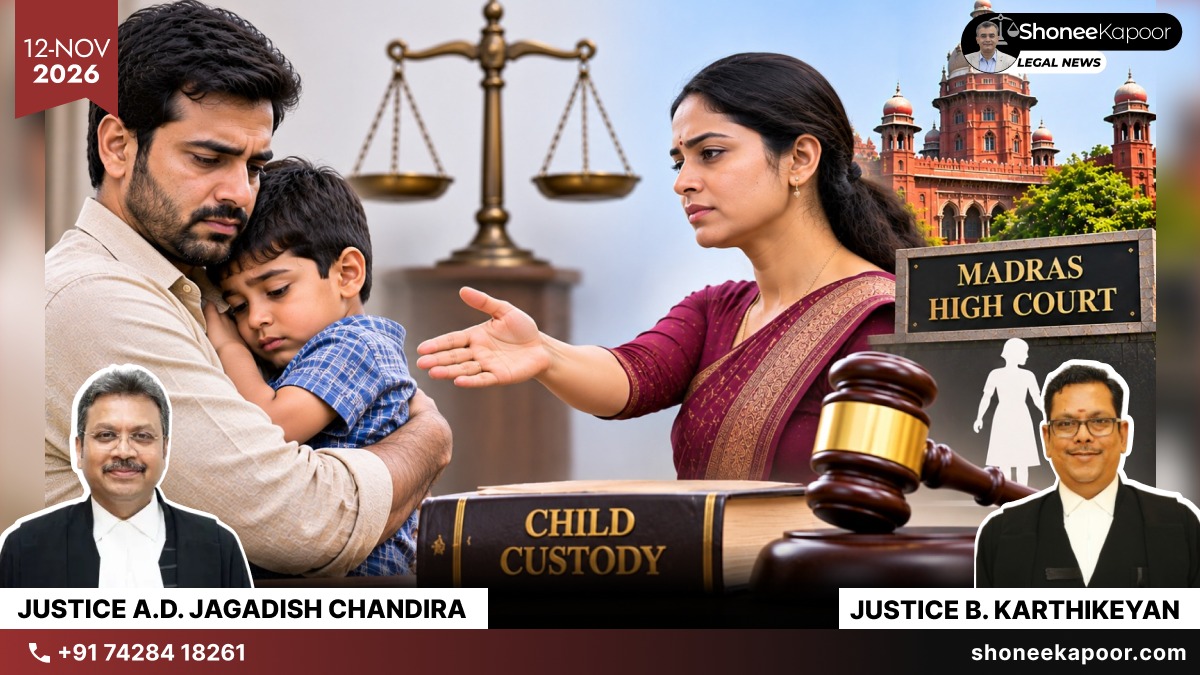
Father Entitled To Take Child's Custody By Force Because He Is The Natural Guardian? Madras High Court Answers

Curated by NEWS DESK
Editorial DeskTAMIL NADU: The Madras High Court has held that a father cannot forcibly take custody of his minor child merely because he is the natural guardian. The Court directed a man to return his 2.5-year-old son to his wife, holding that child custody must be obtained through the proper legal process.
A Division Bench of Justice A.D. Jagadish Chandira and Justice B. Karthikeyan passed the order on 27 October 2026 while hearing a habeas corpus petition filed by the mother.
The couple married on 21 January 2021 in Puducherry and had two children, born in June 2023 and October 2024.
According to the wife, who is a medical doctor, she faced verbal and physical abuse during the marriage. She alleged that her husband had also threatened her with a sickle during their matrimonial disputes.
Following these alleged incidents, she left the matrimonial home with both children and started living with her mother in Chennai.
The wife claimed that on 28 August 2026, her husband entered her parental home and forcibly took away their younger son without her consent.
She approached the All Women Police Station, Madipakkam, where her complaint was registered as CSR No. 0187 of 2026. When no further action was taken, she submitted another representation on 24 September 2026 and later approached the High Court seeking custody of her son.
The husband opposed the petition, arguing that he was the child's father and natural guardian.
He informed the Court that he had already secured admission for his son. According to him, the school had started, but his wife had not brought the child for admission. He therefore went to her residence and took the child.
His counsel also informed the Court that matrimonial disputes were pending between the parties and suggested mediation to explore an amicable settlement.
Read Also:- Section 377 IPC – Would Supreme Court Judgment help Men Facing Matrimonial Disputes
The Additional Public Prosecutor submitted that the police had started an enquiry into the wife's complaint. However, the husband did not appear despite being summoned and instead sent a reply stating that he was taking care of the child.
After examining the circumstances, the High Court acknowledged that the man was the child's father and natural guardian, but held that this status did not permit him to obtain custody through force.
The Court clearly stated:
“The custody of the minor child cannot be taken by force”
The Bench emphasised that even a natural guardian must follow the procedure established by law when seeking custody.
The High Court accordingly directed the father to hand over custody of his minor son to the mother.
Importantly, the Court clarified that its findings were limited to the present habeas corpus petition and would not determine the outcome of any future child custody proceedings.
The Madras High Court closed the petition after directing the father to return the child, leaving any further custody dispute to be decided through the proper legal process.
EXPLANATORY TABLE OF LAWS AND SECTIONS
| Law / Section | What It Means | Application In This Case |
|---|---|---|
| Article 226, Constitution of India | Empowers High Courts to issue writs, including habeas corpus, to protect legal rights. | Mother filed a petition seeking the return of her minor son from the father. |
| Writ of Habeas Corpus | A legal remedy to challenge unlawful detention or custody, including in appropriate child custody disputes. | High Court directed the father to hand over the child to the mother. |
| Section 6, Hindu Minority and Guardianship Act, 1956 | Recognises natural guardians of Hindu minors and ordinarily places custody of children below five years with the mother. | Relevant to natural guardianship rights, but not expressly invoked or applied in this judgment. |
| Section 13, Hindu Minority and Guardianship Act, 1956 | Makes the welfare of the minor the paramount consideration in guardianship matters. | Relevant to future custody proceedings, but not expressly cited by the Court. |
| Section 17, Guardians and Wards Act, 1890 | Requires courts to consider the child's welfare when appointing or declaring a guardian. | May be relevant if either parent initiates separate guardianship proceedings; not expressly applied here. |
CASE DETAILS
| Particular | Details |
|---|---|
| Case Title | J v. The Commissioner of Police & Others |
| Court | Madras High Court, Chennai |
| Bench | Justice A.D. Jagadish Chandira and Justice B. Karthikeyan |
| Judgment Date | 27 October 2026 |
| Case Number | HCP No. 2125 of 2026 |
| CNR Number | HCMA012467652026 |
| Petitioner | Mother |
| Respondent No. 3 | Father |
| Petitioner's Counsel | Advocate K. Venkatesan |
| Father's Counsel | Advocate A. Nagarajan |
| State Counsel | M. Mohamed Riyaz, Additional Public Prosecutor |
| Police Complaint | CSR No. 0187 of 2026, All Women Police Station, Madipakkam |
| Decision | The father was directed to hand over custody of his 2.5-year-old son to the mother. |
| Father's Future Custody Rights | Court clarified that its observations would not affect subsequent proceedings before the appropriate forum. |
KEY TAKEAWAYS
- Father, Yet Denied Custody: Despite being the natural guardian, the father was ordered to return his 2.5-year-old son to the mother.
- Father's Efforts Were Not Enough: Even securing school admission for his son did not justify taking custody without following legal procedure.
- Natural Guardian, But Limited Rights: Being legally recognised as a natural guardian does not automatically give a father the right to physical custody.
- Father Must Fight A Separate Legal Battle: The father can still seek custody, but must approach the appropriate court to enforce his parental rights.
- Fatherhood Deserves Equal Consideration: A father's involvement in his child's education and upbringing matters, but custody decisions must prioritise the child's welfare, not either parent's gender.
Share Your Thoughts
Comments are moderated before publication.