
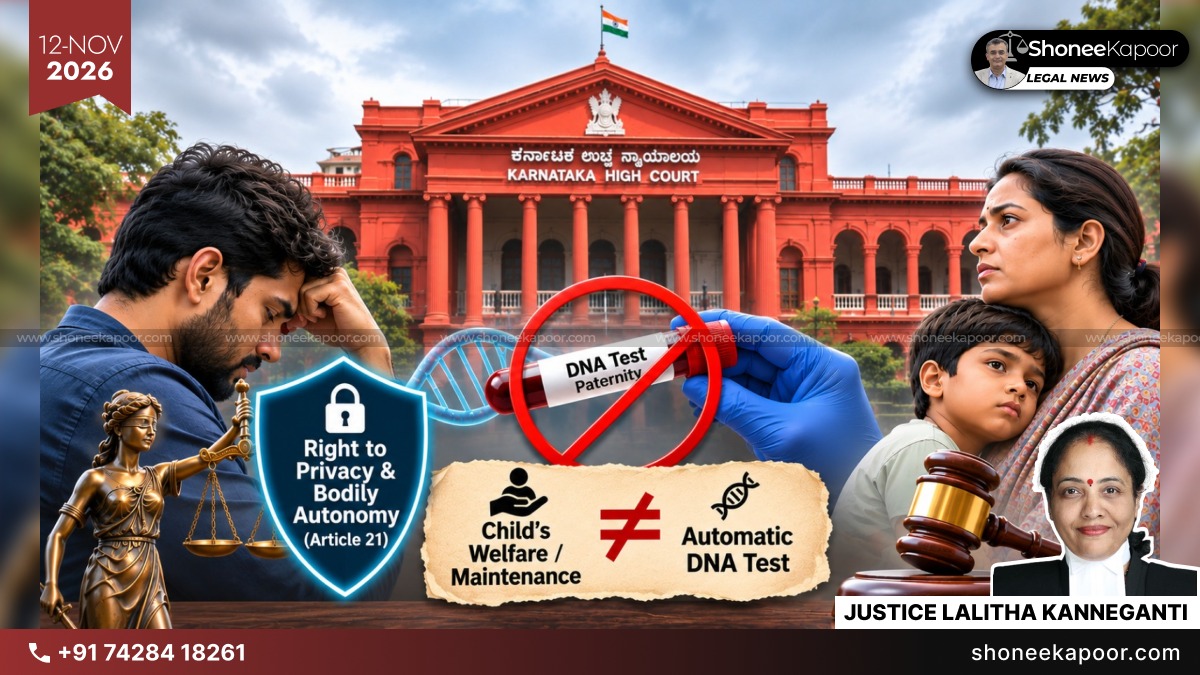
Welfare Of Child Alone Cannot Force Man To Undergo DNA Paternity Test: Karnataka High Court

Curated by NEWS DESK
Editorial DeskKARNATAKA: The Karnataka High Court has set aside a Family Court order directing a man to undergo a DNA paternity test, holding that the welfare of a child and the need for maintenance alone cannot justify compulsory DNA testing without examining other available evidence.
Read Also:- Who Pays School Fees During A Child Custody Dispute? | Parents’ Legal Rights Explained
Justice Lalitha Kanneganti, in an order dated 3 November 2026, held that courts must consider the right to privacy, bodily autonomy and necessity of DNA testing before directing a person to provide biological samples.
The case arose after a woman approached the Bengaluru Family Court seeking maintenance for her minor son. She filed an application under Section 45 of the Bharatiya Sakshya Adhiniyam, 2023, seeking a DNA test to establish the child's biological paternity.
On 18 March 2026, the Family Court allowed her application and directed the man and the child to provide blood samples for DNA examination.
The man challenged the order before the Karnataka High Court, arguing that DNA testing cannot be ordered routinely without a strong prima facie case. He submitted that although he had admitted a physical relationship with the child's mother, it did not prove that he was the biological father.
He further argued that an earlier civil court had rejected a similar DNA testing application and that the woman's multiple legal proceedings and alleged inconsistent statements had not been properly considered.
The woman's counsel opposed the petition, claiming that the man had acknowledged their relationship, interacted with the child, provided financial assistance and given written assurances. She argued that the DNA test was necessary to establish paternity and secure child maintenance.
The High Court examined whether the child's welfare, maintenance requirements and admission of a physical relationship were sufficient grounds to compel a man to undergo DNA testing.
The Court questioned whether these circumstances alone could justify compulsory DNA examination, particularly when an earlier request had been rejected, and the man had invoked his constitutional rights under Article 21.
Referring to Section 125(1)(b) CrPC and Section 144(1)(b) BNSS, the High Court clarified that both legitimate and illegitimate minor children have a statutory right to claim maintenance, subject to the prescribed conditions.
However, the Court distinguished between a child's right to maintenance and a man's legal liability to pay it.
It observed:
“The child's entitlement and the liability of the person from whom maintenance is sought are two distinct matters.”
The High Court explained that admitting a physical relationship does not automatically establish biological paternity. A man's legal responsibility must be determined through admissible evidence.
The Court also clarified that rejecting an earlier DNA testing application does not automatically bar a fresh request unless paternity has already been conclusively decided.
Referring to the Supreme Court's judgment in Ivan Rathinam v. Milan Joseph, the High Court reiterated that DNA tests should not be ordered as a routine procedure. Courts must first examine existing evidence and determine whether scientific testing is genuinely necessary.
The Court found that the Family Court had primarily relied on the child's welfare, maintenance requirements and admitted physical relationship, without examining whether paternity could be established through other evidence.
Protecting the man's right to privacy and bodily autonomy under Article 21, the High Court observed:
“The fact that he has accepted the physical relationship does not amount to consent for a DNA examination or surrender of his constitutional rights.”
The Court further clarified that Article 21 does not provide absolute protection against court-ordered DNA testing. However, such examination must satisfy the legal requirements of necessity and proportionality.
Emphasising that the welfare of a child cannot automatically override an individual's constitutional rights, the High Court stated:
“Merely observing that the welfare of the child is paramount does not answer whether the proposed examination is necessary and proportionate.”
The High Court held that the Family Court had failed to properly examine the available evidence or balance the child's interests against the man's right to privacy and bodily autonomy.
Accordingly, the Karnataka High Court set aside the DNA testing order dated 18 March 2026 and sent the application back to the Family Court for fresh consideration.
EXPLANATORY TABLE OF LAWS AND SECTIONS
| Law / Section | What It Means | Application In This Case |
|---|---|---|
| Section 45, Bharatiya Sakshya Adhiniyam, 2023 | Deals with expert opinions on matters requiring specialised knowledge. | Provision invoked in the DNA testing application. |
| Section 125(1)(b), CrPC | Provides maintenance rights to eligible legitimate and illegitimate minor children. | Recognised the child's right to seek maintenance. |
| Section 144(1)(b), BNSS, 2023 | Corresponding maintenance provision under the new criminal procedure law. | Cited to explain the child's statutory protection. |
| Section 112, Indian Evidence Act, 1872 | Presumption of legitimacy for children born during a valid marriage, subject to the statutory exception. | Family Court directed to examine its applicability. |
| Article 21, Constitution of India | Protects life, personal liberty, privacy and bodily autonomy. | Man's objection to compulsory DNA testing. |
| Articles 226 and 227, Constitution | Confer writ and supervisory jurisdiction on High Courts. | Basis of the petition challenging the Family Court order. |
| Articles 7 and 8, UN Convention on the Rights of the Child | Concern a child's identity and related rights. | Relied upon in arguments supporting the child's right to know parentage. |
CASE DETAILS
| Particular | Details |
|---|---|
| Case Title | Filix Miller and Felix Miller v XXX |
| Court | Karnataka High Court, Bengaluru |
| Bench | Justice Lalitha Kanneganti |
| Judgment Date | 3 November 2026 |
| Neutral Citation | 2026:KHC:61121 |
| Case Number | W.P. No. 11719 of 2026 (GM-FC) |
| CNR Number | KAHC010259362026 |
| Petitioner | Man disputing biological paternity |
| Respondent | Minor child represented through the mother |
| Petitioner's Counsel | Advocate Ravinson M. |
| Respondent's Counsel | Advocates Mithun U., Shubhasri M.V. and Usha Reddy K.P. |
| Original Proceeding | Crl. Misc. No. 63/2025 |
| Challenged Order | 18 March 2026, Principal Judge, Family Court, Bengaluru |
| Earlier Civil Proceeding | O.S. No. 25550/2024 |
| Order Reserved | 28 September 2026 |
| Decision | DNA testing order set aside; application remanded for fresh consideration |
KEY TAKEAWAYS
- Man Cannot Be Forced Into DNA Test: A woman's paternity claim alone cannot justify compulsory DNA testing.
- Sexual Relationship Does Not Prove Fatherhood: Admitting intimacy with a woman does not automatically make a man the biological father.
- Child Welfare Cannot Override Men's Rights: A child's maintenance needs alone cannot justify violating a man's privacy and bodily autonomy.
- Maintenance Liability Needs Proof: A man cannot be held responsible for a child's maintenance merely because paternity is alleged.
- High Court Protects Man's Rights: Karnataka HC set aside the DNA test order, reinforcing that courts must establish necessity before compelling a man to undergo testing.
Share Your Thoughts
Comments are moderated before publication.