
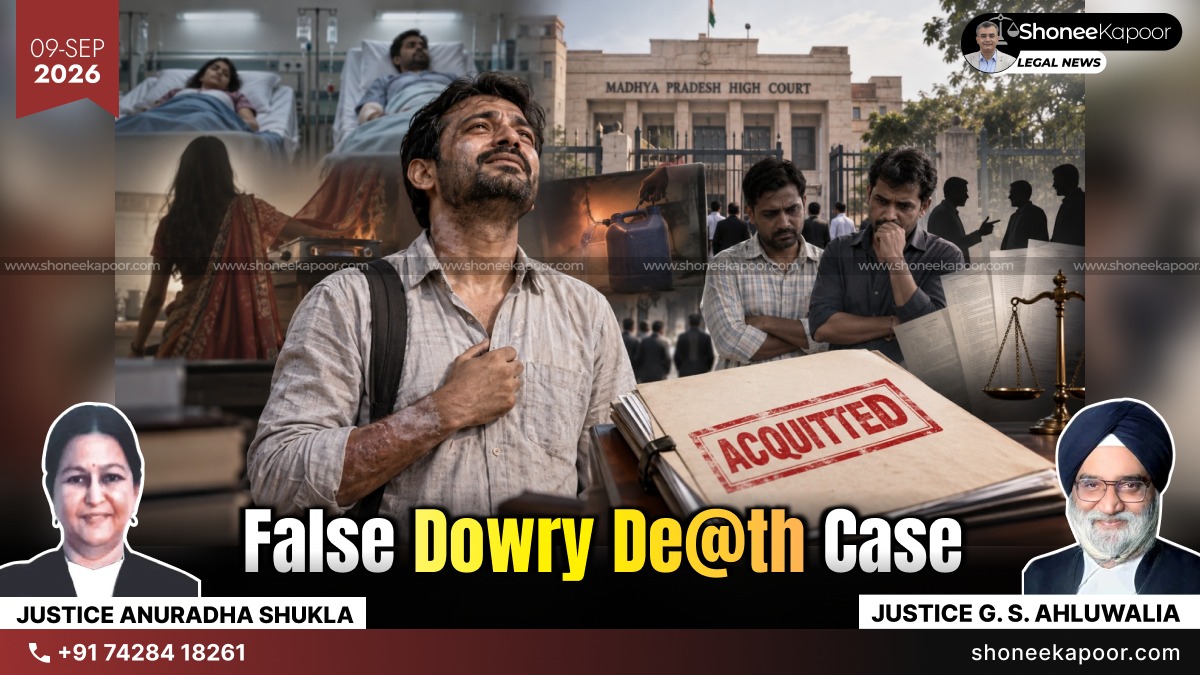
Husband Convicted In False Case Of Wife’s Murder | “Victim's Own Brothers Turned Hostile”: MP High Court Acquits Man

Curated by NEWS DESK
Editorial DeskCan a husband remain convicted of murder when the wife’s own brothers do not support her dying declaration and his 30-35% burn injuries remain unexplained? The Madhya Pradesh High Court found serious contradictions in the prosecution evidence and set aside his life sentence.
MADHYA PRADESH: The Madhya Pradesh High Court has acquitted a man who was sentenced to life imprisonment for allegedly setting his wife ablaze, after finding serious contradictions in the prosecution evidence and noting that even the deceased woman’s own brothers did not support her version.
A Division Bench of Justice G.S. Ahluwalia and Justice Anuradha Shukla allowed the appeal filed by Roopsingh and set aside his conviction under Section 302 IPC. The Trial Court had sentenced him to life imprisonment and imposed a fine of ₹3,000 for the murder of his wife, Gomti Bai.
The case arose from an incident dated November 2, 2017. According to the prosecution, Gomti Bai had cooked only rotis for dinner. This allegedly led to a quarrel, following which Roopsingh poured kerosene on her and set her on fire.
Gomti Bai was admitted to Jaya Arogya Hospital with almost 100% burn injuries. However, an important fact before the Court was that Roopsingh was also admitted to the hospital with 30-35% burn injuries.
Gomti Bai died on November 9, 2017. An FIR was subsequently registered against Roopsingh and, after trial, he was convicted for murder. He challenged the conviction before the High Court, arguing that the prosecution evidence contained material contradictions and that it had not proved his guilt beyond reasonable doubt.
The prosecution examined 16 witnesses, including seven of Gomti Bai's close relatives. Her mother, sister, brother-in-law, sister-in-law, two brothers and son were declared hostile after they failed to support the prosecution story.
The High Court found the evidence of Gomti Bai’s brothers, Ramhet and Babbu, particularly important. In her dying declaration, Gomti Bai had stated that Babbu was present in the house during the incident and that he took her to hospital. However, Babbu did not support the prosecution case in court.
Her other brother, Ramhet, told the Trial Court that Gomti Bai was cooking when her sari caught fire. He further stated that Roopsingh suffered burn injuries while trying to save his wife. The hospital record confirmed that Roopsingh had suffered 30-35% burns.
The Court noted:
“Being the real brothers of deceased Gomti Bai, these two witnesses would naturally have greater affinity and loyalty towards Gomti Bai than towards the present appellant, yet they did not support the version given by their sister in her dying declaration.”
The High Court also examined the conflicting dying declarations. Gomti Bai claimed that Roopsingh had set her on fire. Roopsingh, on the other hand, stated that after the dispute over dinner, Gomti Bai set herself on fire and he suffered burns while trying to extinguish the flames.
There were further contradictions in Ramhet’s statements. During the merg enquiry, he stated that Gomti Bai had poured kerosene on herself. During investigation, he said Roopsingh had poured kerosene on her. Before the Trial Court, he stated that her sari had accidentally caught fire.
The High Court noticed similar inconsistencies in the statements of Gomti Bai’s son. The High Court found that the prosecution witnesses had not only turned hostile but were also inconsistent on material facts concerning how the woman suffered the burns.
The Bench also found that the prosecution had failed to properly explain the husband’s own substantial burn injuries, observing that there was:
“virtually no explanation on the part of the prosecution about the injuries sustained by the appellant in the incident”
Considering the contradictory evidence, hostile testimony of the deceased’s close relatives, conflicting accounts of the incident and the unexplained injuries suffered by Roopsingh, the High Court held that it could not confirm the finding of conviction recorded by the Trial Court.
Accordingly, the High Court allowed Roopsingh’s appeal and acquitted him of the murder charge. Since he was already on bail, the Court discharged his bail bonds. The Court also directed that any fine he deposited be refunded.
EXPLANATORY TABLE OF LAWS AND SECTIONS
| Law / Section | What It Means | Relevance In This Case |
|---|---|---|
| Section 302 IPC | Provides punishment for murder, which may include death or imprisonment for life along with fine. | Roopsingh was convicted under this provision for the alleged murder of his wife and sentenced to life imprisonment. The High Court set aside the conviction. |
| Dying Declaration | A statement made by a person regarding the cause or circumstances of the injuries resulting in death can be relevant evidence. | Gomti Bai alleged in her dying declaration that Roopsingh set her on fire. The High Court examined it against the eyewitness accounts and other evidence. |
| Merg Enquiry | Preliminary enquiry conducted in relation to an unnatural or suspicious death. | Ramhet gave one version during the merg enquiry, another during investigation and a third version before the Trial Court. |
| Hostile Witness | A witness who does not support the case of the party that called him or departs materially from an earlier version. | Seven close relatives of Gomti Bai, including her two brothers and son, were declared hostile by the prosecution. |
CASE DETAILS
| Particular | Details |
|---|---|
| Case Title | Roopsingh v. The State of Madhya Pradesh |
| Court | High Court of Madhya Pradesh at Gwalior |
| Jurisdiction | Criminal Appellate Jurisdiction |
| Criminal Appeal | Criminal Appeal No. 1944 of 2021 |
| Neutral Citation | 2026:MPHC-GWL:26658 |
| Date of Judgment | September 3, 2026 |
| Bench | Justice G.S. Ahluwalia and Justice Anuradha Shukla |
| Judgment By | Justice Anuradha Shukla |
| Trial Court | Fourth Additional Sessions Judge, Dabra, District Gwalior |
| Sessions Trial | S.T. No. 89/2018 |
| Trial Court Judgment | February 16, 2021 |
| Counsel for Appellant | Shri Atul Gupta, Advocate |
| Counsel for State | Shri B.K. Tyagi, Government Advocate |
KEY TAKEAWAYS
- A husband was sentenced to life despite glaring contradictions in the prosecution evidence.
- The wife accused him in her dying declaration, but her own brothers did not support that version before the Court.
- He suffered 30-35% burns himself, yet the prosecution had “virtually no explanation” for his injuries.
- Key witnesses gave conflicting versions of how she caught fire, yet the man still ended up carrying a murder conviction until the High Court intervened.
- When evidence contradicts the accusation, a man’s liberty cannot become collateral damage. A grave allegation is not proof, and suspicion cannot justify a life sentence.
Share Your Thoughts
Comments are moderated before publication.