
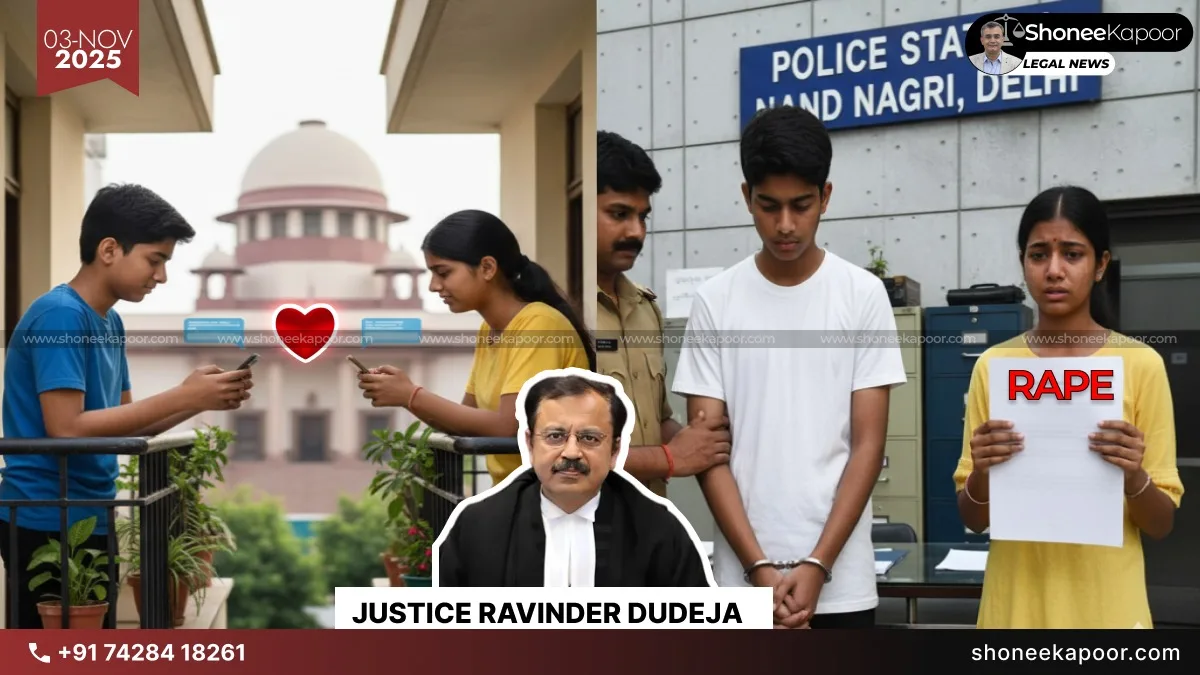
False Promise to Marry Case: Justice Ravinder Dudeja held that every failed relationship cannot be branded as rape. WhatsApp chats and evidence showed the relationship was consensual, not based on deception.
NEW DELHI: In a Section 376 IPC case, the Delhi High Court granted anticipatory bail to a 20-year-old Delhi man, providing significant relief by ruling that “a broken promise to marry does not automatically amount to rape.”
Judge Ravinder Dudeja noted that criminal law cannot be viewed as a tool for emotional retaliation and established a clear distinction between “consensual intimacy and criminal deception”. The ruling in Sumit v. State (NCT of Delhi) reaffirms an important legal principle that is frequently disregarded in public discourse: that whether a crime has been committed is determined by the intent at the start of the relationship, not by disappointment at its conclusion.
This ruling, which reaffirms that heartbreak, no matter how painful, is not a crime and that consent born of trust is not consent born of deceit, is a welcome change for men caught in the crossfire of false promise-of-marriage cases.
Facts of the Case
The case started when a 21-year-old woman accused her neighbor, petitioner Sumit (aged 20 years), of having sex under the guise of marriage under Section 376 IPC (rape) in a formal complaint filed on September 11, 2025, at Police Station Nand Nagri, Delhi.
The complaint claims that the two had been dating for almost 2 years and had known one another since 2023. The woman claims that Sumit promised to marry her, engaged in several sexual encounters with her, and even spent 17 days with her “like husband and wife.” She added that Sumit “betrayed” her by withdrawing after they had gone to Tis Hazari Court to register their marriage. But the defense painted a completely different picture.
A lengthy, loving relationship characterized by mutual consent, emotional exchanges, and repeated declarations of love was demonstrated by WhatsApp conversations, call logs, and images that were presented to the court. In several messages, the complainant expressed emotional pressure, threatened self-harm if the petitioner disassociated himself, and threatened “police action” if he disobeyed her orders.
Sumit maintained that the relationship was completely voluntary and had lasted for a long time without any indication of coercion or dishonesty. Indian rape jurisprudence’s crucial test, that the promise to marry was false at the outset, was not supported by any evidence. Instead, the argument didn’t start until the relationship deteriorated. The petitioner bowed down to Delhi High Court after the Sessions Court had previously denied the plea for anticipatory bail.
Since the entire case was based on digital communication and documentary evidence rather than on physical recovery or corroboration, his legal team argued that custodial interrogation was unnecessary.
Fundamentally, this case concerned a failed relationship that was misrepresented as rape, a growing trend that the courts have repeatedly warned against, rather than sexual assault.
Court’s Findings
Justice Ravinder Dudeja of the Delhi High Court began his analysis by addressing the central issue: whether a relationship that began with mutual consent and affection could later be criminalized as rape merely because it ended in disappointment?
He noted that the essence of the offence under Section 376 IPC lies in the absence of valid consent, and that the burden lies on the prosecution to prove that the accused never intended to marry and that the promise was false from the very beginning.
The Court reaffirmed the long-standing position of the Supreme Court that only a “false promise to marry made in bad faith” can vitiate consent. Relying on Deepak Gulati v. State of Haryana (2013 7 SCC 675), Justice Dudeja quoted:
“Consent may be given by a woman under a misconception of fact. But a false promise is not established merely because the marriage did not take place subsequently. To prove deception, it must be shown that the promise itself was false at the inception.”
Applying this principle, the Court held that the facts of the case reveal a genuine relationship, not one founded on deceit. The complainant’s own chats demonstrated continuous emotional involvement, suggesting that the promise to marry was genuine when made.
The court noted that consensual relationship cannot be criminalized. The judge underscored that the communications exchanged between the two parties; WhatsApp messages, voice notes, and photos clearly indicated voluntary intimacy and emotional reciprocity, not coercion.
“A consensual relationship between two adults, however morally debatable, does not constitute rape. The criminal law is not meant to govern personal choices or emotional fallouts between consenting individuals.”
He added that while both parties may have had expectations, disappointment or withdrawal from marriage negotiations cannot automatically transform a consensual act into a crime.
Referring to Pramod Suryabhan Pawar v. State of Maharashtra (2019 9 SCC 608) and Naim Ahamed v. State (2023 15 SCC 385), the Court reiterated that a distinction must be drawn between “false promise” and “breach of promise.” Justice Dudeja highlighted:
“Every breach of promise cannot be termed as rape. The Court must look for material showing that the accused never intended to marry the woman at the very outset and merely used the promise as a tool for sexual exploitation.”
In the present case, there was no such indication. On the contrary, the record showed the accused had genuinely intended to marry her but later withdrew due to relationship conflicts something that cannot attract criminal liability under Section 376.

The Court emphasized that custodial interrogation serves no purpose in cases resting on electronic evidence. Citing Shane Haider v. State (Delhi HC, 2024), the judge noted that questions of intent and consent are trial issues, not matters requiring arrest. He observed that:
“The investigation in such cases primarily involves examining digital communications. There is no recovery or physical evidence necessitating custody. Personal liberty cannot be sacrificed merely to satisfy emotional outrage.”
Finally, Justice Dudeja issued a broader reminder about the increasing misuse of Section 376 IPC in failed relationships, warning that criminal law cannot be used as a tool for retribution.
“When consent arises out of affection or emotional bonding, its later withdrawal cannot rewrite the past as coercion. If every emotional fallout is treated as rape, it would trivialize the serious nature of the offence and harm genuine victims.”
Outcome / Result:
- Anticipatory Bail Granted under Section 438 CrPC.
- Bail Conditions:
- Personal bond of ₹50,000 with one surety of the same amount.
- Petitioner must join investigation whenever required.
- Must share and keep active his mobile number with the Investigating Officer.
- Must not contact the prosecutrix or tamper with evidence.
- The Court clarified that its observations were only for the purpose of deciding bail and should not influence the trial
In essence, the result of the case is that the Delhi High Court protected the petitioner’s liberty, emphasizing that a broken promise to marry does not constitute rape and that personal liberty under Article 21 must prevail unless deception at inception is clearly proven.
Legal Significance
When Law Draws the Line Between Love and Litigation: This judgment is not just a relief for one young man but it’s a turning point for countless men trapped in false promise-of-marriage cases. The Delhi High Court has made it clear: consensual intimacy cannot be criminalized, and emotional fallout is not rape. Justice Ravinder Dudeja’s ruling reaffirms that criminal law cannot be used to avenge heartbreak or regret, and that liberty under Article 21 cannot be surrendered to emotional manipulation. In doing so, the Court has reminded India that justice must protect both genders not just one narrative.
By stating that “a broken promise does not mean a false promise,” the Court restored balance to a law long misused as a tool of coercion. It’s a message to every man wrongly accused and every system bending under the weight of false FIRs that truth, intent, and fairness still matter in the courtroom, and that law must stand for justice, not gender politics.
Explanatory table of sections and case laws cited
| Law / Case | Section/citation | Explanation/relevancy |
| Section 376 IPC | Rape | Invoked in the FIR alleging sexual intercourse on a false promise of marriage. The Court held that the offence requires proof of absence of consent or consent vitiated by deceit at inception. |
| Section 438 CrPC | Anticipatory bail | Used to secure pre-arrest protection. The Court reiterated that anticipatory bail is a safeguard of personal liberty and cannot be denied merely on moral outrage. |
| Article 21, Constitution of India | Right to Life and Personal Liberty | The Court stressed that liberty under Article 21 must remain paramount; pre-trial incarceration cannot be punitive in consensual relationship disputes. |
| Deepak Gulati v. State of Haryana | (2013) 7 SCC 675 | Drew a line between false promise and breach of promise; held that only a promise proved false at inception can vitiate consent under Section 375 IPC. |
| Pramod Suryabhan Pawar v. State of Maharashtra & Anr., | (2019) 9 SCC 608 | Clarified that consent is invalid only if the promise was false, in bad faith, and directly induced sexual relations. |
| Naim Ahamed v. State | (2023) 15 SCC 385 | Re-affirmed that the intention at the start of the relationship decides whether it is deception or genuine affection. |
| Amol Bhagwan Nehul v. State of Maharashtra & Anr., | 2025 INSC 782 | Warned against criminalising consensual relationships that later fail; treating every breakup as rape undermines genuine victims. |
| Shane Haider v. State (NCT of Delhi), | Bail Appln 466/2024 (DHC 1115) | Held that whether it’s a false promise or breach is a trial issue; custodial interrogation is unnecessary at bail stage. |
Case details
- Case Title: Sumit v. State (NCT of Delhi)
- Court: High Court of Delhi at New Delhi
- Presiding Judge: Hon’ble Mr. Justice Ravinder Dudeja
- Date of Judgment: 31 October 2025
- Police Station: PS Nand Nagri, Delhi
- Sections Invoked: Section 376 IPC (Rape)
- Statutes Applied: Indian Penal Code, 1860; Code of Criminal Procedure, 1973; Constitution of India (Art. 21)
- Petitioner’s Counsel: Mr. Ahmad Ibrahim, Mr. Ishwar Singh Deepak, Mr. Jeet Chakralarti, Ms. Ayesha Zaidi
- Respondent / State Counsel: Mr. Yudhvir Singh Chauhan, APP for State; Mr. Anil Kumar for the Complainant
- Accused / Petitioner: Sumit, 20 years old, resident of Delhi
- Complainant: 21-year-old woman, neighbour of the petitioner
- Nature of Allegation: Sexual relationship on pretext of marriage over two years; alleged refusal to marry after court visit
- Final Order / Result: Anticipatory Bail Granted on following conditions:
- ₹50,000 personal bond + one surety.
- Must join investigation.
- Must keep mobile number active.
- No contact with complainant or witnesses.
- No tampering with evidence.
Question in issue: Whether a consensual relationship between two adults, which later ends without marriage, amounts to “rape on false promise of marriage” under Section 376 IPC or whether criminal liability arises only when it is proven that the promise to marry was false from the very beginning?
Outcome: Petitioner protected from arrest; case to proceed to trial.
Disclaimer: The views and opinions expressed in this article are those of the Indian courts and do not necessarily reflect the official policy or position of “ShoneeKapoor.com” or its affiliates. This article is intended for informational and educational purposes only. The content provided is not legal advice, and viewers should not act upon this information without seeking professional counsel. Viewer discretion is advise.
